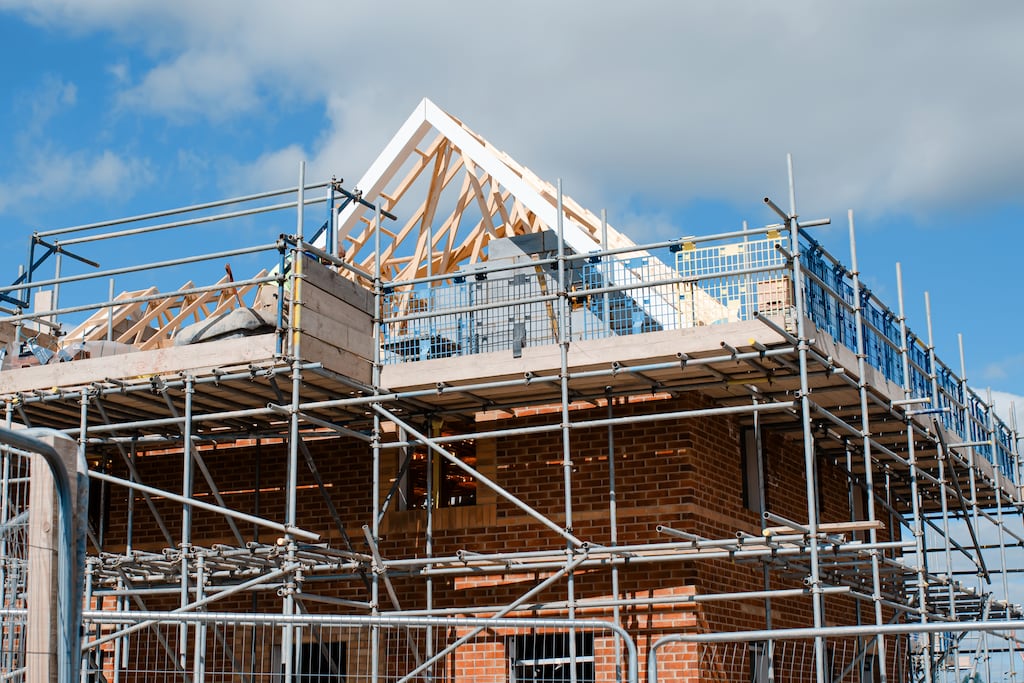
The Republic’s housing shortage will drag into this year as home building continues to lag demand, one expert predicts.
Most estimates of the number of new houses built in the State in 2025 run to about 30,000, which is about half the 60,000-70,000 that are needed. Construction is likely to increase in 2026 but there is little hope of reaching 60,000-70,000 this year, Ronan Lyons, professor in economics at Trinity College Dublin has said.
“What will help is getting lots of new homes built and sold,” said Prof Lyons, adding that this was the only solution to the housing crisis.
His comments come as a new report he has authored for Daft.ie shows asking prices rose by an average of 5.5 per cent last year.
READ MORE


That is slightly below the 2024 figure for 6.8 per cent but higher than the two years before that. Across the State, asking prices are now on average 41 per cent above pre-Covid levels and just 10 per cent below their Celtic Tiger peak.
The gap between asking prices and sale price is widening, the report finds. They are now 7.4 per cent higher than in December 2024. Transaction prices are now 52 per cent above their pre-Covid levels and 92 per cent higher than a decade ago, Daft.ie says.
It says the median price of a newly built home rose faster than the general market – up 10 per cent in the year to December – to €375,000.
The asking price of a three-bedroom semidetached home in the Republic rose more than 5 per cent in 2025 to €423,000, the report calculates.
In Dublin, estate agents are listing such properties at €611,000, 3.1 per cent more than a year ago. In other cities, the price averages €390,000, a 4.5 per cent increase, the report says.
Outside the capital in Leinster, prices rose 7.3 per cent to €363,000. They climbed 5.7 per cent to €300,000 in Munster and 11.6 per cent to €246,000 in Connacht/Ulster, according to Daft.ie’s report, 2025 Quarter 4 – The Year in Review.
Prof Lyons believes that house prices will continue rising in 2026 as pressure remains on the supply of homes.
Low numbers of second-hand properties for sale are a key barometer of the market, the economist argued. There are currently 10,000 to 12,000 such properties for sale at any one time in the Republic. That compares with 25,000 to 30,000 before Covid, he pointed out.
“When the number of second-hand homes is pretty low, it usually means that there is tight pressure on the market,” Prof Lyons explained. “And certainly outside Dublin the number of second-hand homes for sale is well below healthy levels.
“That pressure is going to continue pushing prices up over the next few months,” he predicted.
There were 11,551 second-hand homes for sale in the State on December 1st, according to Daft.ie. That was 7 per cent more than a year earlier, but less than half the 2015 to 2019 average of 26,000.
Outside Dublin, there are 63 per cent fewer second-hand properties on the market than during the late 2010s. In the capital the difference is 16 per cent, the report says.
“Certainty and viability” remain key barriers to reaching the 60,000-plus new homes annually that are needed to tackle the Republic’s chronic shortage, Prof Lyons maintained.
“When you buy land in Ireland it’s not obvious what you will be allowed to do with it,” he said.
He added that it was not clear if the Planning and Development Act, 2024, meant to overhaul a system blamed for delaying housing and infrastructure building, would change this.
At the same time, rising costs make it increasingly difficult for developers to build affordable homes, he added.
In the report, Prof Lyons argues that the Republic needs to double new home building “across owner-occupied, social and rental segments – so that the housing reflects society rather than society having to fit the housing stock”.


