
US president Donald Trump delivered the longest state of the union address in US history on Tuesday night, insisting he had overseen a “turnaround for the ages” during his first year back in office, even as voters lose confidence in his handling of the economy.
In his remarks, which clocked in at one hour and 47 minutes, Trump introduced few new policies and instead appeared to relish the theatrics of the moment. He used the opportunity to berate Democrats as “crazy” for not standing or applauding for his priorities, especially on crime, immigration and the economy.
Trump’s tone shifted throughout his address, seesawing between soaring descriptions of the country’s gains, including gold medals at the Olympics, and strikingly graphic stories of overseas conflicts and crime in the United States.
It was all a preview of his arguments in advance of this year’s midterm elections.
READ MORE


Trump has never had a short speech to Congress. Every time he has addressed the chamber, he has talked for more than an hour, including last year’s defiant, 100-minute speech, which was the longest in modern history – until Tuesday.
Here are seven takeaways from Trump’s state of the union address.
Rubio caught scrolling on phone
It was the kind of moment we’ve all experienced: you’re caught scrolling on your phone when you’re supposed to be paying attention to something else.
On Tuesday, a photographer captured US secretary of state Marco Rubio doing just that shortly after Trump singled him out for praise during the address.
Zooming in on the photos, it was clear that Rubio was reading WhatsApp messages from Richard Grenell, the president of the John F Kennedy Center for the Performing Arts and Trump’s special envoy to Venezuela.
Throughout 2025, Rubio and Grenell were frequently at odds over Venezuela policy, debating the US approach to prisoner swaps and peace talks.
During the speech, Rubio, purposefully or not, scrolled back in his correspondence with Grenell. In a September message caught by the New York Times photographer Tierney L Cross, Grenell told Rubio about a letter that president Nicolás Maduro of Venezuela had written to Trump.
“Just wanted you to know I got a copy of the letter Maduro sent to DJT,” Grenell wrote, referring to Trump by his initials. “You all should have the original – I was told it was delivered to someone on your team.”
While Grenell was actively pursuing a peace deal with Venezuela at the time, Rubio and his aides were sceptical that Maduro was serious.
But Grenell’s texts during the state of the union did not seem contentious. In one photo, Rubio is seen reading a message from Grenell that said: “Class act!!!”
That appeared to be a reference to an interaction between Trump and Rubio during the president’s speech, in which he singled out Rubio for praise.
“You have done a great job,” Trump said. “Great secretary of state. I think he’ll go down as the best ever.”
Rubio struck a humble pose and then pointed back to the president, as if to throw credit to Trump.
The gesture prompted Grenell to text, the phone to buzz, and Rubio to look.
Grenell said in a statement that the photo showed he and Rubio were friendly despite policy differences.
“We are friends,” Grenell wrote. “And I simply reached out to a friend to compliment his humility in such a public moment.”

Trump tried to define Democrats on his own terms
Throughout the night, Trump taunted the Democrats in the chamber, and tried to portray them as anti-American and unelectable. On nearly every issue, he tried to bait his opponents into showing support for his priorities.
He deployed the tactic early in the speech, telling lawmakers to stand if they agreed with his declaration that the “first duty of the American government is to protect American citizens. Not illegal aliens.”
When they declined, he went in for the attack.
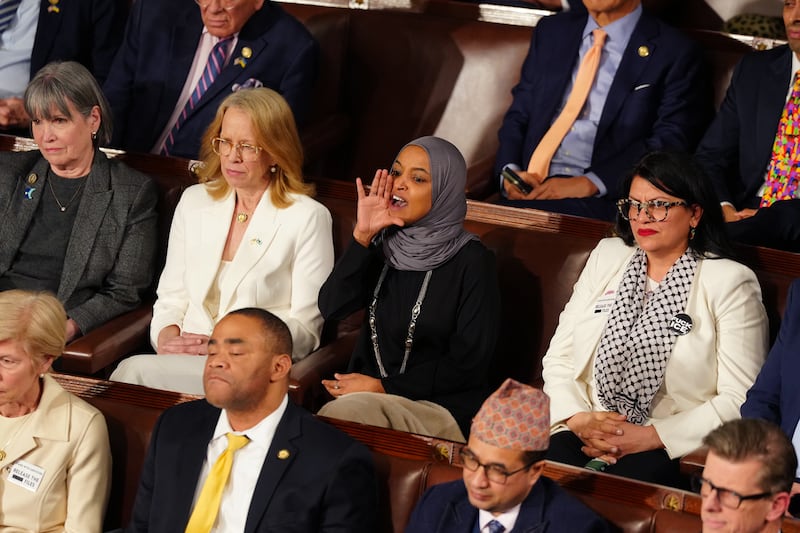
“Isn’t that a shame?” he said. “You should be ashamed of yourself, not standing up. You should be ashamed of yourself.”
Trump repeated the approach throughout the evening, saying: “These people are crazy, I’m telling you. They’re crazy.”
As Republicans gear up for the midterms, Trump was trying to bolster his party’s political prospects by painting the Democrats as extreme. Historical trends and recent polling suggest Republicans are at risk of losing control of at least one chamber of Congress – a result Trump is desperately trying to avoid – and so he spent much of the speech attacking Democrats.
The former reality TV star put on a show
Trump is well aware of the power of images, and he filled his speech with surprises and dramatic moments.
The president welcomed the Olympic champion US men’s ice hockey team – who emerged from behind doors at the balcony above Trump – and announced he would be awarding the team’s goalie the presidential medal of freedom.
He invited air force staff sergeant Andrew Wolfe, one of the two National Guard members who was shot in Washington, DC, last year, to make an appearance. After describing Wolfe’s injuries in graphic terms, Trump surprised him with the purple heart.
He recognised a former prisoner of the Maduro regime and reunited him with his niece, Alejandra Gonzalez.
“After Enrique ran for office and opposed Maduro, he was captured by Maduro’s security forces and thrown into the regime’s really infamous prison in Caracas. Alejandra feared she would never see her uncle again,” Trump said, adding for dramatic effect: “Alejandra, I’m pleased to inform you that not only has your uncle been released but he’s here tonight. We brought him over to celebrate his freedom with you in person. Enrique, please come down.”
He then appeared in the House chamber, too.
Trump struggled to acknowledge Americans’ economic pain
Trump boasted that he has resuscitated the US economy after inheriting “a nation in crisis”. For weeks, Trump’s aides and allies have been encouraging him to tackle voters’ affordability concerns head-on, and so he dutifully ticked off a list of economic indicators – the stock market, price of gas, mortgage rates, job growth – as evidence of the “roaring economy”.
But he appeared less willing to acknowledge that Americans were still struggling.
He railed against Democrats who “suddenly use the word affordability”, continuing his argument that his political opponents have weaponised the word to harm him politically.
“They knew their statements were a dirty, rotten lie,” Trump said.
Polling shows voters remain concerned about the economy, and Republicans know that voters’ attitudes about affordability will be crucial to November’s elections. And yet, the president has often shown little discipline when it comes to addressing these worries.
Trump did not spend much time talking about Iran
Trump has kept the world on edge as he weighs launching strikes against Iran, but he didn’t even get to the subject until about 90 minutes into the speech. He then spent three minutes talking about the country before moving on.
Trump did little to explain why he had amassed the largest amount of US military firepower in the Middle East since the invasion of Iraq in 2003. Instead, he said Iran wants to make a deal with the United States, and he prefers to solve the tensions through diplomacy.
But he said the United States has not heard Iran say “those secret words: we will never have a nuclear weapon”.
Iran has, in fact, often made that promise, although evidence gathered over the years has shown that the country has repeatedly appeared to be testing the components that would go into a nuclear weapon.
Trump said Iran has started to reconstitute its nuclear program after the United States dropped bombs on the country in June.
US officials, including Steve Witkoff, the president’s special envoy, and Jared Kushner, the president’s son-in-law, are scheduled for another round of negotiations with Iran on Thursday in Geneva.
Supreme court justices stayed mostly stone-faced
Just days after lashing out at the US supreme court as “fools and lapdogs” over its ruling against his signature tariffs programme, Trump was face-to-face with several justices who decided against them.
But on Tuesday, Trump was more measured in his criticism of the high court. He called it a “very unfortunate ruling” and a “disappointing ruling” while also vowing that he could move forward with other tariffs without congressional approval.
It was a fairly cordial encounter, all things considered, and Trump shook hands with the justices on his way to the podium.
Only four justices attended the speech: chief justice John Roberts, justice Elena Kagan, justice Brett Kavanaugh and justice Amy Coney Barrett. Roberts, Barrett and Kagan were among the six members of the court who ruled against Trump.
The four justices sat stone-faced throughout the speech, showing little emotion as Trump criticised the ruling.
Trump talked of others’ fraud, but not his own ethical issues
Trump repeatedly railed against what he portrayed as widespread fraud in government programs around the country. And he suggested members of Congress were profiting off their offices through insider stock trading.
He claimed billions of dollars have been stolen through fraud in Minnesota, that “California, Massachusetts, Maine and many other states are even worse”, and tasked vice-president JD Vance with leading a “war on fraud”.
But Trump made no mention of how his family has profited off the presidency. Past presidents often went to great lengths to avoid monetising the White House, but Trump has seemed to have little issue with it.
Trump is also the only president to have been found liable in a civil fraud case, and he has pardoned several individuals who were convicted on fraud charges.
This article originally appeared in The New York Times.


