
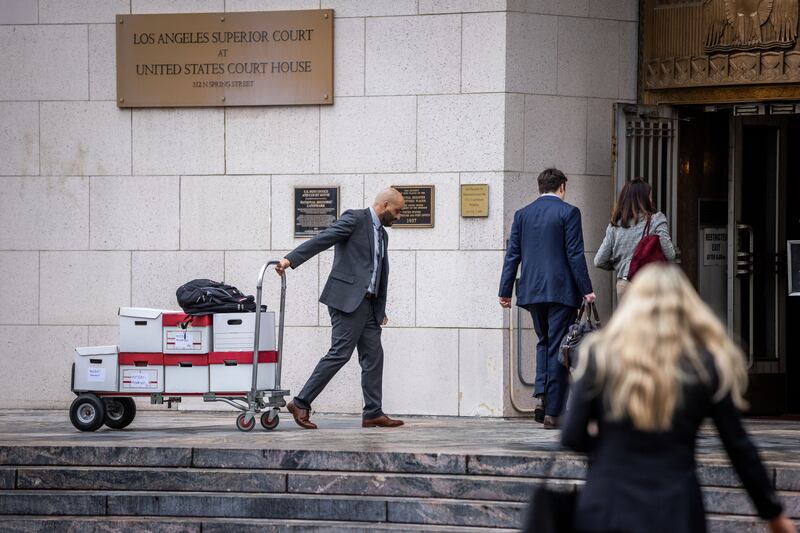
A court case running on Spring Street in Los Angeles in front of 12 jurors is hearing arguments in a case that could reshape social media – and possibly the internet itself.
The case features billionaire chief executives on the stand, armies of lawyers and accusations that companies built machines designed to addict children, all being played out in front of a highly emotional public gallery.
The prosecution argues that Instagram and YouTube deliberately designed their apps to target children and teens, to intentionally make them addicted to the platforms and harm them.
It is being compared to the landmark case taken against “big tobacco” in 1998. That led to a settlement requiring cigarette companies to pay billions in healthcare costs and restrict marketing targeting minors. Interestingly, this is the first time that a social media company will be tried by jury.
READ MORE


The case, which began last Monday, is being taken on behalf of “KGM”, a 20-year-old Californian woman only referred to by her initials. The prosecution claims in their argument that KGM became addicted to social media as a grade-schooler – 10 years of age – and was initially introduced to YouTube at the age of six.
She claims the addictive social media apps caused her to experience body dysmorphia, depression and anxiety.
The prosecution charges in this test case that YouTube and Instagram are specifically designed to hook young users and keep them trapped on the platforms. They also argue that the companies use methods similar to those employed by casinos and cigarette companies.
Meta and Google, as Instagram’s parent companies, are in the dock and that means that Mark Zuckerberg is likely to be called to testify, perhaps as early as next week. TikTok and Snapchat reportedly settled the case out of court.
With so much at stake, the case is, unsurprisingly, attracting considerable attention.
YouTube argued on Tuesday in their opening statement that the platform is entertainment rather than a social network.
“It’s not trying to get in your brain and rewire it, it’s just asking you what you like to watch” said YouTube’s lawyer, Luis Li.
Instagram chief executive Adam Mosseri’s cool testimony on the stand on Wednesday was in contrast with the emotional outbursts of those attending in court.

Grieving mothers of children who died by suicide had been queuing in the rain overnight to attend, and then broke down in public in the court during Mosseri’s testimony.
The atmosphere got so emotional in the courtroom this week that at one point the LA supreme court judge threatened to remove some mothers from the public gallery.
Jurors have been instructed by the judge to stop using Facebook, Instagram, YouTube or any other kind of social media during the trial.
The KGM lawsuit includes the accusation that Instagram is “borrowing heavily from the behavioural and neurobiological techniques used by slot machines and exploited by the cigarette industry” and that the defendants deliberately embedded in their products an “array of design features aimed at maximising youth engagement to drive advertising revenue”.
Mark Lanier, lawyer for the prosecution, said in court this week that the case was “as easy as ABC, addicting the brains of children”.
“These companies built machines designed to addict the brains of children and they did it on purpose,” he said.

Lanier said that internal documents they have discovered show the company deliberately targeted children. He cited internal emails from employees concerned about the potential harm on children and teenagers, and also warned that the companies would try to “blame the little girl and her parents for the trap they built”.
He wasn’t wrong. Instagram’s attorneys did not hesitate to get personal, saying in their opening statements that KGM’s troubled home life and her difficult relationship with her family were the to blame for her suffering.
On Wednesday, Mosseri took the stand calmly, dressed in horn-rimmed glasses and an expensive suit.
“I think it’s important to differentiate between clinical addiction and problematic use,” the Instagram chief executive said.
Sixteen hours of Instagram use, while problematic, was not addiction, he said.
While he himself might be addicted to a Netflix show, Mosseri said, that did not mean he actually had a clinical addiction
He added that Instagram are “trying to be as safe as possible but also censor as little as possible”.
During a lively exchange with Lanier, Mosseri conceded: “It’s not good for the company over the long run to make decisions that profit us but are poor for people’s wellbeing. That’s eventually going to be very problematic for the company.”
The Los Angeles KGM social media addiction case is regarded as a bellwether that could influence the thousands of other pending lawsuits, transforming the legal landscape for some of the world’s most powerful companies.
The suit is being tried as a test case for a much larger group of actions in California state court. A similar set of federal lawsuits are proceeding in parallel through California’s northern district.
A parallel trial in New Mexico, also ongoing this week, alleges that Meta and its social media platforms have failed to protect young users from sexual exploitation, following an undercover online investigation.
Mosseri’s appearance in Los Angeles on Wednesday follows a legal blow to the social media companies in San Francisco earlier this week. A US district judge blocked a plea by the tech giants to avoid their first trial there, coming soon.
That trial, another possible bellwether involving a suit taken by a county school district, is set to begin in San Francisco in June.
The social media companies, defendants in both sets of suits, are arguing that the actions should be thrown out under a powerful 1996 law that shields internet publishers from liability for user content.
If the plaintiff KGM were to win this landmark case, it could lead to social media platforms having to re-engineer their platforms, and could open the door to a flood of substantial monetary damages in parallel and similar lawsuits.
Forty state attorneys in the United States have filed lawsuits against Meta on harming young people and deliberately targeting them. In all, more than 1,700 lawsuits have been lodged.
What will happen in those lawsuits will be hugely influenced by what the jury decides in Los Angeles.
After years of noise – hearings, reports, rebuttals, false starts – it all comes down to the jury of 12 people. They must look at this one case, hear both sides and decide.


