

As war anxiety slowly seeps up Britain’s spine, the UK government is funding a £250 million (€288 million) upgrade of the most critical site of its rickety military: the Clyde naval base in Scotland that hosts the country’s Trident submarine nuclear weapons programme.
Another revamp of sorts is also well under way in the copse of woods directly across the road from the southern gate into the base, which is more commonly known as Faslane.
Mark Stewart (57), a veteran anarchist and anti-nuclear campaigner, is trying to revive what British activists claim is the world’s longest-running peace camp. As the hollowed-out UK military struggles to renew in a time of global angst, so do the zealous critics of the British state’s ultimate weapons of war.
“This old place got a bit run into the ground over the years,” says Stewart of the earthy Faslane camp, a smattering of 10 battered old caravans adorned with anti-war art and timber shelters that activists claim have been continually occupied since 1982.
READ MORE


“Some people thought the place had closed down. They said it was full of druggies and roamers, homeless people passing by just wanting a bed for the night,” says Stewart, an effervescent Newcastle man who finds it hard to sit still for more than a minute.

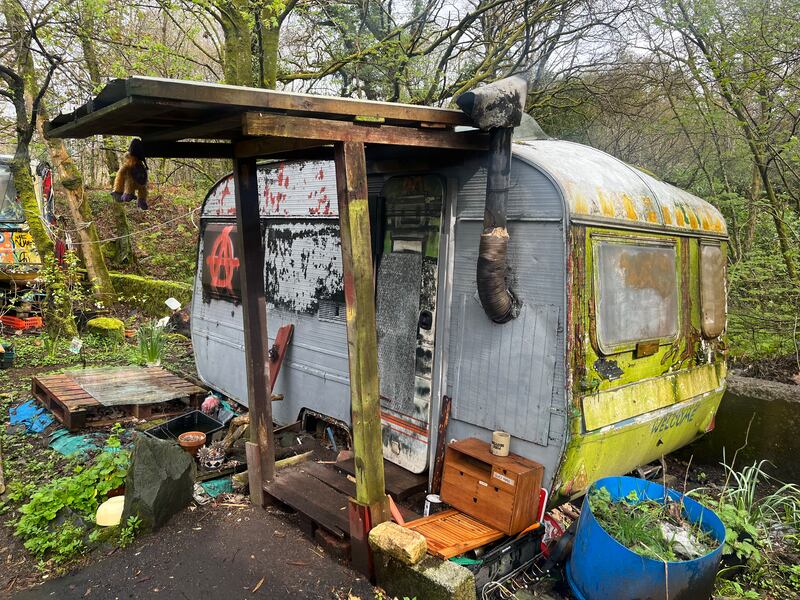
“And, look, maybe there was a bit of that for a while. But we’re going to build it back up. We’re going to remind them (the military) that we’re still here and we’re going to attract more activists and bring back collective protest. We’re all fighting the same thing.”
Andy (50) from Dumfries is the only other current long-term resident at the camp, barely an hour northwest of Glasgow. He has held the fort mostly alone since the Covid years and admits the Faslane camp has been “a bit short of people to get much done” recently. He was often alone on weekly gate vigils.
Stewart, however, plans to change all that. Next month he is due in court, charged over a January night-time jaunt to kayak into the base, one of the most sensitive and highly-protected sites in Britain.
“I could have been shot, man!” he says, grinning as he shows me his charge sheet. “But it woke them up a bit.”
In one of Stewart’s latest videos on Facebook, he asks fellow activists for donations of old wetsuits, kayaks and canoes, promising to “splash about to the delight of the MoD” (ministry of defence).
“Whatever they do to me, it will just help get our message out even more in the media,” he tells me over sweet, freshly-ground coffee in the camp’s common room, warmed by a timber fire.
During Margaret Thatcher’s time, an order once came down to Faslane’s sentries to shoot anyone making incursions after protesters broke in and got into a submarine.
Last week at the camp, it was Stewart, Andy and two other recent arrivals. Siobhan – a friendly woman in her 20s who says she was recently made homeless – was joined by her friend Euan and two even friendlier dogs. Frayer is Stewart’s ageing four-legged companion. The other dog, Acab (it stands for “All coppers are bastards”), has lived on the camp for years.
Stewart bounces around with a glint in his eye. He says recently, Acab went missing for several hours. The protesters have a police liaison and Stewart recalls how a few of the officers helped them look for the dog.
“The police were running about the place in the woods shouting ‘here Acab . . . where are you Acab’. Man, it were absolutely classic.”
Across the road, the base’s security teams were, unknown to the protesters, last week gearing up for an unannounced weekend visit by UK prime minister Keir Starmer. He showed up to welcome back the crew of one of Britain’s nuclear-armed submarines, HMS Vanguard, which returned to dry land after an extra-long 206-day stint at sea.
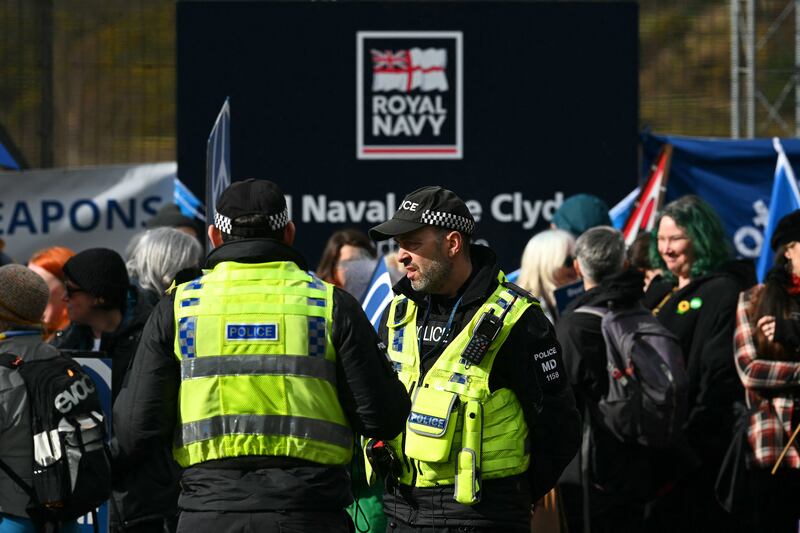
“It’s important to meet the crew and thank them for what they’ve done. It’s quite humbling,” said Starmer.
Britain’s economy may be stagnant and its public finances choked, but it is pouring a fortune into the nuclear weapons programme that Starmer and successive UK leaders have argued keeps Britain safe as a deterrent against attack.
Faslane is home to all of the UK’s attack submarines, but it is particularly associated with its four Vanguard-class vessels – Vanguard, Victorious, Vigilant and Vengeance – that carry its waterborne nuclear missile threat. The warheads are stored in a compound just across the peninsula from Faslane.
At least one of the Vanguard subs has been at sea continually since 1969. Britain says its top-secret Operation Relentless system of concealment is at the core of its nuclear deterrent. US Ohio-class nuclear subs also regularly dock at Faslane.
The ageing Trident system needs an overhaul, however. The UK’s four nuclear-armed subs are due to be replaced by new Dreadnought-class vessels being built down the coast in Cumbria at a cost of at least £31 billion (€35.7 billion), with an extra £10 billion in contingency. But they are still almost a decade away from entering service.


George Robertson, the former UK defence secretary and one-time head of the Nato military alliance, recently criticised the Labour government for “corrosive complacency” over its failure to publish a defence spending plan to beef up its shrunken forces. Nuclear spending, however, appears to have been prioritised.
The £250 million released by Starmer’s government for the Faslane site is being used to upgrade the infrastructure to cope with more trainees and the new vessels. Faslane, which is more than 3km long, is home to 6,500 personnel.
Some of the cash is being used to build more high-rise accommodation blocks – there were diggers on-site when The Irish Times walked the perimeter last week. There was, however, no sign of submarines in the loch port over the 12-foot-high electric fence. HMS Vanguard would not return from the seas until the next day and Starmer’s arrival.
Yet security was, as always, extremely tight. Guards are skittish.
An Iranian man and a Romanian woman were arrested last month “trying to enter” Faslane, police announced. They were later released, however. Faslane protesters claim they were just visitors who drove up to the gate.
Submarining culture is enmeshed in the locality, a loch-dotted landscape in the shadows of Trossach hills. A submarine-shaped memorial sits in Faslane cemetery for the 32 men who died in the HMS K13 sub disaster of 1917 – it sunk in the loch.
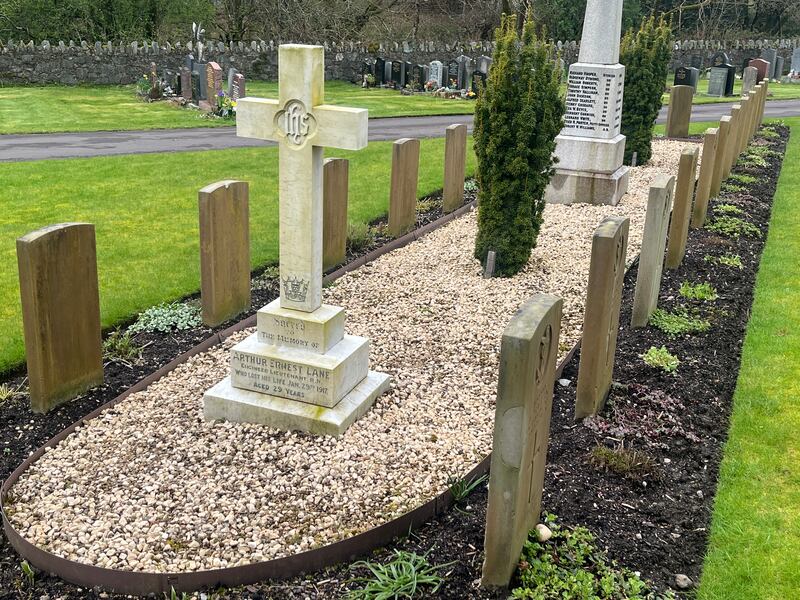
Locals in the nearby big town of Helensburgh are also used to the occasional sight of nuclear subs sailing past on their way to the North Sea. Last week, however, they were more exercised by the prospect of a new supermarket that is planned for a waterfront site. Campaigners have opposed it for decades.
Back at the peace camp, Stewart had ripped out and replaced the old kitchen and upgraded the previously-elementary toilet and bathing facilities. He plans to harness the flowing river water for power to supplement the decrepit solar panels. An old bus has also been imported from Japan – the only country that has ever been attacked with nuclear weapons – which will be brought on-site for use as a library and archive.
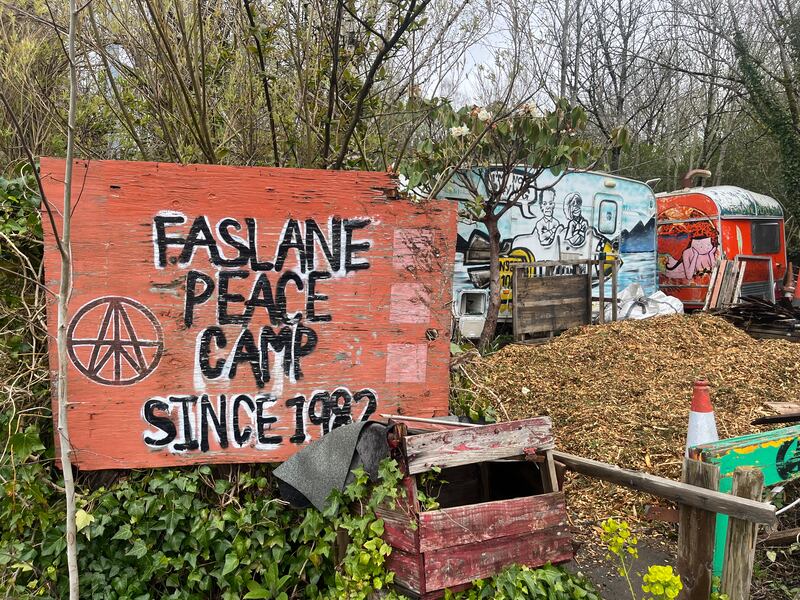
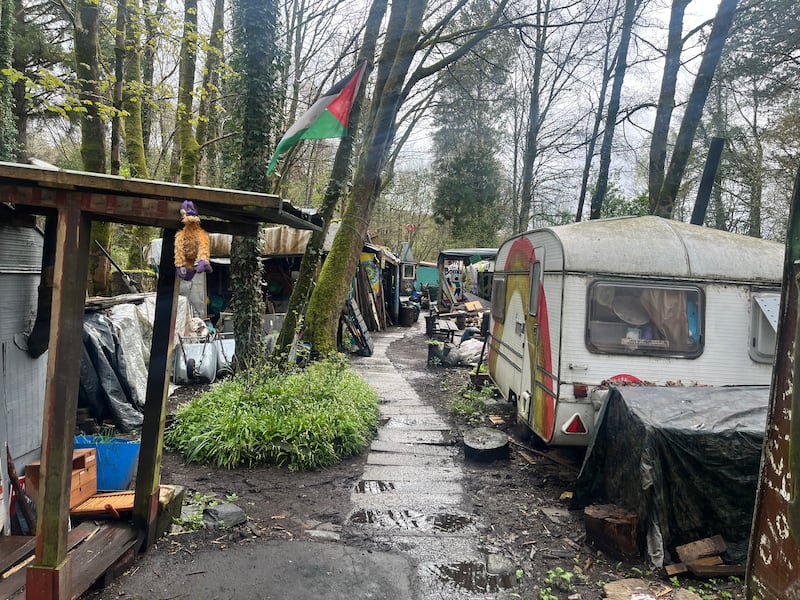
He shows me the inside of his simple caravan, then he points to the view behind.
“What more could you ask for,” he says.
Stewart, who was married and living in a house until he returned, alone, to Faslane camp last year, says his “mental health has improved no end” since he made it back. He first stayed at the camp about 20 years ago.
People sometimes drop off wood and food, he says. Stewart claims he doesn’t need the trappings of modern life anyway.
“We live like kings, man,” he says, laughing. “I’m not going anywhere. I’m stopping here. Why would I want to go anywhere else? I’m getting old now. This place is like my retirement from the system.”


