Two bombs went off in central Damascus on Tuesday near a hotel where French president Emmanuel Macron had spent the night.
The explosions took place minutes after he had departed for the presidential palace to meet Syrian president Ahmed al-Sharaa.
According to the Syrian government, 18 people were injured in the twin explosions, including four police officers. Syrian media said Macron was staying at the Four Seasons hotel. The Elysee Palace said he was unharmed and had already arrived at the palace at the time of the explosions.
At the site of the explosion, blood and shattered glass lined the road. Members of the government’s internal security, some still covered with blood, established a perimeter around the site, while investigators searched through the remnants of the bombing for clues.
READ MORE


The usually bustling city centre was relatively quiet, pierced only by the continuous sound of sirens. In nearby streets, armed men were searching bags of the few passing pedestrians out of fear for a possible third bomb.
Despite the attacks, France’s ministry of foreign affairs has confirmed that Macron’s visit would continue as scheduled.
According to a source in the presidential delegation, Macron remained in a “good mood,” despite the attack. In a statement, posted on Instagram, Macron wrote “nothing will be able to extinguish the aspirations of the Syrian people. This morning I met Syria in all its diversity. I saw dignity, courage and determination.”
“My visit continues.”

Macron arrived on Monday for a two-day visit in advance of the Nato summit in Ankara, Turkey. The visit has been shrouded in secrecy due to security concerns. His visit marks the first for a western leader since the fall of Bashar al-Assad’s regime in 2024 and the first for a French president since Nicolas Sarkozy in 2009.
He has brought a large delegation of business leaders and investors with him, with a particular focus of the trip given to promoting French investment in Syria’s reconstruction. On Tuesday, following the attack, he signed a number of agreements, alongside Al-Sharaa, aimed at expanding bilateral investment.
Security was tight following his arrival on Monday evening. Security services cleared sections of Damascus’ historic old town in preparation for Macron and Al-Sharaa’s visit to the Umayyad mosque on Monday.
Damascus has witnessed a deteriorating security situation and a summer of bombings, with at least nine separate explosive attacks occurring in the capital since May. Tuesday’s explosion comes five days after a separate bomb attack in a busy cafe near the Palace of Justice, which killed 10 and wounded dozens.
Islamic State has claimed responsibility for two of these attacks, raising questions as to who is behind these bombings, and whether the government has adequate capacity to catch them. So far, no one has claimed responsibility for Tuesday’s attack.
According to Syrian state media, security personnel had detected the twin devices during a routine security sweep and were in the process of disarming them when they exploded.
One device was located inside a parked car on the road Macron took to the presidential palace. The second was hidden in a nearby bin.
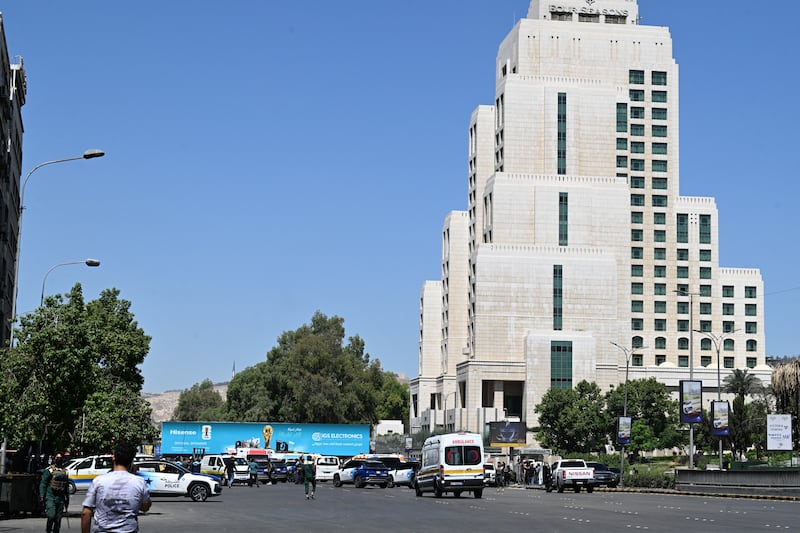
Syria’s interior ministry described the devices as being constructed in a “primitive manner,” a similar description used to describe last Thursday’s cafe bombing, although it remains unclear if there is a connection.
Syria’s government is currently wrestling with armed groups interested in destabilising the country, including groups affiliated with remnants of the Assad regime,Hizbullah-linked cells, and Islamic State, also known as Isis, networks.
Al-Sharaa has pushed to assert full control and bring stability, appeal to minorities sceptical of his Islamist-led rule, and win the support of western governments who were sceptical of his past leadership of the former al-Qaeda-linked Hayat Tahrir al-Sham group.
His government has promised political and economic reform after decades of autocratic rule.
The conflict in Syria killed nearly half a million people and displaced millions.
Syria’s infrastructure lies in ruins, and while other nations and businesses have made large investment pledges, the country still needs hundreds of billions of euro to rebuild and lift millions out of poverty. – Additional reporting: AP