The war on Iran waged by the United States and Israel has prompted a reluctant Europe to contain the fallout of the expanding conflict.
French president Emmanuel Macron and Greek prime minister Kyriakos Mitsotakis visited Cyprus on Monday to reaffirm Europe’s commitment to the island’s security after an Iranian-made Shahed drone struck a British airbase on its southern coast last week.
Drones fired from Lebanon by Iran’s ally, Hizbullah, struck Akrotiri airbase and two drones were intercepted in Lebanese airspace, reportedly en route to Larnaca international airport.
Iranian Revolutionary Guard general Sardar Jabbari said that since US aircraft had shifted to Akrotiri, it was now “in the frame”.
READ MORE


European leaders, meanwhile, have adopted a variety of stances towards the conflict itself.
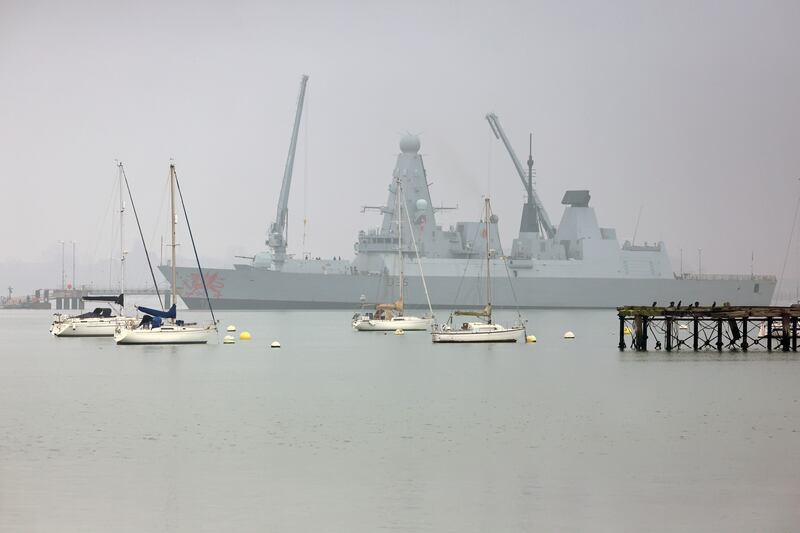
While refusing to join the offensive, Britain has deployed a warship to defend Akrotiri and granted the US permission to use the base for specific, limited defensive purposes.
British prime minister Keir Starmer said he had accepted the US request to prevent Iran from firing missiles across the region. “The only way to stop the threat [posed by Iran] is to destroy [its] missiles at source, in their storage depots or the launchers which are used to fire missiles,” he said.
While German chancellor Friedrich Merz has spoken of sharing the United States and Israel’s interests in seeing an end to Iranian regime, it has said it will not send military support to Cyprus. Berlin says it is focused on protecting Poland, Romania and Lithuania in eastern Europe.
Anti-war-minded Spanish prime minister Pedro Sánchez said: “Today, more than ever, it is essential to remember that one can be against a hateful regime, as is the case with the Iranian regime [but] at the same time be against an unjustified, dangerous military intervention outside of international law.”
He said this was a war initiated without US congressional or United Nations Security Council authorisation. His assessment has been adopted by Ireland, Austria and Malta.
The Cristóbal Colón, a Spanish frigate named after Christopher Columbus, has been deployed in Cypriot waters. The ship carries a “high-precision anti-missile defence system”, including SM-2 missiles which can intercept targets 150km away. Greece took prompt action by dispatching to Cyprus four sophisticated F-16 Viper fighter planes and two frigates to prevent drone attacks.
France has sent navy ships and anti-missile and anti-drone systems to Cyprus. Italy and the Netherlands also said they will dispatch frigates to Cyprus.
Disruptions caused by the war are being felt far more in Europe than in the US.
The war is affecting European economies “heavily dependent” on Gulf oil, said former International Monetary Fund chief economist Maurice Obstfeld.
Prolonged closure of the Strait of Hormuz, through which 20 per cent of Gulf oil exports are shipped, raised the price of oil to a four-year peak on Monday. Transport costs of exporting goods by air from Asia to Europe has risen 45 per cent, more than twice the increase for exports to the US.
The US has not, however, escaped punishment. Petrol prices are rising and farmers face higher bills for essential crop nutrients. Supply chain disruptions are expected if the Iran conflict continues as long or longer than Donald Trump’s administration has anticipated.