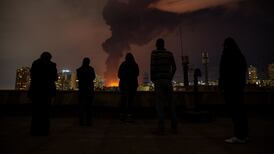
Saif al-Islam Gadafy, son of Libya’s deposed leader Muammar Gadafy, was killed on Tuesday at his home in the hill town of Zintan, southwest of the capital, Tripoli.
Saif al-Islam’s political entourage said four masked men disabled security cameras, entered his house and killed him in a “cowardly and treacherous assassination”.
His death could deepen divisions between the internationally recognised national unity government based in Tripoli and a rival goverment and militia based in Tobruk.
Although he renounced his political ambitions, Saif al-Islam (53) had been described as Libya’s de facto prime minister during his father’s reign and had been seen as his successor.
READ MORE


Born in 1972 in Tripoli, Saif al-Islam, a fluent English speaker, earned a PhD at the London School of Economics. He promoted himself as a reformer, pressed for a constitution to govern the country and called for observance of human rights.
He played a key role in efforts to repair Tripoli’s ruptured relations with the West by conducting negotiations for Libya’s abandonment of its nuclear programme. He also secured compensation for families of passengers killed in the 1988 bombing allegedly carried out by Libyan agents of Pan Am Flight 103 over Lockerbie, Scotland.
Muammar Gadafy ruled Libya with an iron fist from 1969 until he was ousted and murdered during the 2011 Arab Spring uprising.
[ Lockerbie moves on after quarter of a centuryOpens in new window ]
In response to the unrest, Saif al-Islam shunned his carefully cultivated progressive posture and championed the brutal crackdown on opponents. After rebels took over the capital Tripoli, Saif al-Islam tried to flee to Niger dressed as a Bedouin tribesman.
The Abu Bakr Sadik Brigade militia captured him and flew him to Zintan about one month after the death of his father. He was imprisoned for six years in Zintan before his release in 2017 as part of an amnesty.
Separately, in 2015, he was sentenced to death in Tripoli in a trial he could not attend. The sentence was eventually rendered moot by the civil strife engulfing the country.
He was also wanted by the International Criminal Court at The Hague, which issued an arrest warrant against him for “murder and persecution”.
When he announced his controversial candidacy in the country’s 2021 presidential election, the post-civil war elections commission disqualified him. This decision was overturned weeks later and he was reinstated as a presidential candidate. The election did not take place due to disputes between the two rival administrations and their respective militias.
Emadeddin Badi, a political analyst with expertise on Libya, wrote on X that Saif al-Islam’s death was “likely to cast him as a martyr for a significant segment of the population, while also shifting electoral dynamics by removing a major obstacle to presidential elections”. – Additional reporting: agencies