Eighty-one years later, Hanna Bodnar remembers her father Mykhailo’s arrest with total clarity. She was 10 years old when the Soviets took him. Mykhailo had been helping the Ukrainian Insurgent Army (UPA), which fought the Polish, Germans and Soviets for independence in the 1940s and 1950s. Mykhailo distributed banned publications, sheltered fighters and gave them food.
“They took him first to a church which they used as a makeshift prison. The next day I saw him being walked barefoot to a truck. I couldn’t say anything or acknowledge he was my father.”
Hanna approached and passed her father in the street, showing no sign of recognition.
“I couldn’t say I was his daughter because I too would be taken away,” she says. “If I tell you what I felt, I will start crying. He looked into my eyes, but he showed no sign he knew me. I walked around the corner and wept.”
READ MORE


Mykhailo Bodnar was sent to an Arctic prison and was not allowed to return to Ukraine for 41 years. His family was persecuted. Hanna’s memory of a half-century of Soviet oppression certainly helps one to understand why Ukrainians fight so fiercely to preserve their independence.
The 65km drive from Lviv to Hanna Bodnar’s hometown of Khodoriv takes you through rolling green hills studded with flowering fruit trees, rickety wooden fences and vestiges of medieval fortifications built by King Danylo in the hope of stopping the Mongol hordes.
Khodoriv boasted a population of 10,000 before independence in 1991. Roughly half its residents left when factories shut down during the economic crisis that followed the break-up of the Soviet Union.
‘When the Nazis came here in 1941, some people wanted to give them flowers because they were liberating us from the Soviets. I asked my father “Should I give them flowers?” and he said, No’
— Hanna Bodnar
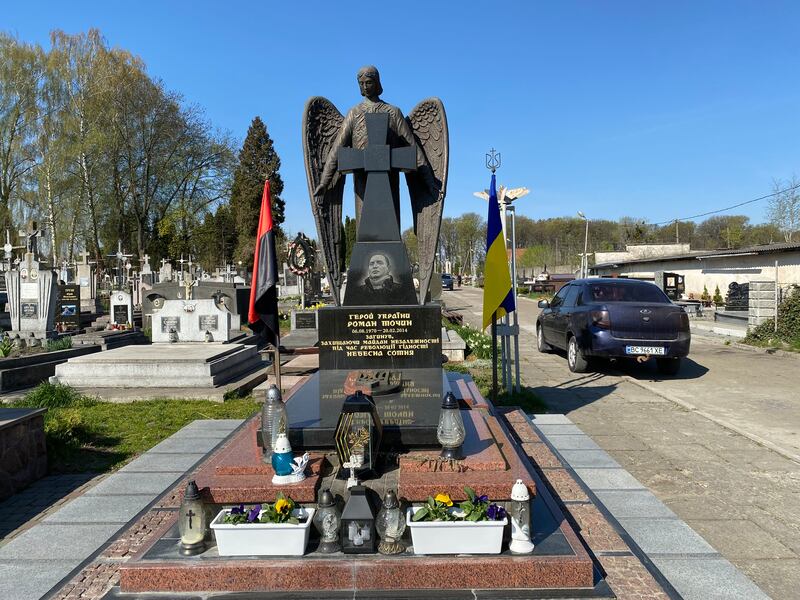
We stop at the cemetery where Khodoriv buries its martyrs. Roman Tochyn was 44 when he joined the ranks of the “Heavenly Hundred” who were murdered in the 2013/14 Maidan revolution by pro-Russian riot police.
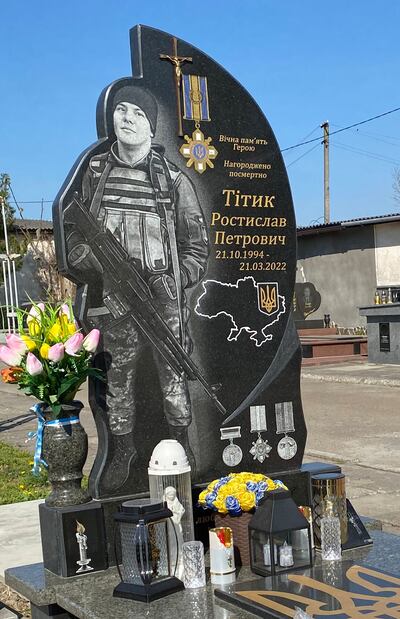
Rostyslav Tityk, the first soldier from Khodoriv to die in the full-scale invasion of 2022, rests beneath an elaborate tombstone with a life-size photo engraving of himself poised with an assault rifle. At least 15 men from Khodoriv have since been killed in combat.
A Greek Catholic church stands a few hundred metres from Bodnar’s two-storey bungalow. Much of western Ukraine converted from Orthodox Christianity to Greek Catholicism in the late 16th and early 17th centuries. Stalin banned all religion, but tolerated the Orthodox church. He saw Greek Catholics as pro-Ukrainian. Greek Catholic priests fled abroad or risked deportation to Siberia. Catholics worshipped in clandestine services.
Hanna’s sittingroom is decorated with Ukrainian embroidery, a portrait of Taras Shevchenko, Ukraine’s national poet, and a replica of Leonardo’s Last Supper.
This part of Ukraine was Austro-Hungarian until the first World War, then Polish until 1939, when the Soviets invaded. The Wehrmacht seized Ukraine from the Soviets between 1941 and 1943. A faction of the UPA collaborated with the Nazis because they falsely believed Germany would give Ukraine independence.
“When the Nazis came here in 1941, some people wanted to give them flowers because they were liberating us from the Soviets,” Hanna recalls. “I asked my father, ‘Should I give them flowers?’ and he said, ‘No. These are not our people. Our people are yet to come’.”
[ How culture became one of Ukraine’s most powerful weapons against RussiaOpens in new window ]
German officers were billeted in Hanna’s house. “One of them liked our embroidery and stole a towel. My mother complained to his commander. Some of the Germans gave me chocolate. They asked my grandmother to fry potatoes for them, then complained that German potatoes tasted better.”
When the Soviets returned in 1943, there was heavy fighting in Cherniv, the village 35km from Khodoriv where Hanna was born. “The main street was filled with dozens of Russian corpses. The Germans took their dead with them.”
‘My husband died early. I was a widow at 60. I raised two grandsons as if they were my own children. I cared for my father-in-law when he was old. I survived and overcame all this’
— Hanna Bodnar
The Bodnar family spoke Ukrainian. “I always knew I was Ukrainian,” says Hanna. “We read Shevchenko and cherished [Ukrainian poet, playwright and political activist] Lesya Ukrainka. We had a trident symbol in the house. The Soviets told us to destroy these things, that it wasn’t allowed.” Her brother Ivan buried symbols of Ukrainian identity in the cellar.
The Soviets sentenced the entire family to exile at Vorkuta, in the Arctic Circle, a punishment used by Russia to this day. Hanna’s brother was caught and sent instead to Yakutia, northeastern Siberia. He met a Ukrainian woman there, also from a deported family. They married and had three children.
After Stalin’s death, Mykhailo Bodnar was allowed to move from Vorkuta to Taishet, in the Irkutsk region near Lake Baikal. He was forbidden, however, from returning to Ukraine until 1986, and then only to the industrial east of the country. His passport was stamped with the words “traitor of the nation”. Mykhailo returned to the Lviv region for his last years and was overjoyed to vote Yes in the December 1990 referendum on independence. He died the following month. The Ukrainian government cleared his name posthumously.
Mykhailo’s arrest was followed by years of fear and poverty for Hanna and her mother Yevdokiia, whose names remained on a Soviet wanted list. Mother and child were often separated. Hanna escaped once through a window when the Soviets came looking for her. She walked through snow to a village where she knew people.
Hanna dreamed of studying at university, “but I couldn’t because of my surname”. She trained to become a librarian. Acquaintances urged her to become a communist youth leader, which would have paid more. “I didn’t try, because I knew they would start digging into my background and it would all come out.”
A railway worker called Ivan, two years Hanna’s junior, had just completed his military service and frequented the library where she worked. Her brother returned from Siberia on their wedding day in 1960. He tried to buy the family’s former home in Cherniv, but the Soviets stopped the sale because of the family’s disgrace.
Hanna and Ivan built their house in Khodoriv and raised two sons. One became an architectural designer in Lutsk, the other an electrician in Prague.
Independence Day in August 1991 was one of the happiest days of Hanna’s life. Ivan passed away prematurely in 1996.

Khodoriv is 5km from an electrical power substation. “The Russians have fired Shahed drones on it many times,” says Hanna. “In bed at night, I watch the red bullets from the anti-aircraft guns shooting at drones.”
Hanna’s life has not been easy. “My husband died early. I was a widow at 60. I raised two grandsons as if they were my own children. I cared for my father-in-law when he was old. I survived and overcame all this. I am grateful for what I have, that I can get up in the morning and still take care of myself.”
Last January, Hanna fell while shovelling snow and could not walk to church for two months. Kind neighbours have ploughed the lot next to her house so that she can plant her garden. They bring her water from a well and buy bread for her. “I pray to God to let me die in my own country,” she says. “I don’t want to die in a country that is no longer Ukraine. I tell my grandchildren to do everything they can to prevent it.”