At the outset of our journey across Ukraine, I pack essential items – money, passport, phone and laptop – in one hold-all, in case we have to jump off the train in a hurry.
The Russians have carried out close to 500 attacks on railway targets since January, including several dozen passenger cars. At least six passengers have been killed. If the military detects a drone within 20 minutes of a train, all passengers must wait in surrounding fields or forest, sometimes for many hours.
The grimy old train belonging to the national railway company Ukrzaliznytsia lurches across the steppes for 18 hours. I sleep fitfully, and awake to the news that a drone strike on Zaporizhzhia train station – my destination – has killed a railway worker overnight.
The conductor brings mugs of boiling water. “You can provide grenade launchers for the armed forces by buying pomegranate honey tea,” is printed on the sachet. (In Ukrainian, there is only a one-letter difference between “pomegranate honey” and “grenade launcher”.) The tea is delicious.
READ MORE


There’s a drone alert on when we arrive at Zaporizhzhia railway station. A crowd forms in the stairs leading from the underground passage to ground level. I wonder momentarily whether the people want to remain in the relative safety of the concrete stairwell. No – they are eager to leave, but police check all passports and mobile phones. Officers enter every passenger’s name, date of birth and the 15-digit IMEI number of his or her telephone in a tablet, creating digital fingerprints that may enable them to trace spotters who correct fire for the Russians.

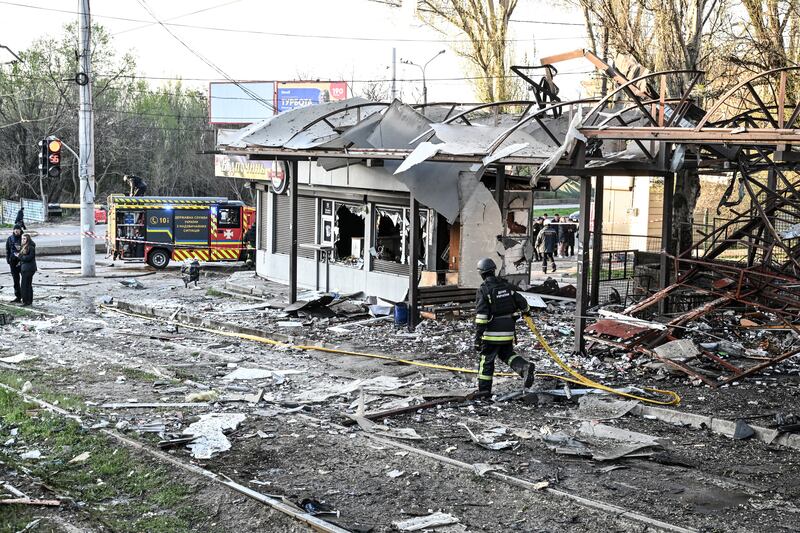
Pickup trucks mounted with machine guns lurk in shrubbery along the roadside, waiting to fire on incoming drones. As we speed down the highway, I note bombed out factories and apartment buildings, the blackened wreckage of the Optima Hotel.
After a quick shower, I head for an interview with Ivan Fedorov, the 35-year-old governor of Zaporizhzhia oblast. His press office sends map co-ordinates for the underground school where I am to meet him. The alarm signal screams again during the taxi ride. No one flinches, but the GPS stops working because the Ukrainians scramble the signal to confuse Russian drones.

Fedorov arrives late, dressed in the black sports clothing that is de rigueur for President Zelenskiy and his lieutenants. He is tall and wiry and looks more like a secret agent, resistance leader or cat burglar than a provincial notable. Fedorov gives quick, clipped answers, and focuses on the screen of his smart phone.
Kherson is Ukraine’s most dangerous frontline city, but Kharkiv and Zaporizhzhia share a close second place. Nearly three-quarters of Zaporizhzhia oblast is occupied by Russian forces, who stage an average 800 attacks on the front line daily, Fedorov says. Up to 15 of those attacks are on Zaporizhzhia city, 30km from the line of contact.
“President Zelenskiy says our intelligence indicates that the Russians’ next target will be water, our supply system and logistics. They regularly attack our train station. Earlier this year, we shut down rail connections with Dnipro for two weeks; after last night’s attack, we’ll stop the connection again for a few days.” My mind registers that I will have to take the bus to Dnipro to reach Kyiv.
I ask the governor how citizens carry on. “We have no choice,” he said. “Russia’s goal is to empty the city.” About one in five residents of Zaporizhzhia is a refugee from occupied parts of the region. They compensate for those who fled westward. The population is about the same as it was at the start of the full-scale invasion, Fedorov says.
Until Zelenskiy appointed him governor in 2022, Fedorov was mayor of Melitopol, now under Russian occupation. Fedorov always refers to “temporarily occupied territory”, stressing the word “temporarily”. The Russians held him captive for six days in 2022 and tortured him; standard operating procedure. “It changed me, because I understood the Russians are totally lawless. The temporarily occupied territory is a prison where they do whatever they want to.”
As we spoke, Zelenskiy was about to leave for an EU summit in Cyprus to plead for the opening of accession negotiations. The Europeans “have no choice” but to accept Ukraine, Fedorov says. “We are fighting for European values and European nations. Not all European countries understand that… We have earned a place in the EU.”
Ukrainian negotiators have reportedly offered to name the 25 per cent of Donetsk still in Ukrainian hands “Donnyland”, after Donald Trump, in the hope the US president will stop demanding that Ukraine give it to Putin. By necessity, Ukrainian officials refrain from criticising Trump. “Donald Trump is president of the greatest country in the world,” Fedorov says. “Of course, we have to say thank you to the United States as a nation.”
The classroom where we meet is seven metres below ground, part of a network of 20 underground schools built by Fedorov. He plans three underground kindergartens for September, and an extra 10 schools within a year.
Fedorov’s face is very pale. I ask what he does for his own security. “I live underground. I work underground. I sleep underground. All the time.”