

Asked to comment on the hope of United States president Donald Trump that European countries would join him in his war on Iran, the retired French general didn’t mince his words.
“He wanted to invade a country of the European Union, Greenland, not so long ago,” Nicolas Richoux said on a French television panel. “Now, those old friends who he never consulted ... now he needs us? He can go F himself.”
The sentiment from the head of France’s armed forces was more diplomatically expressed.
“They simply decided to intervene in the Middle East without warning us,” Fabien Mandon told a defence conference this week.
READ MORE


“The United States ... remains an ally, but is becoming increasingly unpredictable and doesn’t even bother to inform us when it decides to engage in military operations. This affects our security. This affects our interests.”
European countries have found themselves in an awkward squeeze: under severe domestic pressure to try to resolve the Iran conflict and avoid the worst inflation, while not becoming combatants in an unpopular war.
The conflict has already cost a French life: a soldier sent to help local Iraqi troops prevent a revival of the Islamic State was killed by a drone attack attributed to an Iranian-allied militia earlier this month.
Despite, or perhaps because of this, the French government is at pains to stress it is not joining the war on the side of the US.
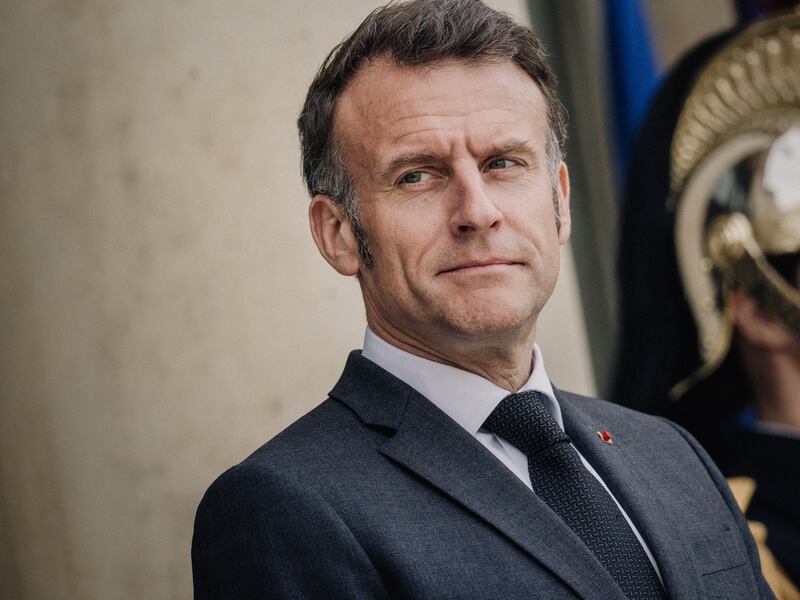
“Strictly defensive,” is the mantra of president Emmanuel Macron when describing France’s position on the conflict.
The country has initiated talks with 35 countries on whether they can set up a system to jointly escort commercial ships through the Strait of Hormuz, the narrow channel off Iran’s south coast that is usually the conduit for 20 per cent of the world’s oil and gas.
“We won’t take part in any forcible opening of the strait in the context of the war operations and bombardments under way,” Macron made clear. The mission would only be possible after “discussions” with Iran and “once the situation calms down”.
Iran’s ability to operate the channel as a huge strategic tollbooth - allowing through some vessels of friendly nations, setting the price, refusing the majority - is its greatest bargaining chip.
A 90 per cent fall in traffic since the outbreak of the war has caused oil prices to soar while putting a squeeze on fertiliser for food, helium used in the manufacturing of microchips and ingredients needed for medicines and batteries.
It is an unpleasant rerun of the energy and food price shock caused by Russia’s invasion of Ukraine in 2022. Coming just as prices had begun to stabilise, it could not be less welcome for European leaders.
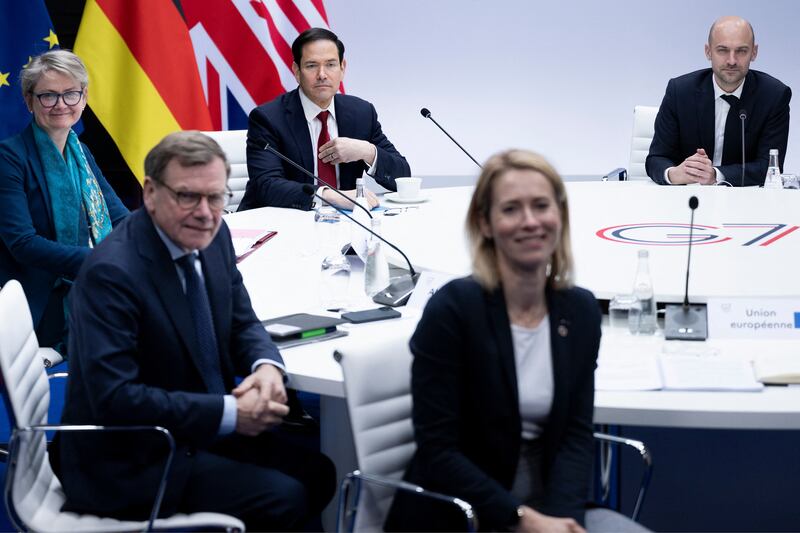
The US secretary of state Marco Rubio travelled to Paris this week to try to convince Europeans to get on board, in his first overseas trip since Israel and the US launched their initial attacks.
Some European leaders have been careful not to reject any US overtures too directly, desperate to get the US back on board regarding the war in Ukraine and to reverse course on a decision to ease sanctions on Russia, which is also benefitting from rising oil prices.
“These two wars are very much interlinked,” Kaja Kallas, a former Estonian prime minister, urged this week, accusing Russia of ”helping Iran to kill Americans“.
Elsewhere, you can sense a chapter closing on an era of transatlantic relations. German president Frank-Walter Steinmeier described the war as not only “illegal” and a “politically fatal error” but also a sign that relations with the US can never return to what it was before.
The US can never again be seen in Europe as a “friendly hegemon”, Steinmeier said. “The rift is too deep.”


