
Parties on the hard right and left gained ground in the first round of French local elections this weekend in a contest closely watched for implications for the country’s 2027 presidential election.
The elections of 35,000 mayors in villages, towns and cities are full of local idiosyncrasies, but are seen as a test of strength for the far-right National Rally (RN) party of Marine Le Pen that will set the scene for a presidential race in which incumbent Emmanuel Macron cannot run.
While there was no landslide, RN regained and built on previous record results last achieved in 2014 after it deployed 33 of its 119 members of parliament to run in local races in a bid to build momentum in advance of next year.
Le Pen’s protege, Jordan Bardella, welcomed the re-election of several mayors and a strong showing for the party in the country’s south, where candidates are set to compete in the second round of voting next weekend in big cities including Marseilles and Nice.
READ MORE


“Change doesn’t wait for 2027. It starts next Sunday,” Bardella told supporters, urging voters to rally against any advance of the “extreme left”.

Meanwhile, the hard-left France Unbowed party of firebrand Jean-Luc Mélenchon did better than expected in several cities it was targeting, complicating the path to power for a still potent, but weakened, centre-left Socialist Party.
The socialists have sought to retain broad appeal by distancing themselves from France Unbowed, but are under pressure in some races to form an alliance or face defeat if right-wing and centrist forces team up in the second round.
“The outstretched hand must be taken,” Mélenchon wrote on social media, describing the results as a “magnificent breakthrough”.
“The traditional left coalitions must rise to the historical challenge of this political moment.”
Parties can choose to withdraw or merge in the second round to boost an ally or block a rival, making the final results next Sunday unpredictable.
Paris is set for a five-way run-off as a fragmented electorate rewarded multiple parties with the required 10 per cent vote to contest the second round.
The centre-left Emmanuel Grégoire, the former deputy of the capital’s outgoing reformist mayor Anne Hidalgo, bested polls by winning almost 38 per cent of the vote, boosting his chances of seeing off a conservative challenge from former minister Rachida Dati.
Edouard Philippe, founder of the centre-right Horizons party, achieved a commanding lead in the first round of mayoral elections in the northern port city of Le Havre, leaving intact his ambitions to contend the 2027 election as a Macron successor.
Nationally, centrist parties and allies of Macron had a weak showing, continuing a tendency to underperform at local elections that has not necessarily been replicated in national votes in the past.
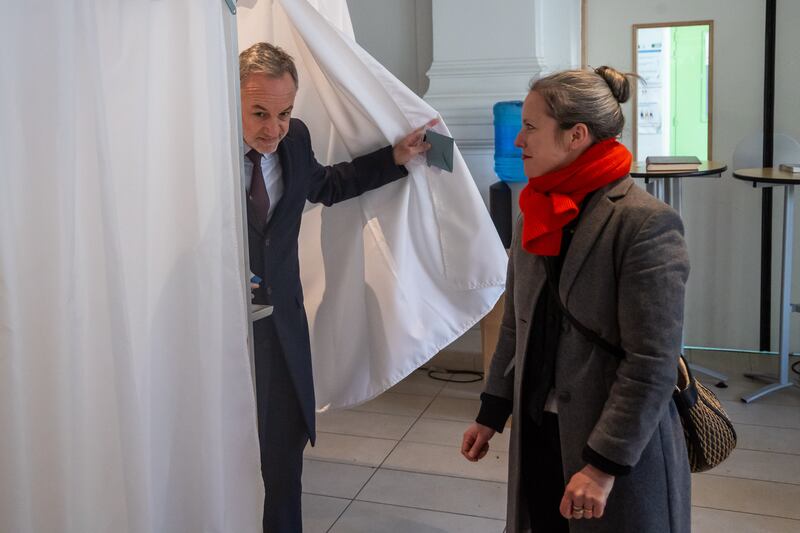
Voters at a Paris polling station where there were long queues to cast ballots said it was positive that people had turned out to vote.
“Paris is very polarised politically,” said Frederick, a local resident in the 18th arrondissement. “There are a lot of people here so that’s positive. It’s good for democracy and it’s good for Paris.”
[ Naomi O'Leary: Why Europe is watching closely as France votesOpens in new window ]
Aurélie, who had come to cast her vote with her dog Yuko, said it was important to her to vote against candidates proposing a ban on dogs from some public spaces.
“This is a vote that can change our daily lives because it’s about our arrondissement, our streets, our local schools,” she said. “It’s very important.”
Turnout was 49 per cent nationally and just under 60 per cent in Paris, an increase on 2020 municipal elections that were disrupted by the Covid-19 pandemic, but a decrease compared to 2014.


