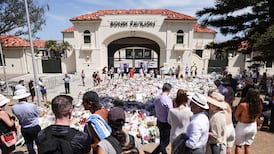
The Bondi terror attacks suspects spent their entire four-week visit to the Philippines in Davao City, rarely leaving their hotel except for an hour or so at a time, and never talking to any other guests or receiving visitors, Philippine police and hotel staff have said.
The initial police investigation casts more light on the four-week trip by the alleged gunmen, the father and son Sajid and Naveed Akram, amid speculation they went to the Philippines to receive military training from Islamist groups believed to operate in the country.
Naveed Akram (24), has been charged by police in Australia with 59 offences, including 15 counts of murder after allegedly opening fire on a Jewish Hanukkah celebration at Bondi beach on Sunday. He was seriously injured in a subsequent shoot-out with police and his father, Sajid (50), was shot dead.
Australian police have also charged Naveed Akram with one count of committing a terrorist act, which investigators allege may have been “inspired by” Islamic State after indications that the pair were radicalised in some way before the attack.
READ MORE


An Islamic State flag was found in the car they used to travel to Bondi from a short-term rental they were living in elsewhere in Sydney.Naveed Akram’s prior connections with radical Islamists in Sydney was investigated by Australia’s spy agency, Asio, leading to suggestions that they sought instruction or training in the Philippines during their stay on November 1st-28th.
Sajid Akram travelled to the country on an Indian passport while his son used his Australian passport.
However, Philippine police visited GV Hotel in Davao City on Wednesday afternoon and found that the pair stayed in the same room on November 1st-28th – the entire duration of their visit to the country. Police also interviewed hotel staff who had interacted with them.
One hotel worker, Jenelyn Sayson, told the Guardian the Akrams did not behave suspiciously during their stay.
[ Bondi Beach shooting: Australia vows stricter gun laws after 15 killedOpens in new window ]
They initially booked a seven-night stay online but requested extensions on arrival and continued to extend their stay until checking out on November 28th, according to Ms Sayson, a front desk staff member who served them during their stay. The two arrived carrying one big piece of luggage and a backpack, she said.
They rarely left the hotel and only for about an hour at a time, apparently staying in Davao City, which lies in the southern province of Mindanao.
“They would just go out and come back. Just the two of them ... We never saw them talk to any visitors,” said Ms Sayson, who regularly saw the father and son come in and out of the lobby.
She recognised them from the media coverage of the attack.
They were not chatty, but the son occasionally greeted front-desk employees.
They did not have their own vehicle. “We would see them cross the street and walk towards the next block. We never saw them take a ride or saw anyone pick them up here at the hotel.”
The Philippines national security adviser, Eduardo Año, said the father and son were believed to have remained in the city. “No evidence that they went outside Davao. Our investigation is still ongoing,” Mr Año said.
He dismissed reports that they had undergone training in the Philippines and travelled to Marawi City, the site of an Islamic State-linked siege in 2017.
[ ‘It was dead people everywhere’: Inside Australia’s Hanukkah massacreOpens in new window ]
“A mere visit does not support allegations of terrorist training, and the duration of their stay would not have allowed for any meaningful and structured training,” Mr Año said, adding that the Philippines was co-ordinating with counterparts in Australia to determine the purpose of their visit.
A spokesman for the president, Ferdinand Marcos Jr, rejected what he called a “misleading characterisation of the Philippines as an Isis training hotspot” following a report that the attackers underwent “military-style” training in the country.
The Philippine military said the number of Islamic State-linked militants was down to about 50, distributed in provinces in Mindanao. There has been no record of foreign terrorist activities in recent years, its spokesman said. “That’s why we cannot see the credibility of reports that the gunmen ... underwent training here,” said Gen Romeo Brawner. – Guardian