The numbers alone reflect the scale of the destruction: Hundreds of people are reported dead so far, with more than 1,400 others missing, and entire towns have been wiped out after floods swept the Himalayan region on the border between Nepal and Tibet on Wednesday.
But for the survivors, it is the force of the deluge that haunts them. One minute, their lives were routine. The next, the world turned upside down.
Rajan Khatri (41), a police officer posted at Syabrubesi, one of the riverside villages worst affected by the floods, said he had received a call at 9.10am local time from a friend warning him that a massive flash flood was heading downstream.
He and his colleagues had no time to react. As soon as he hung up, high waves swept through the police station.
READ MORE


The water flung him out of the building, and he lost consciousness.
“One of my senior officers and I were together when the wave struck. I was thrown out, but he was unlucky and was buried or swept away,” he said, from a hospital bed in Kathmandu.

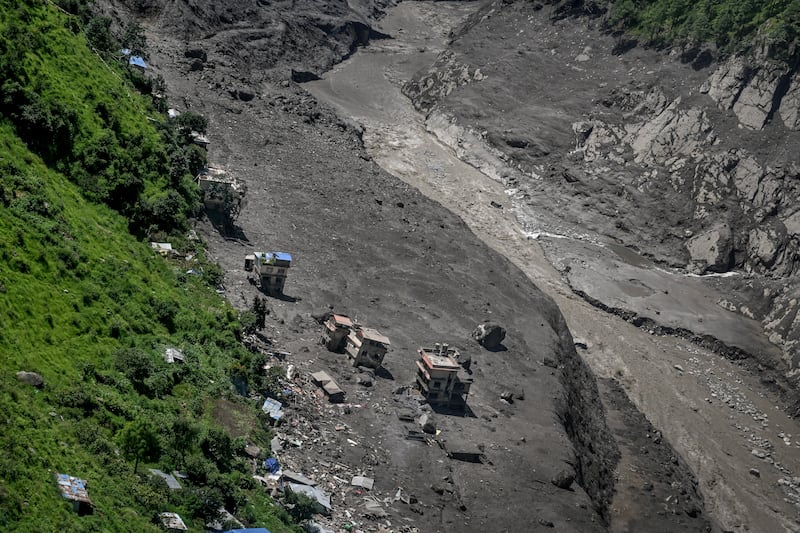
“I cannot explain how big the waves were. They engulfed several-metres-high buildings in a fraction of seconds,” he said. “It wasn’t just water. It was a combination of boulders, sand and thick sludge.”
Of the seven people who had been working at his police station, Khatri is one of three to have been found alive. He said he was worried about whether the other four had survived.
After regaining consciousness, he looked around and saw nothing but debris. He said at least 100 houses had been swept away, along with the office of a hydropower project, schools and other government facilities.
Khatri waited amid the debris until his rescue Thursday morning. He had sustained chest injuries from the force of the floodwaters.
Smriti Ojha (17) was getting ready for school in Trishuli, in Nepal’s Nuwakot district, when she felt a tremor.
Initially, she thought it was an earthquake – not unlike the one in 2015 that destroyed her family’s home. She rushed out of the rented house where she lives with her friends. Just as she came out, she saw enormous waves.
“Everyone in the house got out before it was too late, but we couldn’t save anything,” she said from her hospital bed, where she was receiving treatment for a cut on her right foot. Her immediate family, which lives more than 5 kilometres from the destruction, is safe, but four of her relatives are missing.
“It was terror,” she said. “I cannot believe everything was swept away before my eyes.”


The search for more than 1,400 people missing after the devastating floods continued on Thursday, as emergency workers scrambled across steep mountain valleys and mud-covered villages to look for survivors and deliver supplies.
A giant torrent of water, rocks and ice swept through the area between Nepal and the Tibet region of China, destroying roads, snapping bridges, toppling buildings and cutting communications. Scientists said the flood was probably unleashed after an enormous chunk of ice broke off from a glacier high in the mountains Wednesday morning.
Images from the disaster captured its terrifying speed and force. Surveillance footage shows crowds running from the surging water before torrents of water and thick clouds engulfed buildings and vehicles. Survivors described lightning-fast floodwaters that ripped down houses and flung people out of buildings in an instant.
Officials and aid organisations were still assessing the scale of the tragedy and struggling to establish an accurate count of the missing.
In Nepal, more than 800 people, including about 500 foreign visitors, were unaccounted for on Thursday morning, the country’s disaster management authority said. The missing foreigners included at least 288 from India as well as visitors from the United States, Australia, Britain, Canada and Malaysia.
In China, at least 558 people were missing in Tibet’s Gyirong County, including 260 foreigners, Chinese state media reported. China’s Foreign Ministry said 100 Chinese citizens were missing in Nepal.
- This article originally appeared in The New York Times.