
JD Vance takes axe to transatlantic alliance at Munich security conference
February 14th
It was Valentine’s Day. Instead of a love letter to Europe, US vice-president JD Vance took an axe to the same transatlantic alliance the Munich gathering was established to nurture.
Ignoring Munich’s golden rule to “engage and interact ... don’t lecture”, Vance lectured Europeans that Russia was less of a danger to their Continent than the “enemy within”.
In his view, this “enemy” was a Europe-wide crackdown on free speech and democracy, silencing citizens most concerned by the consequences of immigration – and the far-right parties they vote for.
Shaking off icy shock, Friedrich Merz – then still opposition leader and not yet chancellor – said “free speech remains free speech” in Europe. In a nod to a recent White House reporting ban on the Associated Press, in a name dispute over the Gulf of Mexico, he added: “We would never kick out a news agency from the press room of our chancellery.”
READ MORE


By year-end, a new 33-page Washington national security strategy expanded Vance’s speech, suggesting the US should cultivate “resistance to Europe’s current trajectory within European nations”.
[ Trump’s disturbing National Security Strategy should be required readingOpens in new window ]
If the transatlantic relationship is falling apart by degrees, future historians are likely to remember that the end began in Munich. Derek Scally, Berlin Correspondent
Volodymyr Zelenskiy’s explosive meeting with Donald Trump and JD Vance
February 28th
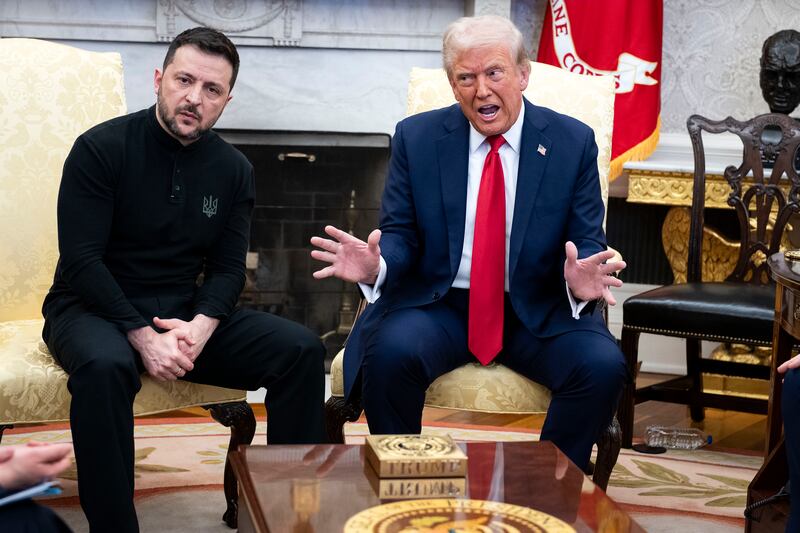
Ukrainians hoped it would be the day when relations with the US got back on track, but instead they watched agog – along with millions around the world – as their president was harangued before television cameras in the Oval Office and then asked to leave the White House.
Volodymyr Zelenskiy’s visit to Washington felt like a moment of great jeopardy for Ukraine, and his meeting with Donald Trump, JD Vance and assorted other US officials and pro-Trump journalists could not have gone much worse.
Zelenskiy began the meeting by showing Trump photos of emaciated Ukrainian soldiers who had survived brutal captivity in Russia, but they only seemed to make Trump bristle at his guest, and prompted Vance to accuse him of being ungrateful by trying to “litigate this in front of the American media”.
When Zelenskiy tried to respond he was shouted down, as Trump told him Ukraine didn’t “have the cards” to take on Russia, that he was “gambling with world war three”.
The relationship was patched up over the following months, but the tone was set: Trump could turn on Ukraine in a flash, while showing uncharacteristic restraint and respect in all his dealings with Russia and Vladimir Putin. Daniel McLaughlin, Eastern Europe Correspondent

Trump’s ‘Liberation Day’ tariffs
April 2nd
The chosen date for president Donald Trump’s tariff announcement was April 2nd; but even then it was clear that April 1st would have been appropriate in that nobody was sure who the joke was on.
Despite Trump’s promise that it would be “forever remembered as the day American industry was reborn”, the pageantry in the Rose Garden seemed curiously rushed and half-baked. Trump held before the world a chart bearing the title “reciprocal tariffs”, which had about it the bang of a transition year project hurriedly compiled by a group who had spent the holidays slacking.
The punitive impositions were staggering, with 34 per cent on China (on top of 20 per cent fentanyl-punishment tariff) and, in a widely mocked error, 10 per cent on the Heard and McDonald islands, inhabited only by penguins.
Economists dashed out alarmed predictions; stock markets plummeted and anxiety hit the ceiling in Ireland over fears that vital pharmaceutical giants would begin to pack up.
Grand announcements that the age of mercantilism had returned fell quiet again. The stock markets continued to boom. US authorities announced that tariffs collected some $200 billion by December while the courts continued to deliberate on their legality.
When soybean farmers across the midwest stared forlornly at harvests that the Chinese declined to buy, Trump was forced back to the negotiating table. Monthly employment reports remained sluggish. For an unforgettable moment in history, Liberation Day was fast becoming a distant memory. Keith Duggan, Washington Correspondent

The election of the first US pope
May 8th
A great surprise this year in the world of religion was the election of Chicago-born Robert Prevost as Pope Leo XIV in May.
“Not a hope” was the word on the streets around the Vatican beforehand that he, an American – any American – would be elected bishop of Rome. It would have been in accord with a long-held Church tradition that no cardinal from a major world power is ever elected pope. More fool us, me included.
Leo’s election saw that bite the dust. It was so much easier when popes were Italian. That too ended, with the election of “the Polish pope”, Karol Wojtyla, in 1978. Since then, it’s been nothing but “foreigners” as bishop of Rome.
Then, Leo is not your typical US prelate. He has spent almost his entire clerical life in Peru, where he was deeply influenced by deprivation there, as pastor and bishop. The rest he spent in Rome leading the Augustinians, visiting confreres around the world, including Ireland (six times).
His papacy has started quietly, with indications already that there will be no great changes on his watch as pope. His primary degree is in mathematics and this is reflected in his precise, prepared, calibrated approach to matters, though with a tendency towards the traditional. It has led some liberal Catholics to dub him “Benedict Lite”, after Pope Benedict XVI. This is probably unfair, seven months into his papacy. Time will tell. Patsy McGarry
Israel’s 12-day war with Iran
June 13th-24th
By the summer of 2025, Israelis had become used to sleepless nights, rushing to the bomb shelter after projectiles were launched from Gaza, Lebanon or Yemen. But this time was different.
The nationwide alert sent to mobile phones in the early hours of June 13th informed the public that Israel had launched a massive attack on Iran.
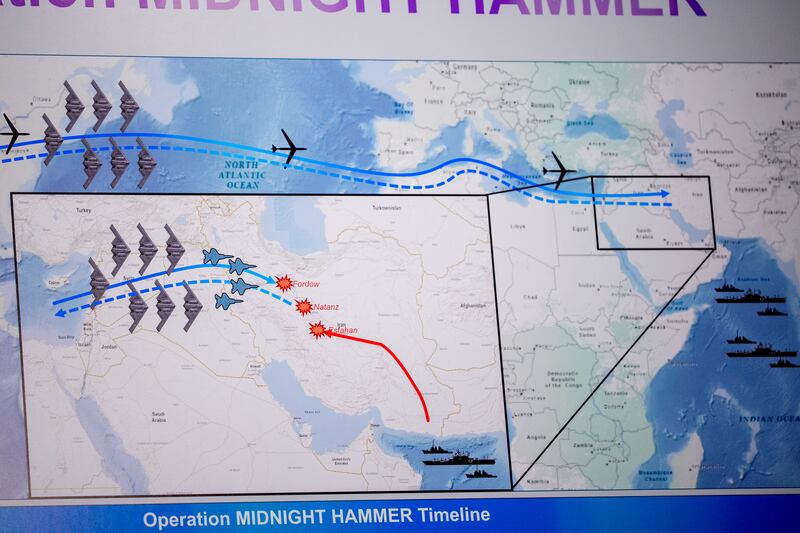
What became known as the 12-day war was actually 30 years in the making. The proxy war between Israel and Iran was over. This was the real thing. It ended in Israeli military success that set back Iran’s nuclear programme (at least for a few years), left Israel as the uncontested regional superpower and reshaped the Middle East’s strategic landscape.
A synchronised opening strike combined fighter jets travelling some 1,000 miles with Mossad teams on the ground, hitting senior military commanders and nuclear scientists, all within minutes. After Israel secured the skies, US B-2 stealth bombers on June 22nd hit Iran’s underground nuclear facilities at Fordo, Natanz and Isfahan.
However, despite the setback to Iran’s “axis of resistance” the regime remains in place, along with Tehran’s nuclear ambitions and its long-range ballistic missile arsenal. Mark Weiss in Jerusalem

A taboo is broken over international law
June 22nd
This summer Dutch politician Rob Jetten, leader of the liberal pro-European Union party D66, called for the 1951 Refugee Convention to be amended.
Previously the preserve of the radical right, the shift broke a taboo on calling for reform in treaties drawn up in the wake of the second World War in a country that considers itself the home of international law.
“Centrist parties, in particular, should not leave this discussion to the extremists,” Jetten told a Dutch newspaper. He called for change to allow for asylum claims to be processed outside Europe as a default, so people are not incentivised to physically travel to the Netherlands to claim refugee status there.
The context was that the Dutch government had just collapsed due to disagreements over asylum policy.
Jetten led his party to victory in the October elections, winning the largest vote share and increasing his party’s seats in parliament. With coalition talks ongoing, reform of the treaties is likely to form part of the new Dutch government’s policy platform.
It crystallised a broader trend around Europe. In December, Ireland was among 27 countries to join a call initiated by hardline governments in Italy and Denmark for changes to the European Convention on Human Rights. They want courts to give less weight to key treaty’s protections – such as family life – in order to ease deportations. It was a major policy shift for Ireland, previously a staunch defender of the convention as underpinning the Belfast Agreement. Naomi O’Leary
Xi, Putin and Modi’s show of strength
August 31st
One of the most striking images from China in 2025 was that of Xi Jinping with Vladimir Putin and Kim Jong-un at a huge military parade in Beijing to mark the 80th anniversary of the end of the second World War.
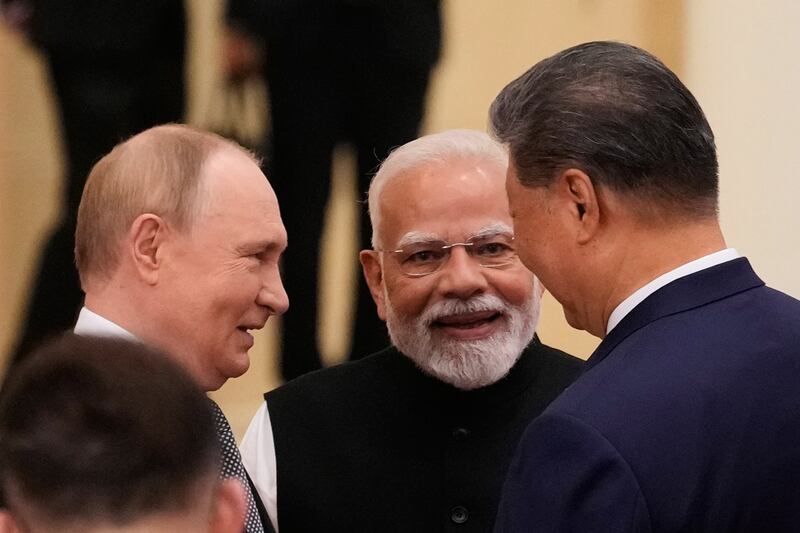
But a meeting of the Shanghai Cooperation Organisation (SCO) two days earlier in Tianjin, about 150km south of Beijing, offered a more telling image of the changing global order.
This showed Putin and Indian leader Narendra Modi holding hands as they walked towards Xi before the three leaders huddled together, smiling and joking. The show of unity was also a gesture of defiance towards Donald Trump and his attempt to use tariffs to bend the world to his will.
Weeks before the Tianjin meeting, the US had imposed an extra 50 per cent tariff on India because of its continued purchases of Russian energy, which Trump said was prolonging the war. New Delhi and Moscow have had a close relationship for almost 80 years but relations between India and China have long been difficult.
For the past 25 years, successive US administrations have courted India as a counterweight to China’s rising power in Asia. Modi’s meeting with Xi and Putin was a reminder to Washington that India has other options. Denis Staunton, China Correspondent

Political turmoil as French government collapses
September 8th
There was a sense of inevitability when French prime minister François Bayrou stood up to address the National Assembly in early September.
The embattled politician was trying to rally support from deputies who had made up their minds to topple his minority government before they walked into the parliament chamber that day.
A centrist ally of Emmanuel Macron, Bayrou had tabled a deeply unpopular budget to tighten the nation’s fiscal belt.
Bayrou led a government that never commanded a majority and he always seemed to have one eye on the 2027 presidential election, during his nine months as prime minister.
[ The Irish Times view on French politics: a Parisian polycrisisOpens in new window ]
In a back-me-or-sack me confidence vote, Bayrou tried to bounce opposition parties on the left and far right into supporting his budget.
Reporting from Paris on the day, I was listening to Bayrou’s speech on my headphones, while out chatting to Parisians about what they made of the whole thing.
It was clear from his sweeping appeals for deputies to think of France’s future that Bayrou knew he was on the way out, but hoped he might be proven right in the longer term – preferably in time for him to launch a presidential bid. Ultimately, he lost the vote comprehensively, collapsing the French government. Jack Power, Europe Correspondent
Conviction of former Brazilian president Jair Bolsonaro for plotting a coup
September 11th
Although the verdict was expected, it nonetheless felt momentous when it finally arrived.
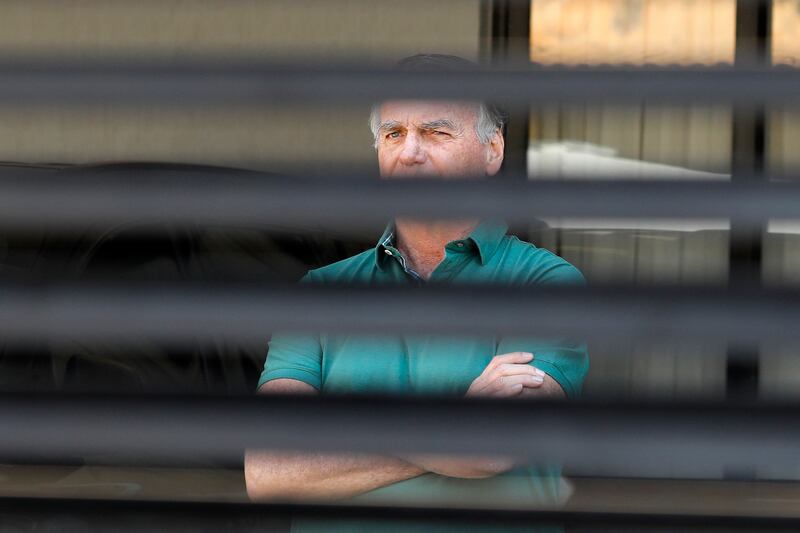
As Brazil’s supreme court justice Cármen Lúcia cast the decisive vote in Brasília to convict former president Jair Bolsonaro and seven mainly military allies of plotting a coup, a chorus of car horns erupted in my neighbourhood in São Paulo.
For the first time in its history, Brazil had held a group of military men to account for attempting to overthrow the country’s democratic arrangements.
After a career marked by petty corruption and moral turpitude Brazil’s justice system had finally caught up with the volatile ex-army captain.
[ Bolsonaro jailing marks end to Brazil’s notorious leniency with military menOpens in new window ]
Sentenced to 27 years in prison, Bolsonaro was incarcerated last month after trying to remove an ankle monitor with an iron while under house arrest. The trial itself was flawed but the evidence against the conspirators was overwhelming.
The aftershocks of the verdict continue to roll through Brazilian politics. Few expect Bolsonaro to serve anything but a fraction of his long sentence in prison. But regardless of what comes next, the once seemingly impregnable wall of immunity that for too long protected Brazil’s military men from justice for their illegal actions had been breached. Tom Hennigan in São Paulo

Chinese-made cars outsell Korean cars in Europe
September 30th
Car sales data for September revealed that Chinese-made cars outsold models from South Korea in Europe for the first time, driven by demand in electric vehicles and plug-in hybrids.
The growth has been sudden: Chinese car brands BYD and Chery saw car-sales growth of 397 per cent and 587 per cent year-on-year respectively.
It illustrates how 2025 was the year in which China’s dominance in green tech became unignorable, as it emerges as the world’s leading manufacturer of batteries, electric cars, solar panels, and wind turbines.
Benjamin Kibies, an analyst with Dataforce, said the figures were “a pointer to what might lie ahead” that “signals a lasting shift in Europe’s market structure”. This happened despite tariffs imposed by the European Union on Chinese-made electric vehicles. Where technology and energy dominance goes, political clout follows, and this shift may prove to be part of a transition into a multipolar world. Naomi O’Leary
Prince Andrew’s loss of royal titles
October 30th
It was the nightmare before Halloween for the younger brother of Britain’s monarch, King Charles. The process formally started to strip all remaining royal titles from the man formerly known as prince, now just plain old Andrew Mountbatten-Windsor.
It was a historic moment. It had been more than a century since Britain formally stripped a royal title from a male member: Prince Ernest Augustus, Duke of Cumberland and Teviotdale, in 1919, because he fought for Germany in the first World War. (King Edward VIII’s title was taken away in 1936, but that was a voluntary abdication.)
Mountbatten-Windsor was stripped of his titles for bringing the royal family into disrepute over his association with the late convicted sex offender, Jeffrey Epstein.
[ Andrew: the fall of the man formerly known as PrinceOpens in new window ]
Further details emerged through the autumn of his connections with Epstein, including emails casting doubt on his version of events. Charles tried to get ahead of the game on October 17th by announcing that his disgraced brother would voluntary stop using his titles, such as duke of York.
Public anger did not subside. The king pressed the nuclear button on October 30th and did away with all his younger brother’s titles, including prince.
Streets across Britain named after him and even a golf course in Scotland – the former Duke’s Course in St Andrew’s – have since deleted their association with him: a proper royal cancellation. Mark Paul, London Correspondent

French military chief warns Russia is preparing to attack Europe
November 18th
In a speech that caused shock waves, the head of the French defence forces, Gen Fabien Mandon, warned the public that Russia was preparing to attack countries beyond Ukraine.
“Unfortunately Russia today, as I know from the information to which I have access, is preparing for a confrontation by 2030 with our countries. It is organising for it, preparing for it, and it is convinced that its existential enemy is Nato, and therefore our countries,” Mandon said.
[ What would happen if Russians landed at Shannon and took over the airport?Opens in new window ]
It came as president Emmanuel Macron announced the introduction of voluntary military service, with France becoming the latest in a string of European countries to boost defence capabilities.
It was part of a perceptible mood shift in Europe towards preparing for a war as a concrete possibility, fuelled by a sense that an alliance with the US that has underpinned security since the end of the second World War can no longer be relied upon.
Weeks later, in December, Nato chief Mark Rutte warned in a speech that “we must be prepared for the scale of war our grandparents and great grandparents endured.”
Faced with the possibility of war without the support of the United States, European Union countries have hastily reversed years of low defence spending, increasing budgets by 11 per cent this year, and by 63 per cent compared to 2020, according to the European Commission. Naomi O’Leary


