In the privacy of Ireland’s team room at the Castleknock Hotel ahead of the World Cup playoff against the Czech Republic in March, Heimir Hallgrímsson hung a series of giant images from the delirious 3-2 victory over Hungary on the walls.
This reporter gained access to the team room to interview Hallgrímsson, and one image that hung beside the PowerPoint screen stood out above the others. The photo was taken behind the goal as Troy Parrott scored, his face contorted in desperate effort to reach a stud to the dropping ball. It was the only image we had seen that foregrounded the desperation of his effort rather than the deftness of his touch.
The picture’s focus on Parrott’s expression reinforced the message that Hallgrímsson continually preaches about his new talisman: all of this is founded on work ethic.
Asked to sing another round of hosannas to Parrott after his two goals against Austria, the head coach again pointed to his striker’s less glamorous qualities.
READ MORE


“I always say that what I see in him, what I don’t see in many other attackers, is defensive discipline and hard work for the defensive structure as well,” said Hallgrímsson.
Look back closely at Parrott’s winning goal in Budapest and you’ll realise his exquisite timing in meeting Liam Scales’s knock-down was a direct consequence of his work ethic.
After Hungary defended an Irish ball into their penalty area, Parrott sprinted from the box to the left wing to put pressure on defender Wili Orban, forcing him to smash the ball long, directly to Caoimhín Kelleher. The rest is history, with Scales flicking on Kelleher’s long pass into Parrott’s path. Had Parrott stood in the penalty area and not worked so hard to close Orban down, he would have been a marked man when Scales’ header fell to him.
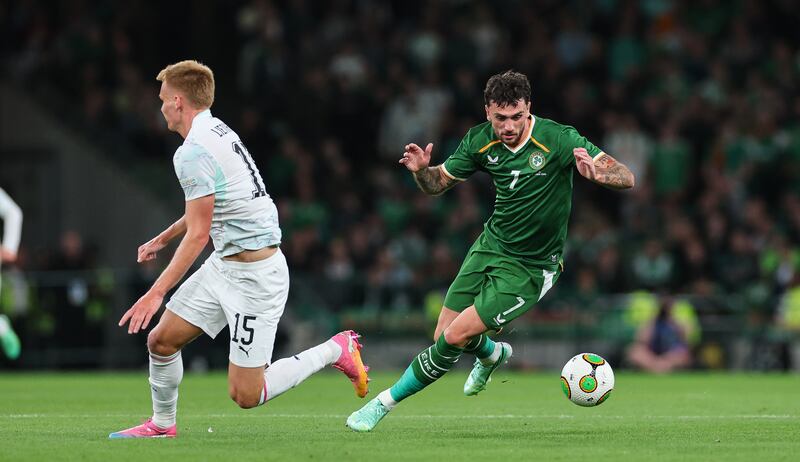
Of course, this is not to say Hallgrímsson is blind to Parrott’s remarkable qualities in front of goal, paying appropriate homage to his slaloming opening goal by describing it as a reminder of “why we love the game.”
Parrott is in stunning goalscoring form, with nine goals in his last six competitive matches, all but one of which have come against sides ranked above Ireland. Not even Robbie Keane put together a scoring run like this. It is an unprecedented streak and it may not be sustainable in the longer term, given Parrott has converted 60 per cent of his shots across these games. For context, the game’s top finisher, Erling Haaland, generally converts about one-in-three of his chances, his stats considered an outlier. Still, Parrott is in such an easy groove with Ireland there is no sense it will come to an end anytime soon.
The exception in this run was last week’s dowdy defeat away to Kosovo in which Parrott was isolated and kicked a ball against a wall in frustration when substituted with more than 10 minutes remaining. Against Israel and Austria, Hallgrímsson hit on a better formula to keep Parrott connected to the team, starting Adam Idah in an unfamiliar, withdrawn role behind the 24-year-old.
While Hallgrímsson admits Idah’s defensive work needs some fine-tuning in his new position, it is a worthwhile trade-off as it allows the Parrott-Idah partnership to ignite. The pair have genuine chemistry, and it was Idah’s clever, flicked header that put Parrott in a position to exhibit his outrageous skills for the first goal against Austria.
The duo have been playing together throughout Ireland’s underage ranks, and since under-17 level have shared a pitch 32 times in green. Ireland have lost just six of these games, two of which were penalty shoot-outs: against the Czech Republic in March and in the 2018 Under-17 Euros quarter-final, in which goalkeeper Jimmy Corcoran was infamously sent off.
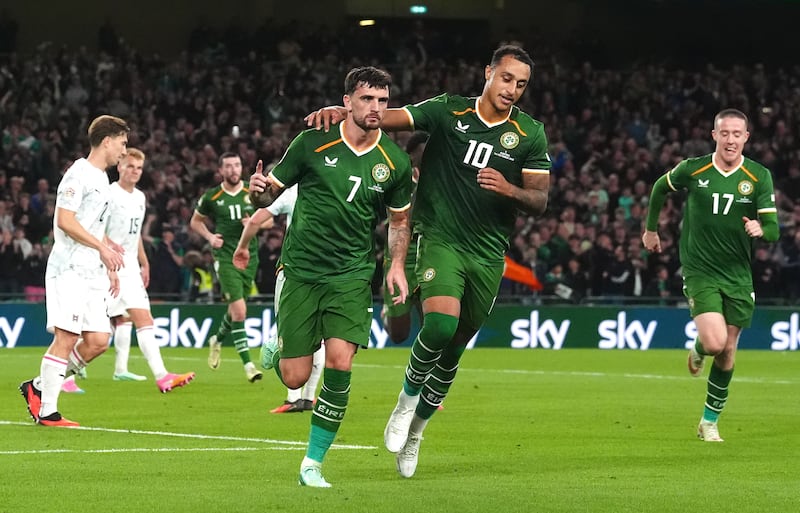
Of the other four defeats, two were at underage level – a 2-0 group stage loss to Belgium at the 2018 Under-17 Euros and a 3-0 friendly loss to Wales at Under-19 level – while the only losses at senior level were the 1-0 defeat away to the Netherlands in 2023 and a 3-0 friendly loss to Portugal during John O’Shea’s interregnum in the summer of 2024. (There’s an asterisk alongside the Dutch defeat too, as Parrott played only the last couple of minutes as a late substitute.)
“Both players’ strengths complement each other,” says Tom Mohan, who coached Parrott and Idah at under-19 level. “Adam occupies centre-backs really well with his physicality and movement, which helps take some of the physical burden off Troy. Anyone who plays with Troy will know if you make good runs off the ball, he will make clever decisions to create for you or take chances himself. Obviously, the coaching team are also making things happening on the training ground between the two lads.”
Asked for a standout memory of both players, Mohan alights on a Under-19 Euro qualifier win in Longford against a Dutch side featuring Jurrien Timber and Ryan Gravneberch. Idah scored and Parrott excelled in a 2-1 win. That side went on to reach the semi-finals of the Euros but were without both Idah and Parrott as their clubs refused to release them. It is an underappreciated ‘what if’ in recent Irish football history.
Now we can ask ourselves a much more exciting version of the same question: What if Troy Parrott is only getting started?
“There was a question about where his roof is,” says Hallgrímsson. “I don’t see the roof yet because he’s continuing to improve.”