Is a 12-week suspension long enough for gouging an opponent in the eye? Is sitting out playing rugby until March 27th of next year a tough enough sanction for the two-time World Cup winning Springbok Eben Etzebeth, who was found guilty of intentionally making contact with the eye of Welsh flanker Alex Mann?
A mid-range entry point of 18 weeks/matches was deemed an appropriate penalty with some mitigating factors, including the player’s previous good disciplinary record.
Etzebeth has never received a red card before in his 13-year international career, which allowed the independent disciplinary committee to reduce the 18-week number by a third to 12 matches.
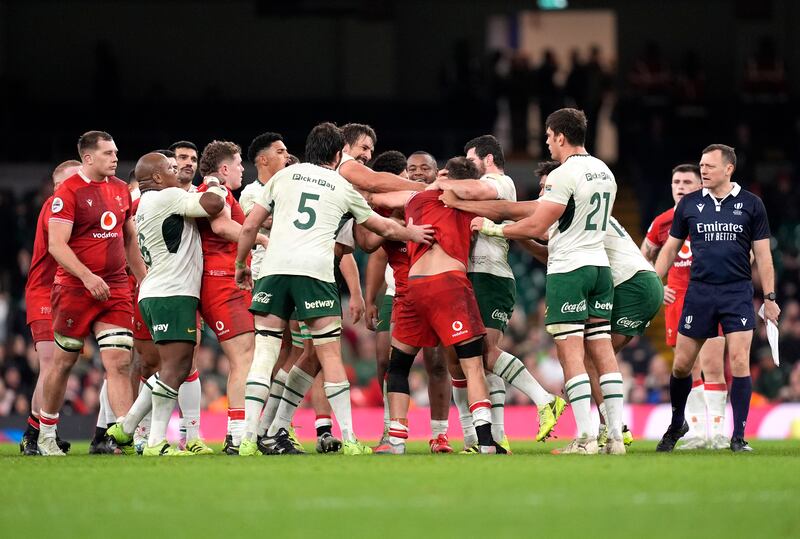
For those who didn’t see the incident, it arrived last weekend when thoughts and prayers went out for Welsh rugby as the match neared its calamitous 11-try end in the Principality Stadium, with the hosts losing 73-0.
READ MORE


In the 79th minute, before the French referee Luc Ramos could blow his whistle to end the Welsh misery, it got worse.
The 6ft 8in frame of South African lock Etzebeth arrived into camera view and stood with his long arm spanned over scuffling bodies.
Ireland's path to World Cup redemption + European preview
By the end of the brief altercation Etzebeth’s right thumb was buried in the left eye socket of the Welsh flanker. Mann recoiled away in pain from the lunge as Etzebeth’s thumb sank in.
It was a gruesome watch, a disgusting foul, which is rightfully considered one of rugby’s cardinal sins. The independent disciplinary committee judged it to be deliberate.
Ramos showed a straight red card to the lock, the only decision he could have made. It was South Africa’s third red card of the Autumn Nation Series for Springbok locks following those shown to Lood de Jager and Franco Mostert.
Even Springbok head coach Rassie Erasmus spoke clearly on the matter.
“I don’t know what I can say that won’t be controversial,” he said. “It didn’t look good. It justified the red card. How it happened and why it happened, whether it was provoked, I’m not sure. But the optics were correct.”
In a less conventional take, Schalk Burger, a marauding Springbok flanker from a different era, said in a South African panel discussion on The Verdict Show that Etzebeth should have punched Mann instead.
In a weird way he was right. In the jungle law of professional rugby, a landed punch would have been better assimilated. It would have been bang to rights illegal, but a more acceptable retaliation to whatever it was that stirred Etzebeth.
Burger subsequently conceded that he was in no position to talk. In a brutal second Test against the Lions in Loftus Versfeld in 2009, Burger was not sent off but cited after the match. Following a disciplinary hearing, he was banned for eight weeks for eye-gouging Ireland winger Luke Fitzgerald.
A whole range of Test level professional players in the past have fallen foul of law 9.12, with various sanctions meted out.
In 2017 England prop Kyle Sinckler was suspended for seven weeks for making contact with the eyes, or the eye area of Northampton’s Michael Patterson.
England captain Dylan Hartley appeared to go on a spree when he was banned for 26 weeks after being found guilty of eye-gouging two Wasps players, Ireland’s Johnny O’Connor and England’s James Haskell, in the same match in 2007.
The list of those banned for some degree of eye contact on other players contains plenty of household names including Springboks Bakkies Botha and Bismarck du Plessis, England’s Mark Cueto and Martin Corry, Ireland’s Alan Quinlan, Italy’s Mauro Bergamasco and Sergio Parisse to name just a few.
Hartley’s ban was severe because of his appalling record, which had built up to a 60-week total of suspensions between 2007 and 2016, not all for gouging.
He also bit the finger of Irish backrow Stephen Ferris in a Six Nations match and was handed an eight-week ban.

But this is not 2009 and in 2025 gouging is not supposed to be as tolerated or as frequent as it was before.
With Etzebeth, people will measure the sanction’s severity by how obvious the foul was and how much revulsion was felt as his thumb sank into the corner of Mann’s eye. It was a spectacularly public act of violence.
That it was clearly captured on camera as cynical and dangerous will also add to the feeling that the Springbok with a record 141 caps, got away lightly. His lay-off is about as long as it takes to rehab a knee with an ACL injury.
There is also a bigger picture.
Because of Etzebeth and his reputation in the game, the distasteful nature of the foul is high profile, and the message World Rugby are sending out is also consequential for their reputation.
They need to ask themselves whether the reduced mid-level suspension will sit well with the public’s sense of repugnance, or set them wondering what a high-level offence looks like. An eye popping out?
More critically, people will take a position on what the game of rugby thinks of its stakeholders and whether 12 weeks lays waste to the claim that player welfare is always at the forefront of their thinking.
The decorated 34-year-old Springbok won’t play again until after the Sharks meet Cardiff on March 27th. That seems lenient.
For that, World Rugby might now find itself in the dock.