Rory McIlroy was on top of the world when he came to Killarney for an Irish Open homecoming in 2011. Just a month earlier he had won his first Major, clinching the US Open by eight strokes at Congressional.
Few would have expected him to launch a broadside at commentator Jay Townsend, who was scathing about a decision made by McIlroy on the 18th hole of his first round at the Irish Open. McIlroy found a fairway bunker off the tee and instead of laying up, he hooked a shot into the water en route to a double-bogey six.
Townsend tweeted: “McIlroy’s course management was shocking. Some of the worst course management I have ever seen beyond an under 10 boys golf competition.”
The Holywood golfer sniped back at Townsend, saying: “Shut up… you’re a commentator and a failed golfer, your opinion means nothing!”
READ MORE


The criticism had clearly stung, but it was not entirely unfounded. McIlroy’s US Open win at Congressional had come after heavy rain softened up a long course, playing to his strengths. His 16-under-par total was at odds with tough US Open set-ups, which usually lead to winners shooting scores of near level-par.
The narrative around McIlroy was of a circumstantial elite golfer who was unstoppable when he could play his aggressive, pin-hunting game, but struggled when he had to eke out a score in dry, firm or windy conditions. The fairweather label was crystallised after the 2011 Open at Royal St George’s when he said playing in tough, windy conditions was “not my sort of golf” and that he’d rather play when it’s “sunny and not much wind”.
While he battled some wind at a damp Kiawah Island for his dominant 2012 PGA Championship win, his 2014 Open and 2014 PGA Championship were won in relatively benign conditions too.

On US Open courses that required patience, McIlroy missed four of the next seven cuts after 2011. For a player of his talent, he did not contend enough on Major courses from that 2014 win until the end of the decade.
“I make too many mistakes,” McIlroy said of his issues at Majors during the 2021 Open. “Whether that’s trying to be a little too aggressive from bad spots or putting myself in bad spots to begin with.”
From that point, though, green shoots started to emerge. He finished in the top 10 of all four Majors in 2022 and should have won the Open at St Andrews. At the 2023 US Open, he had a patient 16 pars in his final round at LA Country en route to a second-place finish, one behind Wyndham Clark.
[ Rory McIlroy is the greatest European golfer and he is not finished yetOpens in new window ]
A month later, he hit one of the greatest shots in his career, a 202-yard two iron into a gale, to birdie the final hole of the Scottish Open at Renaissance Golf Club. He won that tournament in conditions that can now be considered his “kind of golf”.
A year later, he almost won the US Open at fast and firm Pinehurst. After missing two late, short putts, he lost by one to Bryson DeChambeau, but his round had been exceptionally crafted until that last hour.
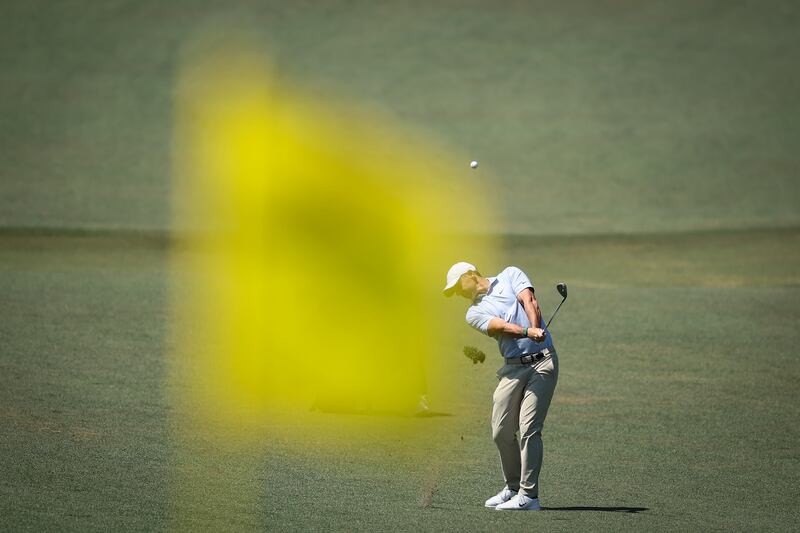
McIlroy came into 2025 as a golfer with a different mindset, taking a leaf out of his rival Scottie Scheffler’s book. “I’m a big admirer of Scottie’s for a lot of different reasons, but every time I play with him I watch how disciplined he is,” he said.
His approach paid off with wins at Pebble Beach and TPC Sawgrass, before his crown jewel at the 2025 Masters to win the career Grand Slam.
Still though, that victory came after an eclectic final round with hero shots galore and swashbuckling approaches.
Last weekend’s Masters defence, meanwhile, was an exercise in discipline. It showcased his maturation into an all-round golfing great a month before his 37th birthday.
The world number two remarkably missed every fairway on the par fives on Thursday and Friday, yet played the holes seven under par. Only on the eighth on Thursday did he go for the green in two, laying up elsewhere to rely on his much-improved wedge game. On a difficult Thursday with dried-out greens, McIlroy manufactured a 67 on a day when the scoring average was 74.65.
The best area of McIlroy’s game was his short game, gaining plus-1.39 strokes on the field. His pitching and chipping was exceptional, but it is almost impossible to get up and down from the wrong angle on Augusta’s greens when you shortside yourself. McIlroy was rarely on the wrong side.

There was still some room to go for the jugular. This is McIlroy after all. On the 12th hole, Jack Nicklaus always advised players not to go for the pin in its Sunday position – to play for the middle of the green and try to make par. That is what Scheffler did. He finished one behind.
McIlroy ignored Nicklaus’s advice and hit his tee shot to seven feet and made birdie. There was more thinking behind the aggression though, with a tip from another former champion.
“Tom Watson told me he always waited until he felt the wind, then just hit it as soon as he could,” McIlroy said. “I stayed patient, waited until I felt it settle, and knew it was a perfect three-quarter nine-iron.”
In that 2011 Irish Open round criticised by Townsend, McIlroy had hit the European Tour’s shot of the month only four holes earlier. It involved him, quite remarkably, hooking a sand wedge 50 yards around a tree on the 14th, landing just 12 feet from the hole before missing the birdie putt.
One hero shot had worked, the other had not. The combined score from the holes was two over, likely the same as if he had played smarter. There are no pictures on the scorecard, which is something McIlroy understands now more than ever, and explains why he is a two-time Masters champion.