All-Ireland SHC semi-final: Galway 2-26 Cork 1-18
Who knows? A championship that had been pedestrian and numbingly predictable was suddenly electrified in Croke Park by a young Galway team with no limits yet, just new horizons. In a second half of overwhelming dominance and devastating clarity, the Tribesmen reduced Cork to tortured witnesses.
It was Galway’s best performance in Croke Park since 2017, their last All-Ireland winning year. The new tactical blueprint that Micheál Donoghue and his inner cabinet rolled out at the beginning of the season had been building to this clinical in-game management. When the game reached its tipping point after half-time, Galway manipulated where space would appear and how the ball should move. Cork were paralysed in their web.
For this group of Cork players, it was another bewildering collapse. Having engineered a 10-point swing to lead by five after a half-hour, they were obliterated in a 20-minute spell either side of the break. Galway scored four of the last five points in the first half, and 11 of the first 12 points in the second. Galway’s momentum was irresistible and irreversible.
For Cork, the poltergeist of last year’s All-Ireland final had visited a waking nightmare. Twelve months ago, Cork lost the second half to Tipperary by 21 points and scored only twice; this time, they scored five points in the second half and were outscored by 13. The numbers are different, but they tell the same story. When the tide started to turn, they didn’t know how to swim, or float, or keep their heads above the waves. Tomorrow must feel like it is time-locked now.
READ MORE


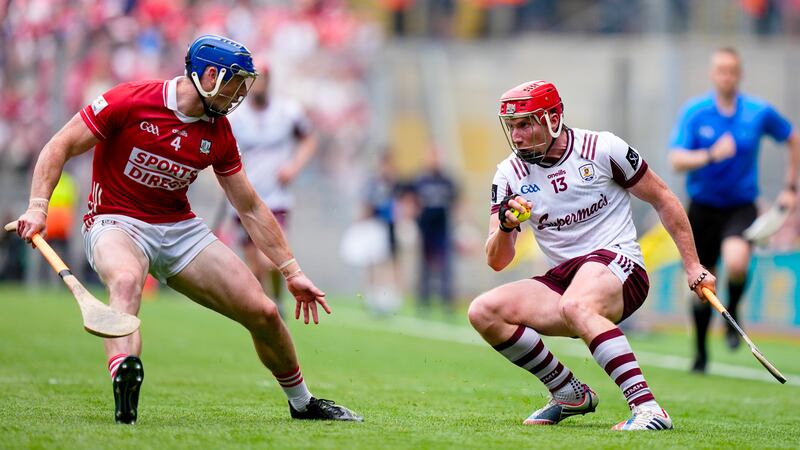
Galway suffered for a while in the middle of the first half, when they scored just twice in 17 minutes and Cork were energised by Alan Walsh’s terrific goal, but that was their only faint spell in the game.
After half-time, they pushed up on Cork’s puck-outs and forced them to go long more often than Cork had intended. Time after time Galway got the ball to ground and mopped up the breaks. A couple of years ago, Cork’s long puck-outs were a potent weapon, but they harvested just two points from them here.
On the counterattack, Galway’s outside shooting was not perfect, but their misses were manageable. At the elite level of the game, shooting is a matter of scale now. Having managed just 23 shots against Limerick in the Munster final, Cork could only muster 29 shots here. Those volumes are unsustainable.
Galway hit 14 wides, but that was from 48 shots, one more than they had managed against Dublin in the Leinster final. Given their set-up, Galway put a huge premium on scoring from distance, and those shooters stood up: Tom Monaghan scored four, Ronan Glennon three, Cathal Mannion two from play.
Closer to goal, Cork couldn’t get a grip on Jason Rabbitte, the breakthrough player of the hurling year. Cork left Damien Cahalane on him until he was booked for persistent fouling four minutes before half time; the veteran defender was replaced at the break, but Eoin Downey and Ger Millerick fared no better on the Athenry man in the second half.
In an overall sense, Cork’s indiscipline amounted to grievous self-harm. Seán O’Donoghue was booked in first-half stoppage time, putting him on the back foot, and Cork captain Darragh Fitzgibbon was booked twice in the opening 20 minutes of the second half.
His second yellow card was for precisely the kind of tackle that had caused such controversy in the Galway-Cork league game earlier this year, catching a player on the back of the helmet while trying to execute a hook. Referee Johnny Murphy had no choice but to reach for another card.
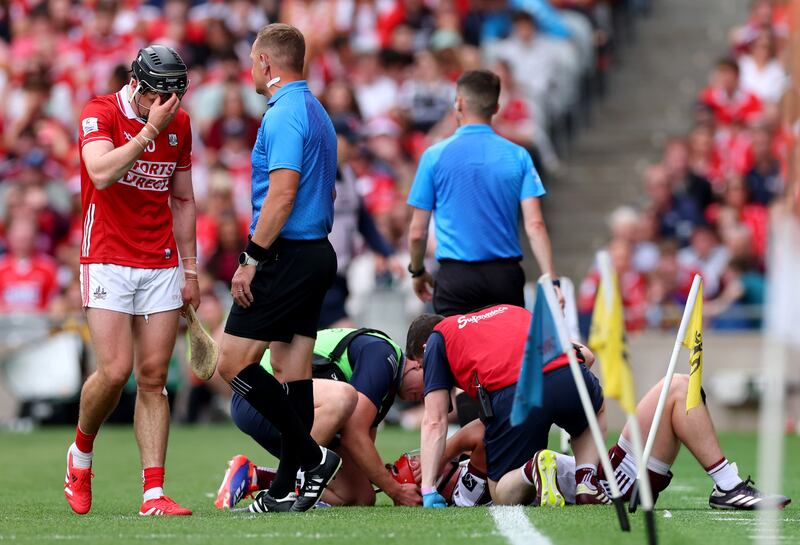
Just like in the All-Ireland final last year, Cork played the final quarter with 14 men. Shane Barrett and Brian Hayes tried manfully to force a goal, and Darach Fahy made a brilliant save from Barrett with seven minutes left when there were six points between the teams. It would be risible to suggest it was the last turning point; all the turning had been done.
Tactically, the first half had been a game of chicken. Galway pressed the ball ferociously once it crossed the Cork 45-metre line and tried to force them to hit it long rather than going through the phases. For their part, Cork tried to stretch Galway across the width of the pitch and drag them out by drilling ball into the hands of their half forwards.
Their ultimate aim was the create landing areas in front of Hayes and Alan Walsh, and as the first half wore on, they got their way. Hayes ran amok with Daithí Burke, who played with a heavily strapped left knee and can’t have been fully fit.
After Hayes scored his fourth point, Galway switched Cillian Trayers on to the Cork full forward, but he still mustered another two points before the break. Hayes finished the game with seven points and was fouled for two pointed frees. In this defeat, he was stainless.
Galway outflanked Cork tactically in the second half, but there was much more to it than that. For their system to flourish, it must be animated by tackling and selfless covering and relentless hitting. Galway won the fight too. They hit Cork for 1-15 on turnovers and Cork had no response.
Galway will go into the final with nothing to fear. And Cork? They go back to black.
GALWAY: D Fahy, J Ryan, D Burke, C Trayers, P Mannion (0-1), D Morrissey (0-1), R Glennon (0-3), G Lee (0-2), T Killeen (0-1), T Monaghan (0-4), C Mannion (0-3, 1f), D Neary (1-0), C Whelan (0-3), J Rabbitte (0-3), A Niland (0-3f). Subs: C Cooney (1-1) for Niland (48 mins), C Daniels for Ryan (56), J Fleming (0-1) for Killeen (62), B Concannon for Lee (67), S Linnane for Neary (70).
CORK: P Collins, N O’Leary, D Cahalane, S O’Donoghue, E Downey, R Downey, M Coleman, T O’Mahony, T O’Connell, D Fitzgibbon (0-2), S Barrett (0-3, 1f), D Healy, A Walsh (1-0), B Hayes (0-7), A Connolly (0-4, 3f). Subs: C O’Brien for Cahalane (ht), R O’Flynn for O’Connell (49), W Buckley (0-1) for Connolly (50), B Walsh (0-1f) for A Walsh (52), G Millerick for E Downey (60).
Referee: Johnny Murphy (Limerick).