In hurling’s Old Testament, full forwards were typecast, like the romantic leads in the black-and-white movies. In shape and size, there was no deviation from the norm. The audience was firm in its expectations: full forwards should be tall, broad-shouldered, square-jawed, hard, fearless and maybe filthy, according to taste.
Hurling was a linear game with fixed combat zones. The ball came fitted with blinkers, as standard: no sideways stuff, no back passes. Full forwards and full backs duked it out. It was a trial of strength and guile. A pressure point.
“It was a duel, that was it,” says Diarmuid O’Sullivan, the former Cork full back. “It was expected that the full forward and the full back would go at it in a different way. There was very little movement. It was man-on-man stuff. At times, that overshadowed the ability that the big full forward had as a hurler or the full back had. Oftentimes people were more interested in the contest than the ability of the players.”
O’Sullivan, though, played during an era in the late 1990s and the early years of this century when hurling started messing with the beat. Nothing radical yet, just a shift from a Casio keyboard to a synthesiser. Naturally, O’Sullivan came up against his share of full forwards from central casting: Brian Begley from Limerick, Declan Ryan and Micheál Webster from Tipperary, Séamus Prendergast from Waterford (“I thought I was strong until I met him”), Martin Comerford and Henry Shefflin from Kilkenny.
READ MORE


But alternative ways of playing the position had started to crystallise. When DJ Carey started at full forward in the 2000 All-Ireland, it was the fifth year in a row that at least one team had lined up in the final with a number 14 that was shorter than six foot: Damien Quigley from Limerick in 1996, Eugene O’Neill from Tipperary and Ger “Sparrow” O’Loughlin from Clare in 1997, Joe Errity from Offaly and PJ Delaney from Kilkenny in 1998, Joe Deane from Cork in 1999.

In Deane’s case he was just 5ft 7in; O’Neill was 5ft 9in. In the span of O’Sullivan’s career, John Troy from Offaly was liable to turn up at full forward and so was Eoin Kelly from Tipp and Alan Markham from Clare, none of whom were full forwards in the classical mould. To make that work, other fundamental stuff had to change. The incoming ball had a different trajectory and character – more sympathetic.
The thing about evolution, though, is that it never stops. Big men never left the stage but, in the modern game, nobody is picked for their size alone. Most of the time, teams are playing with just two full-time forwards on their inside line, and if one of them is a big man, he must be able to move to the rhythm and dance with the ball.
“They’re a different breed now,” says O’Sullivan. “Someone like [Aaron] Gillane, he’s six foot, but his hurling is incredible, his speed, his movement. Brian Hayes is phenomenal. Did you see his hand speed for the second goal against Limerick? To be able to kill that ball [with a man swinging out of him], and get the pass off, a wristy, one-handed pass – like, what size is he?” (He’s 6ft 7in.) “That is a frightening skill.”

In the evolutionary continuum, target-men full forwards assumed the skill sets of nippy corner forwards. It was no longer their mission to break the ball for somebody else; in the modern manufacturing of scores, they have become a one-man processing plant: possession, evasion, execution.
Hurling’s jungle is full of these beasts: Hayes in Cork, Gillane and Shane O’Brien in Limerick, Peter Duggan in Clare, Seán Walsh in Waterford, John Hetherton in Dublin, Brian Duignan in Offaly, Lee Chin in Wexford, young Jason Rabbitte in Galway.
[ Who will win the All-Ireland? Denis Walsh previews 2026 hurling championshipOpens in new window ]
Not all of them started their careers as inside men. Duggan spent much of his career as a wing forward, where he was a gold-plated puck-out target and a premium finisher. Cork couldn’t cope with him, though, when Clare played him close to goal last year, and a fortnight ago Waterford couldn’t manage him either.
“The most attractive thing to me, or the thing that I would admire the most about the big man on the edge of the square is the maturity and the discipline of their mind,” says Gavin Keary, who was the Clare coach in 2017 and 2018, when Duggan was an All-Star, and is the Galway under-20s coach now in Rabbitte’s breakthrough year.
“That’s one thing I’ve noticed about Peter, the maturity of his mind has come on an awful lot. If you’re in the heat of battle in one-on-one scenarios, you have to have a bit of mischief in you as well. You have to hold off a really talented defender and that’s a game in itself before the ball arrives. That’s where I find the inside guys intriguing to watch and intriguing to coach. They’re very detailed in the small game, winning the small battle, before the ball arrives.”
Duggan is a huge man with the wingspan of a swan, but under a dropping ball he is not depending on power alone. One of the things that makes him so difficult to mark is his rare capacity to switch hands while a ball is in the air. A right-handed hurler would typically catch a ball in his left which at least gives the defender only one limb to worry about. Duggan, though, turns two hands into a three-card trick.
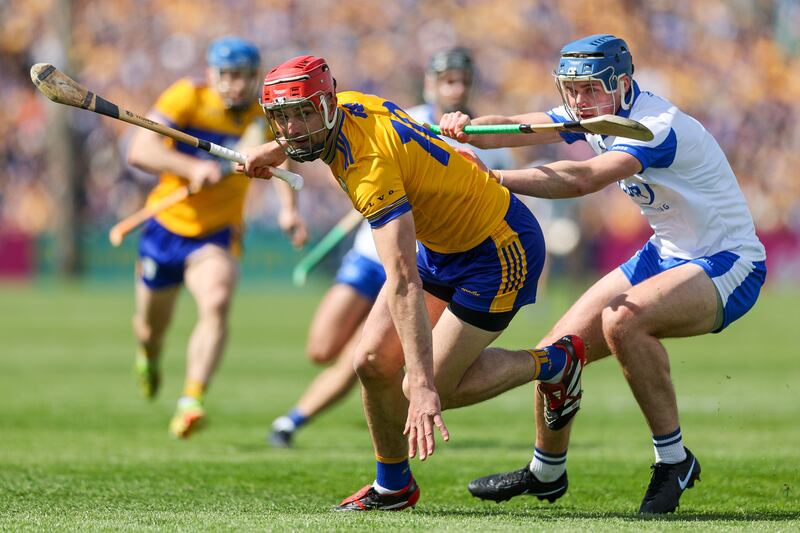
“You think you have him where you want him and, suddenly, he catches it in the right hand,” says Darragh Egan, the former Wexford manager and Tipperary selector when they won the 2019 All-Ireland. “It’s completely unorthodox. If I’m a right-handed defender, I’ll have him where I want him with my right hand across his body, stopping him getting his left hand up. Then, suddenly, he’ll swap his hurley into his left hand and catch with his right hand. He’s unreal at it. Timing is a huge thing with that. It’s not a simple skill.”
“He’s at that for a long time,” says Keary. “Sometimes I see other guys trying to do it and it unhinges them. He doesn’t do it for show or anything like that, he’d do that to ride the situation so that he’d get himself into a better position. When you’re coaching lads about winning the small battle first, I would say Peter finds that very comfortable now whereas six or seven years ago that wasn’t so much the case.”
For the big men inside, the stuff that happens before the ball arrives is critical. With O’Brien and Gillane Limerick have two players who can win a dropping ball over their heads, but that is not the game they play. Their preference is to deliver one-hop passes into space in front of their inside men. Before the ball arrives, the groundwork is done.
“It’s incredible the damage Gillane is doing to the full back before he sets off,” says Egan. “Soon enough, someone is going to watch five years of footage of him doing this. Like, the power, the lean-in. Basically, stepping into his man and pushing off his man’s chest. He’s fighting for every single yard. And then you’re wondering, when the ball goes in, how does he have so many yards of separation on his man?
“But that takes so much work. Limerick deserve some amount of credit because they must run it and run it and run it and that must be monotonous training. The ball that Gillane catches over his head is a shot that dropped short, or a shot that was half-blocked. It’s never a purposeful ball. But he can take it any way it comes.”
Historically, hurling was never as hung up on size as Gaelic football. Culturally, it was much slower to embrace strength and conditioning than its sibling in the GAA family. The intrinsic belief was that skill would trump everything.
Kilkenny at their peak under Brian Cody had the best hurlers and the biggest team and the deepest reserves of aggression, but that was a perfect storm. After they were removed from the throne in the middle of the last decade the accent on size took on other dimensions.
When Kilkenny won the All-Ireland in 2015, they fielded eight players in the final who were six foot or taller; two years later, when Galway won it, 13 of their starters in the final were over six foot; in 2018 Limerick had 11.
[ Munster hurling’s facility for laughing at logic is undefeatedOpens in new window ]
One of the things that set Limerick apart, though, was their athleticism. They had big players who could hurl and move. Gearóid Hegarty was a 6ft 5in, 15 stone wing forward who had all the touch and graces of an elite hurler, but the power and explosiveness of Caelan Doris.
All over the hurling map, teams were looking for big men who could move like Hegarty or Gillane or Séamus Flanagan. On the inside line, it changed the dynamic of the modern game. The teams that could find two accomplished big men and pair them off immediately had a competitive advantage.
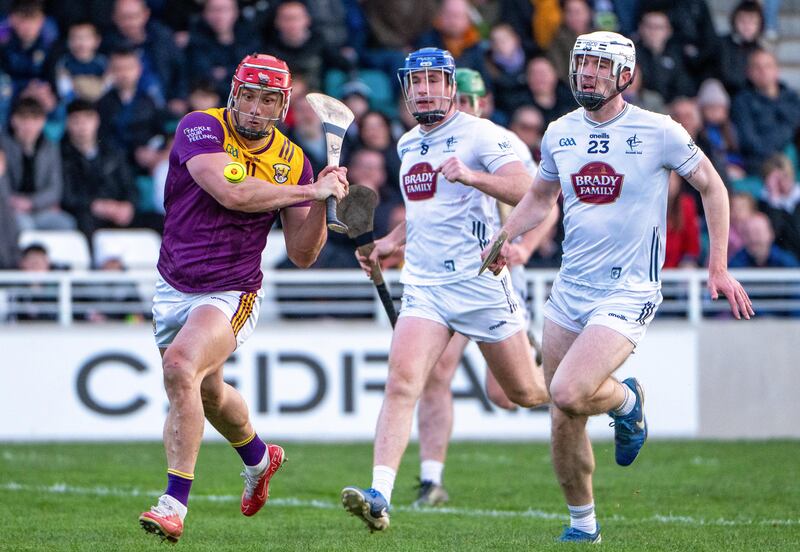
“In the two years that I was in Wexford,” says Egan, “the most change we ever got from our inside line was when we had Lee Chin and Conor McDonald inside together – the twin towers type scenario. In the All-Ireland quarter-final against Clare in 2022 Chin had damaged his hamstring in the first half, but we had Clare on the rack big time, and we just said, ‘This is old school now, just get it into him.’ The two of them were doing damage.

“The real big man around the square is definitely back, but it’s a different specimen.”
Jason Rabbitte is the next generation of the species. In his breakthrough season he has been the prototype of the modern target man: athletic, silky, independent. “He’s very eager to learn,” says Keary. “He’s receptive to learning, which is huge.”
In hurling now, everything is counted and evaluated. One of the key metrics is ball retention close to goal. Every team knows the established percentages: hit the ball in to your full forwards from the top of your own D and you’re only likely to retain three balls in 10; hit if from what’s called the platform zone between the 65s and the retention rate climbs to over 70 per cent. In their pomp, Limerick dominated this stat. One of their performance targets was to hit their inside line with at least 15 balls in each half. That fundamental principle hasn’t changed.
It will be fascinating to see how it plays out in Ennis. Last Sunday, Limerick ultimately couldn’t cope with Brian Hayes; this weekend Peter Duggan has the same capacity to blow them up. That’s the battle.