Cork’s control
Cork’s improvement is real, but it may not be the improvement they actually needed. In moving away from the direct, early delivery that exposed them in last year’s All-Ireland final, Cork have prioritised control and ball retention through their half-forward line. The adjustment brought structure, composure and scoring flow, but it also reduced their capacity to deliver a decisive blow. Below we see Cork’s passing sequence from the first half. Cork attacked repeatedly through Darragh Fitzgibbon, Barry Walsh and Shane Barrett down Tipp’s right flank.

The trio declined to let the ball in quick to Brian Hayes and William Buckley, with Hayes keeping depth on the pitch and Buckley sweeping across the line in support. Instead, they ran hard at the Tipp backs, drew them in and popped the ball into space for the runner.

On the surface, this was an impressive start to the Munster championship. Cork hit 0-29, worked 40 shots, and showed far greater control than in last July’s final. Their attacking play was measured, patient and efficient. But for all that, the game rarely felt as though it was tipping irreversibly in their favour.
The contrast with last year is instructive. Cork managed 35 shots in the All-Ireland final but struggled badly with ball retention inside. The response here was clear: reduce risk, avoid low-percentage delivery, and build through the middle third. That approach was evident throughout, with the half-forward line – Barrett, Fitzgibbon and Walsh – contributing 12 points from play. Below we see from the first half how Cork attacked repeatedly down the right side of Tipp’s defence.
READ MORE


Cork puckouts were on a different level throughout, retaining possession short; Hayes was used just once in the first half on their usual puckout down the 11 channel. Both midfielders O’Connell and O’Mahoney came deep to link play and build their attack.

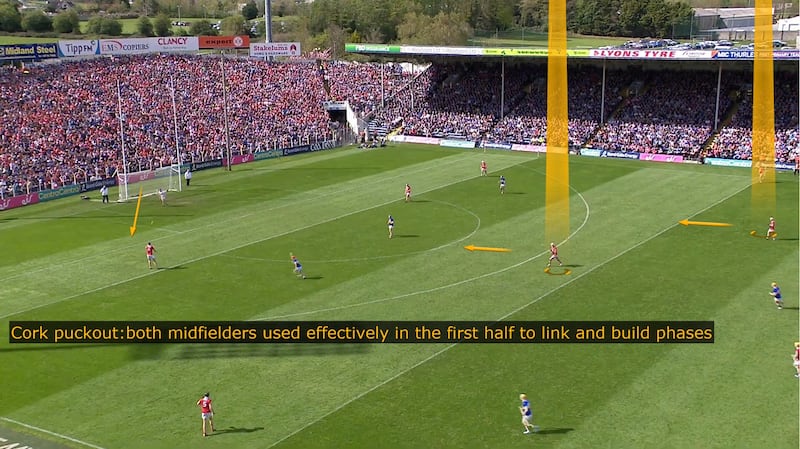
It gave Cork control. They recycled possession intelligently, found shooters in space, and kept the scoreboard moving. But it also shaped the nature of their attack. Cork’s penetration came not through sudden incision, but through accumulation – a steady chipping away rather than a decisive strike.
Second half
That became most apparent during their dominant second-half spell. Cork’s intensity in the tackle went up, their work-rate around the middle third improved, and they began to disrupt Tipperary’s puckout. From the 44th to 59th minute they outscored Tipp by 0-11 to 0-1. Tipp struggled to secure clean primary possession, and Cork built repeated phases off turnovers and breaking ball.
Tipp struggled with their puckouts in the second half with too many deliveries hit from deep, which gave Cork the platform to attack. Cork didn’t dominate Tipp’s puckout – they dominated what happened next. Cork’s set-up and press was relentless with their forwards hunting in packs.
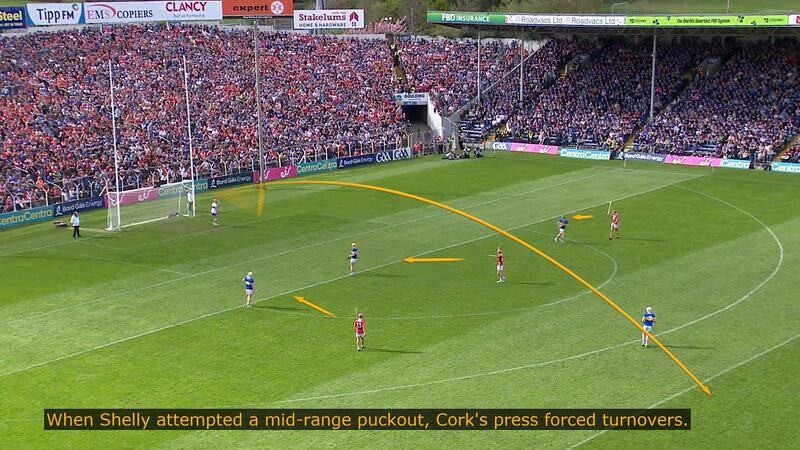
In the example above, Rhys Shelly finds a Tipp midfielder; however, Cork forwards have swarmed to create a turnover on the second press.

Tipp’s ball delivery from short puckouts was hit and hope, and the Downey brothers and Mark Coleman were immense throughout. Far too many deliveries were hit from inside their 45m line, leaving Tipp’s forwards have to compete on 50/50 ball. Without possession, Tipp struggled, and their entire full forward line was substituted before the end.

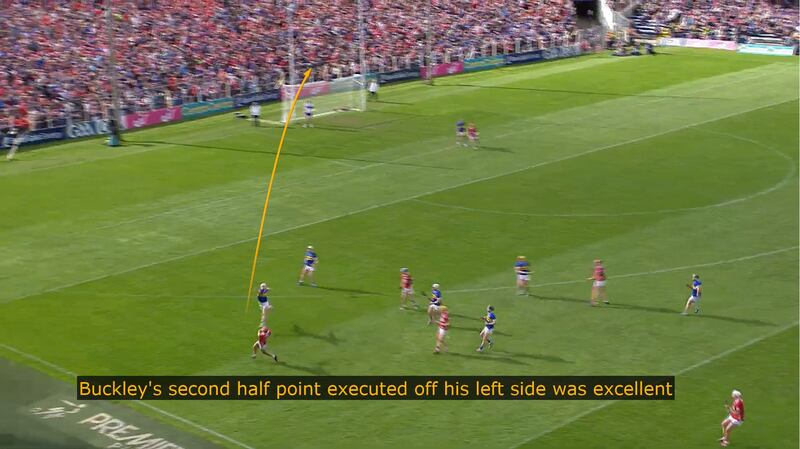
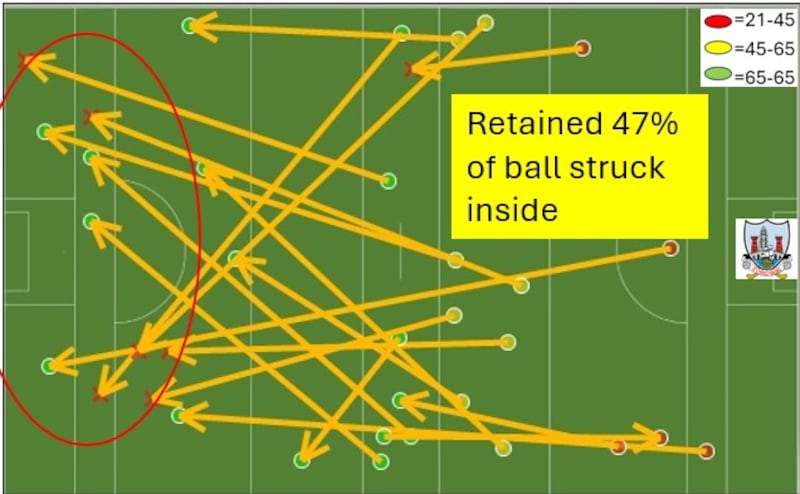
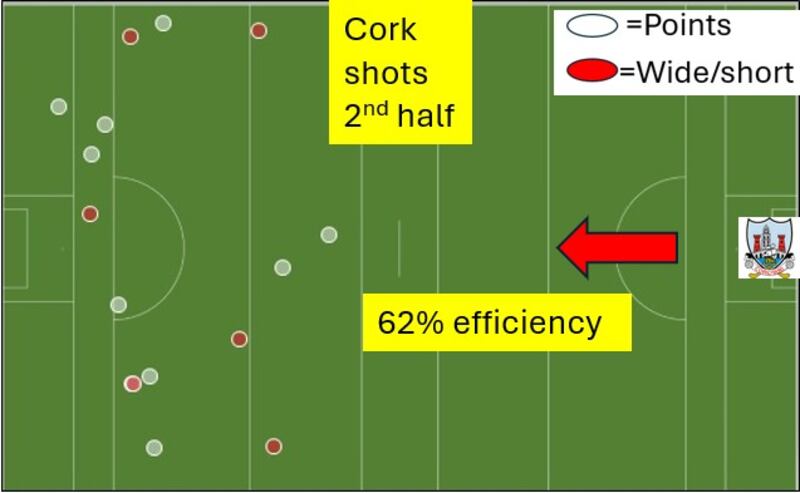
From the start of second half, Cork began to deliver more direct balls into the inside line, and William Buckley, finishing with 0-6, was central to that shift. His ability to score off both sides added a sharper edge and offered a glimpse of a more balanced attacking approach. Cork deliveries were higher up the pitch as we can see by yellow and green markers in the graph below.
But even in that dominant phase, Cork’s threat remained largely incremental. They worked on scores, applied pressure and maintained momentum – but without the single, high-impact moment that forces a defence to collapse.
What comes next
Forty shots reflect their attacking control, but not all chances to carry equal weight. Without sustained pressure on the full-back line or the creation of clear goal opportunities, Cork’s dominance never fully translated into separation on the scoreboard.
Tipperary, for their part, struggled in that second half – particularly on their own puckout – but remained in the game. And that is the key point. Cork had control, momentum and repeated attacking platforms, yet never created the kind of gap on the scoreboard that reflected that superiority.
The broader numbers underline the shift in Cork’s approach. Their shot count increased from 35 in last year’s final to 40 here, while Tipperary dropped from 47 shots in that decider to 30 in a more orthodox set-up. Cork improved their volume, but not necessarily their threat profile.
From a coaching perspective, the adjustment is understandable. Last year exposed vulnerabilities in the inside line, Cork exerted greater control with their short passing, support play and direct running; this game model reduces turnover risk and stabilises attacking play. But this felt like an overcorrection. In prioritising security, Cork limited their ability to fully exploit periods of dominance.
The balance is critical. Control gives you a foothold in games. Variation wins them. Against an opposition struggling for primary possession and under pressure in the tackle, there must be a willingness to go direct, to isolate defenders, and to create goal chances that change the game’s trajectory.
But this was clearly progress. Cork were more composed, more efficient, and tactically clearer than they were in the All-Ireland final. The next step is more complex. It is not just about control, but about knowing when to abandon it – when to inject risk, pace and directness into the game.
Because at this level, control alone is not enough. Cork dictated the terms for long stretches, but never quite delivered the decisive blow. They will need to find it at some point in this year’s Championship.