There is a certain generation of athlete who will remember when there was only one physiological metric worth measuring. This involved placing your index and middle fingers on your wrist, preferably first thing in the morning, then counting the beats of your own pulse for 30 seconds.
When finished, this number was multiplied by two, resulting in your more-or-less resting heart rate (RHR), measured in beats per minute (BPM). For the normal adult, the average RHR is 60-100 BPM, and for the elite athlete it can be 40-50. Sometimes even lower. At my absolute fittest, many moons ago, mine was clocked at about 33 BPM, and on that occasion my doctor pronounced me as almost clinically dead.
The trick was to ensure there were no great disturbances in your morning RHR, which might signal illness, burnout, a hangover or worse. Especially if running 100 miles a week. Most of the time it was a pretty reliable measure, provided you didn’t get too stressed about it.
Over time this evolved into measuring your maximum heart rate, which can be roughly calculated as 220 BPM minus your age. Another critical benchmark in avoiding complete breakdown. And these days heart rate variability is all the rage, those slight fluctuations in heartbeat that can also signal a pending crisis of some sort.
READ MORE


Maybe Rory McIlroy still puts two fingers on his pulse every morning, just in case. But like most elite athletes – and McIlroy unquestionably qualifies on that front – he has one of those fancy branded wearables on his right wrist telling him everything he wants to know about his heart rate, sleep patterns, stress, load, recovery and so on. It’s a sort of finger on the pulse every second, 24/7, all year round.
McIlroy often swears by this little device known as his Whoop, possibly helped by the fact he’s one of the main investors in the company now estimated to be worth €8.5 billion. Last month, he was among several global superstar athletes including Shane Lowry, Cristiano Ronaldo, LeBron James and Virgil van Dijk that raised $575 million (€500 million) in the latest round of Whoop funding.
According to his biographer, Alan Shipnuck, the value of McIlroy’s holding in Whoop is “close to $80 million”, which must feel like a lot of money to have wrapped around your wrist at any given time. Not that he would have found it harder to win back-to-back green jackets at The Masters last Sunday without it. Or would he?
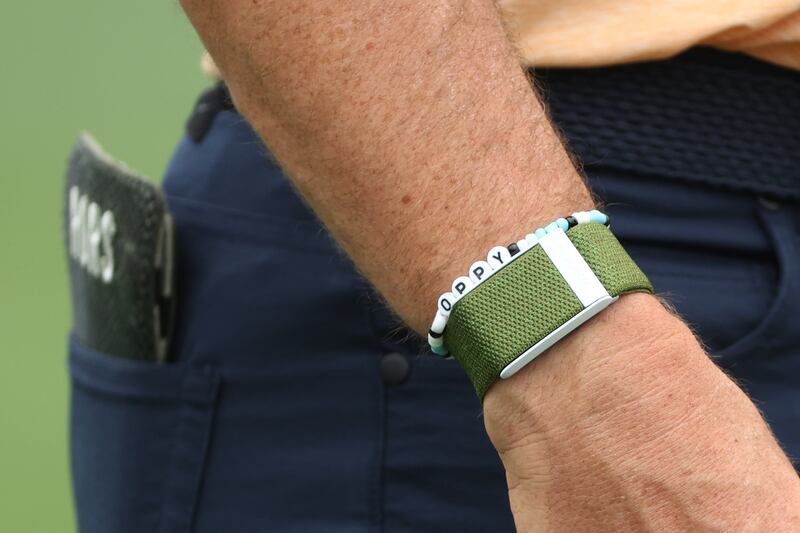
His Whoop measurements released on Monday did make for interesting reading. Especially around Sunday’s final hole. After his tee shot found the trees, McIlroy’s heartrate spiked to 135 BPM. He kept it to 121 BPM on the recovery shot, then somehow kept it at 105 BPM on his winning putt. Calmness personified.
His sleep patterns last weekend were impressive too, averaging 8½ hours a night, ensuring he was “94 per cent” recovered after Saturday’s wobble round. He also clocked up 24,000 steps on Sunday, which must have compared favourably against anyone wearing a Whoop device while watching from home.
Claiming 2.5 million users, with subscriptions ranging from €199 to €399 a year, Whoop is clearly a big business now, and for some people a small price to pay for the knowledge of a good night’s sleep. That is why so many other brands such as Apple Watch, Fitbit, Polar and Oura Ring are also cashing in. Even though a lot of this basic information is now available on your iPhone for free.
[ I played Augusta the day after the Masters. This is how it wentOpens in new window ]
Disclaimer alert: the people at Whoop did send me out a free sample device a while back. After a week or so, the frequently surprising spikes in my BPM, even after a short mountain run, plus the persistently less than 50 per cent recovery sleeps, reached the point of TMI (too much information).
Still, it’s getting harder to avoid these fancy wearables, with more and more elite athletes endorsing them. At last month’s World Indoor Championships in Poland, Cooper Lutkenhaus from the US became the youngest world champion in athletics, winning the 800m at the age of 17 years and 93 days, and strapped to his upper right arm was the Coros brand of heartrate monitor. Britain’s Josh Kerr won the 3,000m with a similar device strapped to his arm, his being the Amazfit Helio Strap, which also measures heartrate, sleep, recovery, etc.
Some sporting federations aren’t yet fans, tennis chief among them. Although earlier this week, Wimbledon and the French and US Opens announced that players would be allowed to wear their preferred data-tracking devices on a trial basis.

This follows incidents at the Australian Open in February, where Carlos Alcaraz, Jannik Sinner and Aryna Sabalenka, among others, were forced to remove wrist devices that the tournament had placed on its “banned list”. The worry was their Whoop might be receiving physiological metrics during the match, for better or for worse, which could give them an unfair advantage over their opponent.
Maybe there is a certain generation of athlete who will always be naturally sceptical of any such device that claims to offer so much from so little. Especially as Whoop expands its features to other specific areas including inflammation, nutrient deficiency and quality of sporting dreams (okay, that last one was made up).
There is for me also the reminder of what Sean Kelly experienced when he first started out in professional cycling, and was subjected to a maximum volume of oxygen test, known as the VO2 Max – high levels of which are still regarded as the premier indicator of aerobic endurance.
When Kelly scored one of the lowest of the pro riders, he responded by saying: “Yeah, but your device doesn’t measure suffering, does it?”