

Sophie Germain, born in Paris 250 years ago this month, spent long periods at home while growing up in the politically turbulent era of the French Revolution.
Studying in her father’s library, she was captivated by mathematics when she read of the life and death of Archimedes. Her parents were initially opposed to her interest, as mathematics was considered inappropriate for a woman, but they gradually mellowed as she persisted and her exceptional talent became evident.
Germain was just 18 when the École Polytechnique was founded in 1794. Women were not admitted but, using the name of a former student, Monsieur LeBlanc, she managed to obtain from the École the lecture notes of the great Joseph-Louis Lagrange.
She submitted original work under the former student’s name and, recognising its brilliance, Lagrange arranged to interview LeBlanc. Although surprised when Germain appeared, he was supportive and encouraged her further studies.
READ MORE


Subsequently, she corresponded with Carl Friedrich Gauss, one of the all-time greats in mathematical history, again using the pseudonym LeBlanc. When Gauss eventually discovered that his correspondent was Sophie Germain, he acknowledged the great obstacles that she had overcome and concluded that she had “quite extraordinary talent, and superior genius.” This was impressive, as Gauss was notably reluctant to praise younger mathematicians.
Germain tackled some of the most challenging mathematical problems of her time. One of her most important contributions was her work on Fermat’s Last Theorem, a problem proposed by Pierre de Fermat in the 17th century. Her results were the first major contribution to the problem in many years. A complete proof of the theorem arrived only in 1994.
Germain next turned her attention to the theory of vibrating elastic plates. In 1816 she was awarded for her paper on the theory of elasticity, the first woman ever to win a prize from the Paris Academy of Sciences.
Her work remains important for mechanical engineering, and was relevant in particular for the construction of the Eiffel Tower.
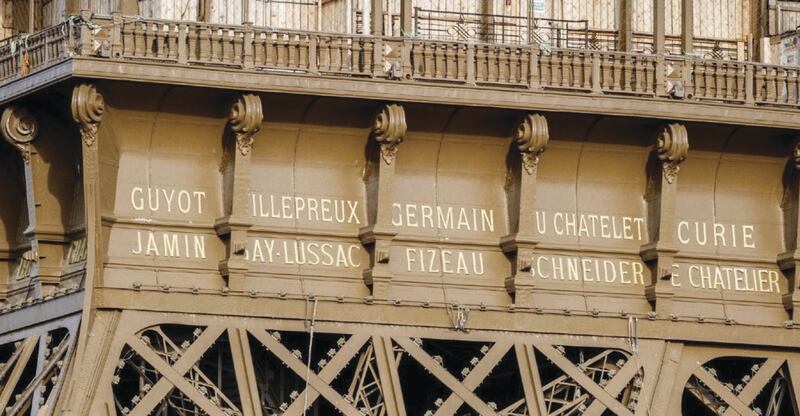
When the Eiffel Tower was built in 1889, Gustave Eiffel added the names of 72 scientists who had contributed to the advancement of science since the French Revolution.
Although Germain’s elasticity theory was germane to the calculations used in the construction of the tower, her name was not included in the original list, which honoured 72 men.
The Hypatia Project of the Sorbonne University has proposed that the names of 72 women who have contributed to French science should be added to the tower. Several major research institutes have suggested names, which are to be engraved on the same panels as the original 72 men’s names.
At a time when women were excluded from scientific institutions, Germain pursued knowledge through self-education and correspondence with leading mathematicians.
She had abundant ability, but she never reached her full potential, due to her haphazard education. Had she had access to the rigorous mathematical training available to men, she would undoubtedly have had a more stellar career.
Today the name of Sophie Germain appears in several mathematical contexts: a class of prime numbers, her result concerning Fermat’s Last Theorem and her contributions to elasticity theory.
Her name, which is already attached to a crater on the moon, will come down to Earth when it appears soon on the Eiffel Tower.
Peter Lynch is emeritus professor at the school of mathematics and statistics at University College Dublin. He blogs at thatsmaths.com


