Efforts to attract foreign direct investment (FDI) and planning and investment in big infrastructure projects should be carried out by a new cross-Border body, the SDLP has argued in a new report.
Too often the debate is dominated by claims that unity would automatically deliver an economic dividend, or that Northern Ireland is “inherently unaffordable”, the party’s Success by Design document said.
The economic gap that has grown between the Republic and Northern Ireland in the 30 years since the Belfast Agreement demonstrates that no outcome is inevitable, and that progress depends on the right choices being made, it said.
Besides all-island FDI and infrastructure co-operation, the SDLP argued that workers should be able to work anywhere on the island without tax, pension, or welfare complications.
READ MORE


Qualifications and skills should be mutually recognised on both sides of the Border, while much greater efforts must be made to encourage more Northern third-level students to go to universities in the Republic.
Rail services across the island should be integrated and substantially developed, while investment should be targeted to develop cross-Border “city regions” and “growth corridors”, such as Derry/Letterkenny and the Dublin-Belfast economic corridor.
Calling for planning for “a new Ireland”, SDLP leader Claire Hanna said many of the recommendations should be carried out regardless of the constitutional question, since they make sense whether unity happens or not.
However, the party believed that unity planning was essential to ensure that preparations for future governance, the running of the economy and health and welfare systems are properly made.
The Brexit referendum “absolutely” showed how constitutional change should not be handled: “That was constitutional change by slogan. A big idea was thrown out with no planning, no sense of responsibility and vision.
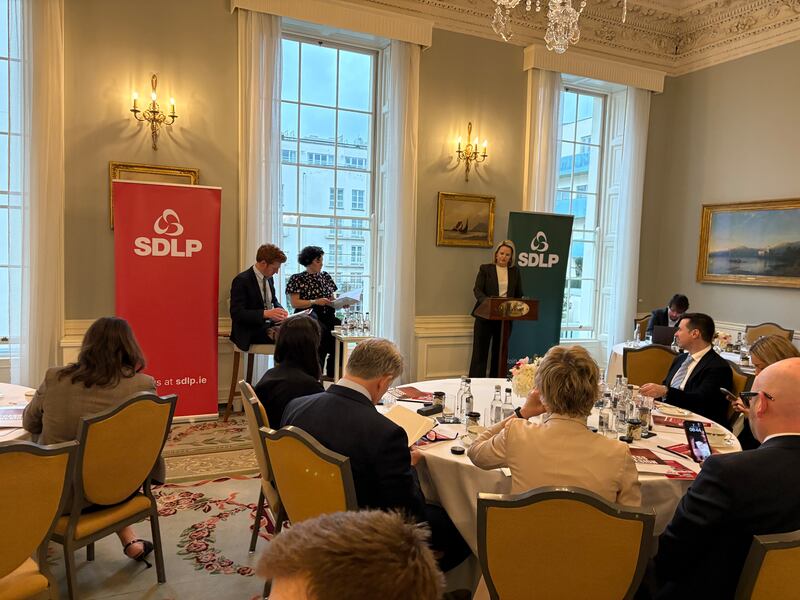
“We want the opposite to happen. Our tagline is build something new. We want to do that by planning and by preparation,” Hanna told a gathering of party supporters and others in Dublin on Thursday.
“The ramifications of the Brexit vote – structural and psychological – are still shaping politics in Britain in particular. Right-wing English nationalism is shaping the political culture. Even the parties that don’t lean into it are adjusting around that.
“That is one of the key reasons why we think we do need to be ready for change. Change isn’t the risk, change is coming to us whatever we decide to do. It’s unprepared change that is the risk.”
Accompanied by the SDLP’s leader of the Opposition in Stormont, MLA Matthew O’Toole, and MLA Sinead McLaughlin, Hanna said: “We really need to plan and prepare for change that’s coming, even if we decide to just be passengers in the future.”
Many from a Unionist background are more prepared to have broad-ranging discussions about future possibilities than is often recognised, she said, as long as such conversation is respectful.
“Without trying to be negative about it, people are clear that the status quo isn’t working. People are finding the politics of Stormont quite suffocating, that there is a lack of delivery from the institutions that were designed to change their lives.”
The headline claim that Unionists are not engaging with the unity debate is simply not true, she said.
“We don’t find that. We are taking this away from being a tribal conversation. We really do think there’s an appetite. People want to see some hope. They are looking down south, and they are seeing an economy that, while far from perfect, has progressed.”