

Twenty years ago, at the height of his fame, Eddie Hobbs could barely walk down the street in Ireland.
In a 2022 podcast, the financial adviser recalled how people would pull up beside him at red lights and ask, jokingly, “fixed or tracker?”.
“People wouldn’t even say hello. They’d just launch into whatever question they had.”
It was hard to avoid Hobbs in the mid-to-late 2000s. He had just finished Rip-off Republic – a four-part RTÉ show skewering the high cost of living in Ireland – which broke viewership records and set news agendas. He was rarely off the radio and published his own magazine, You & Your Money, featuring on the cover most weeks.
READ MORE


He published books, wrote financial advice columns for several newspapers and was the subject of a song by Dustin the Turkey.
His criticism of government financial policy earned him the ire of taoiseach Bertie Ahern, who accused him of not being factual, while opposition TDs praised his “brilliant forensic analysis”.
All of this is a distant memory. Today, Hobbs is rarely seen in the mainstream media or mentioned in the Dáil. His books do not trouble the bestseller lists and his magazine is long out of print.
However, the Corkman is as active as always, just in a different sphere. He regularly features on podcasts, including his own show Counterpoint, and frequently speaks at public events.
He also continues to bring out books, although with smaller publishers. His latest release is published by 104 Publishing which, on its website, tells prospective authors they must pay for a €300 course before they will be considered as a client.
Financial advice of the type that made him famous rarely features in Hobbs’s output these days. Instead, he promotes a range of right-wing conspiracy theories regarding world banking, climate change and, in particular, Covid-19.
This pivot has generated a smaller, but loyal following for Hobbs in Ireland. It has also dramatically increased his profile overseas.
He regularly appears on popular conspiracy theory-focused podcasts with large international audiences. He talks about a globalist takeover of Ireland and vents his spleen over a media system he says is entirely beholden to Government.
High-profile appearances included repeat guest spots last year on War Room, the show hosted by former White House strategist Steve Bannon which regularly features near the top of US podcasts charts.
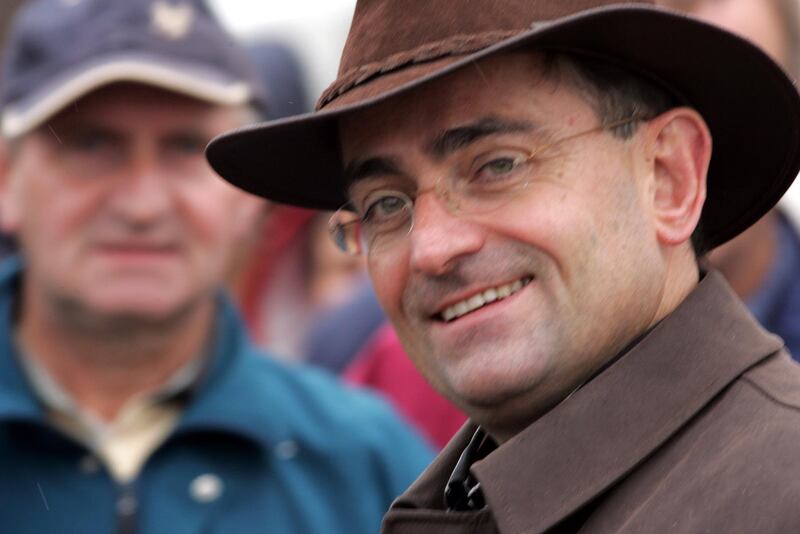
“The mainstream media is the North Korea of Europe,” Hobbs told Bannon when he appeared on his show last June and was asked to explain why there is no major populist right-wing movement in Ireland.
Barely pausing for breath, he then listed off a list of grievances about the Lisbon Treaty, the financial crash and immigration, including many dubious or contested claims, while also accusing the Irish Government of “high treason”.
Over the course of six minutes, before Bannon interrupted to go to commercial, Hobbs complained about gender ideology, hate speech laws and what he claimed was a move by the World Health Organisation (WHO) to take over the entirety of Ireland’s health policy.
What led Hobbs down the road from celebrity financial guru to conspiracy theorist? This week he declined to sit down for an interview, instead pointing towards his recent writings and podcasts on the issue.
“I don’t need to give The Irish Times an interview, for me it is not important,” he said by email.
Hobbs is no stranger to controversy and criticism, including during his time as a celebrity financial adviser. Though his financial predictions were often accurate, they could also be badly wrong.
On one of his RTÉ shows, two years before the 2008 financial crisis, he advised people to buy as much property as possible. In 2012, in a piece in the Wall Street Journal, he predicted there would be no “Celtic comeback” for the Irish economy shortly before the country experienced just that.
In 2006, he helped convince 1,200 Irish investors to buy holiday apartments on the island of Cape Verde off West Africa through a development which later became mired in legal issues.
It was Hobbs’s role in another investment company, Brendan Investments, which likely caused the most damage to his reputation. Starting in 2006, he cofounded and heavily promoted the company’s fund, convincing many ordinary investors to put money into speculative property investments.
After raising €13 million, the fund invested in the abandoned-homes market in Detroit despite warnings about the risk of such a move. Almost all of the money was lost, including €600,000 invested by Hobbs.
In 2015, he quit as director of the company at the same time he cofounded a new political party, Renua. He said he did this to avoid the company becoming a target for rival politicians and the press.
Hobbs’s involvement with Renua gives an early insight into political views which were markedly different from the ones he espouses today.

At the time, the party billed itself as a right-of-centre, common-sense party in the mould of the defunct Progressive Democrats.
Hobbs served as Renua president, although after much vacillation, declined to run for the Dáil. During that time, he tried to steer the party “from social conservatism to a liberal democrat ethos”, he recalled in a 2022 podcast interview with the comedian Mario Rosenstock.
Renua, he said, was founded by “social conservatives of the hard type”, who only cared about abortion.
He attributed the party’s demise to this cohort. After failing to return a single TD, Hobbs quit in June 2016 and Renua faded into obscurity.
Whether it was due to the controversy surrounding Brendan Investments or his failed political career, by the late 2010s, Hobbs was becoming less of a feature in the media, although he still gave interviews every now and then and wrote the occasional advice column.
Then, Covid-19 came. Hobbs began to express conspiratorial views regarding the virus, lockdowns and vaccinations. In 2021, he suggested on social media that Star of David badges – used to label Jewish people in Nazi Germany – be used to “identify the unvaccinated among us”.
The tweet drew widespread criticism, including from the Auschwitz Memorial Museum. Hobbs deleted his tweet but brushed off calls to apologise and said he was being sarcastic to make a point.
“God help anyone who tries to cancel me. I can’t be cancelled,” he remarked to Rosenstock the following year. “I put the run on them and within 24 hours they’re off running at some other target.”
Hobbs’s adoption of Covid-19 related conspiracy theories was a gradual one. In that same 2022 interview, after being highly critical of lockdowns, the WHO and antigen testing, he concluded by saying he does not believe there is any “global conspiracy” regarding the pandemic.
By 2025, his views had evolved. “We went through a massive psychological event globally that was premeditated and organised by the security state and all of those countries and it was clearly co-ordinated,” he said during a video interview with the Roscommon People, amid diatribes about the Rothschilds, the Bilderberg Group and the Soros Foundation.
It is very challenging to accept that you’ve been duped; I get that fully because I fought against it for nearly four years
— Eddie Hobbs
Hobbs’s 2024 book, Breaking the Silence, provides some insight into this journey.
“Each evening in the spring of 2020, along with millions of fellow Irish citizens, I too sat down to listen to reports from breathless RTÉ journalists emerging from the latest Covid updates,” he wrote.
“Sleep wasn’t coming easy, but I couldn’t explain why. I now know that I had free-floating anxiety, a general sense of unease without any identifiable targets. Eventually, I stopped engaging with mainstream media altogether. That helped considerably.”
Hobbs said he redirected his energy into running his firm and writing his self-published novel, a work of historical fiction in the style of Dan Brown, about a secret which could “destroy the foundation of the Roman Church and the secular power structures of Europe”.
“It is very challenging to accept that you’ve been duped; I get that fully because I fought against it for nearly four years. I contested what my research, discussions and experiences laid out as the truth insofar as I could discern it, the truth of the big lie.”
These days, Hobbs’s main activity is presenting his Counterpoint podcast, during which he interviews various figures, some from Ireland’s populist milieu including Dublin city councillor Malachy Steenson, activist and conspiracy theorist Ben Gilroy and Cork anti-immigration campaigner Derek Blighe.
Other guests include Independent Ireland TD Ken O’Flynn and former Master of the High Court Edmund Honohan.
Last October, activist Keith O’Brien, who goes by the name Keith Woods, appeared on the show where his work was effusively praised by Hobbs. O’Brien is a frequent collaborator with US neo-Nazis and previously described himself as a “raging anti-Semite” (he later claimed he was joking).
Hobbs’s most recent guest on the podcast was former Irish Times columnist Kevin Myers. They spoke about “cancel culture, media bias and free speech.”
During one of his interviews with Hobbs last year, Steve Bannon outlined his plans to start an Irish version of his War Room podcast. Last week, in an interview with Politico, Bannon said he is “spending a tonne of time behind the scenes on the Irish situation to help form an Irish national party.
“They’re going to have an Irish Maga, and we’re going to have an Irish Trump. That’s all going to come together, no doubt. That country is right on the edge thanks to mass migration.”
Could Hobbs be Bannon’s “Irish Trump”? The “nascent” political right is still “atomised”, Hobbs said via email, and he has little interest in being its leader.
“I’ve zero intention to get involved in Irish politics right or left, sticking to the media side only and have made that public many times.”


