If there’s one way to draw attention to something, it’s by going to the High Court to ban publication of it. Which brings us to another episode of “is this a new accountability low?”, in which the Government has decided to block the publication of a report relating to how it spends its taxpayers’ money.
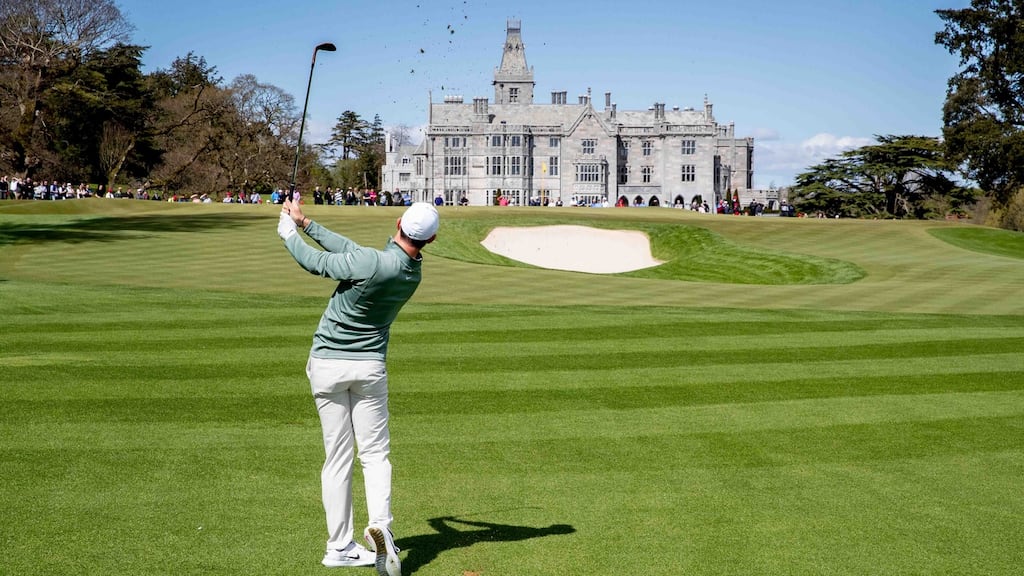
You read that correctly: the Department of Sport is attempting to block the release into the public domain of an EY report entitled 2027 Ryder Cup Economic Impact Study – Final Report for Fáilte Ireland and the Department. This report investigates the economic impact of hosting the 2027 Ryder Cup at Adare Manor.
This seems like an awful lot of trouble for the Government to go to – unless, of course, the numbers were likely to prove deeply embarrassing.
While it’s not clear that we ever will see this report, there is enough information in the public domain to put together some informed, back-of-the-envelope calculations that can help us to imagine what may be contained within it – and what this means for how we should view the Government’s fiscal competence.
READ MORE


What has the State said it will spend?
Let’s start with what we know the State to be spending.
In 2019, it approved €31 million for the European Tour in relation to the Ryder Cup hosting, which was broken down into a €22.5 million hosting licence fee and €8.5 million of tour support. However, by 2023, The Irish Times reported that the figure had risen to a much higher taxpayer expense of €58 million, with a further request – understood to be up to an extra €30 million – that was expected for infrastructure and hospitality needs in Adare, two years later.
We can exclude the additional €150 million of transport that will need to be completed in time for the event since it was already commissioned and includes necessary public spending; even though – as I have already pointed out here – the temporary train to the golf tour is itself a joke, one taxpayers are on the wrong side of.
Conversely, we have what Ireland gets back for this money: the Government predicts returns of up to €160 million, which some view as conservative. Organisers claim 60,000 visitors from overseas, spending on average €600 per day during a four-day trip, rising to €1,000 for US visitors.
How much will the taxpayer really get back?
The problem with this “gross visitor-spend projection” methodology, which is the same one that was used for the 2006 Ryder Cup at the K-Club, is that the headline amount is rarely realised. Victor Matheson, an economist at the College of the Holy Cross, who has spent his career testing these claims against their outcomes, has found that the hosts of such events typically only ever come to receive about a quarter of the returns that were predicted.
Why? For boring reasons, such as mid-September is still “high season”, meaning that the “new tourists” are actually just displacing tourists who would already be in Ireland, staying in the same hotels and eating in the restaurants at tables that would otherwise be occupied by other visitors.
In fact, an in-depth study of a similar event – the 2014 Gleneagles Ryder Cup – by Sheffield Hallam University, found that only a fraction of the returns came to fruition, at £24.6 million of direct new spending, with up to £16.6 million in indirect spending, for the Scottish economy compared with the £100 million predicted.
So applying a standard “shrinkage” to the Adare event, and the €160 million could drop to anywhere between €39 million and €66 million of new spending.
So how much of that money will flow directly back to the State in VAT returns? Around €8 million to €13 million. But remember – this is against at least €58 million of committed spending plus up to €30 million of expected further spending.
On these reported figures alone, my basic calculations suggest the State could lose between 85 cent and 91 cent per euro, based on the VAT returns to the exchequer.
Of course, direct tax is not the only way the State can make a return on its investment. But it’s hard to measure the longer term benefit of the publicity for Ireland – and no best-case scenario of these calculations comes close to returning taxpayer money.
If we add in additional costs of the Limerick park-and-ride sites, traffic planning and licensing, and the entire web of spending that is pushed diffusely into numerous parts of the State that may never appear in a report, the numbers look considerably worse.
So what does this mean? Well, under Ireland’s own policy, significant projects are meant to show benefits at least matching costs; good public expenditure often sees €1.50-€2 overall return for every euro spent. Ireland’s model fails even this modest standard.
Have other countries had a similar experience?
If it’s any consolation, we are in “good” company with our spending, just not of the fiscally responsible variety. Delhi’s 2010 Commonwealth Games were so financially overrun that its government inquiry led to corruption prosecutions – not that anyone is suggesting anything like that here.
South Africa similarly overspent on its World Cup stadiums; Brazil’s 2014 World Cup built a nearly-one billion euro arena that functioned as a bus depot; and Sri Lanka created the Mahinda Rajapaksa stadium for international cricket that had to host weddings to generate revenue.
At least those countries had a stadium to show for their capital expense – we will have nothing very much to show for ours. For the sake of the national mood, perhaps we should wish the department well in the High Court.


