

When Roger Bannister broke the four-minute mile on May 6th 1954, he packed up his running kit and quietly returned to his medical studies.
When Sabastian Sawe ran the first ever sub-two-hour marathon on April 26th last, he posed for photographs with the €500 Adizero Adios Pro Evo 3 trainers which he is contracted to wear, thus boosting Adidas’s share price overnight as it targets the growing “super shoe” market.
For those unaware, the “super shoe” contains a curved carbon-fibre plate embedded in extra-bouncy foam. Together with its featherweight design, it has been shown to shave average running times by 1-4 per cent.
It is the latest example of “technology doping” in sport – so called because technological gains can permanently alter the nature of competition. Once a device for performance enhancement is created, all athletes are pressurised to adopt it. And it’s not just professionals bouncing on the bandwagon. The super shoe has become a more frequent sight at mini-marathons and fun runs, thanks in part to aggressive marketing.
READ MORE


In the UK, Nike has been targeting Parkrun events with billboard ads telling participants: “You didn’t come all this way for a walk in the park.” Well, actually, the whole point of Parkrun is inclusivity, the voluntary organisation politely told the US sports giant – walkers are very welcome on Saturday mornings (as I can testify myself, having got the odd stitch on the Marlay Park 5km).

The morality of the super shoe comes into sharper focus against the backdrop of the Enhanced Games, which take place from May 21st to 24th in Las Vegas. Competitors in swimming, athletics, weightlifting and other events will be allowed to use substances that are banned in the Olympics, and to access prohibited technologies such as full-body polyurethane “supersuits” which decrease drag for swimmers. It’s not a total free-for-all – “hard drugs” such as cocaine and heroin are prohibited, and athletes will be medically supervised, organisers say.
While the Enhanced Games have been widely condemned by sports governing bodies, it is not entirely clear what moral principle is being breached by the commercial enterprise. After all, those entering the games are consenting adults and, like Graeme McDowell when he joined LIV Golf, they may be thinking, “this is good for my bank account”.
‘Given the ubiquity of a “win at all costs” mentality, the Enhanced Games could be seen as part of a continuum in sport, rather than a break from it entirely’
Professional sport has long ago blurred the line between what’s natural and what’s artificial. And if technological doping is okay, then why isn’t actual doping okay? Drugs are bad for one’s health, you might say. But so are inherent features of modern sport, from concussions and serious injuries to results-oriented diets that put severe strain on the body.
Given the ubiquity of a “win at all costs” mentality, the Enhanced Games could be seen as part of a continuum in sport, rather than a break from it entirely.
For Bannister, the slide towards “anything goes” in athletics coincided with a rise of moral relativism. Writing on the subject of sporting ethics 40 years before his death in 2018, he said: “It is an increasingly popular notion among many young people that we can throw off ethical and moral principles in more and more spheres of life.” However, “the fact of the matter [is] that we are all faced with moral choices many times a day, and if we do not notice them it must be that our intelligence or sensitivity is becoming blunted”.
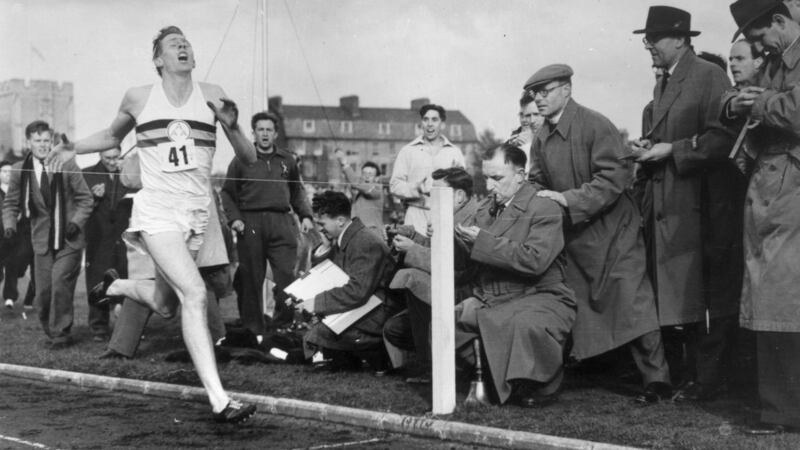
Bannister grew up in a society of clear moral codes, where people were called out for being “un-Christian” or “ungentlemanly”. In this more secular age, we lack a shared language to adjudicate effectively on ethical affairs. Not just that, but were you to mount an argument today against the super shoe, for example, or the Enhanced Games, you would find yourself exposed to the charge of paternalism. “Who are you to tell people what they can, or cannot, do?” is the standard relativist reply.
‘What of the super shoe? Okay, it’s not the worst blight on civilisation. But it is a step – or rather a bounce – further away from what’s best about sport’
Yet we should not be silent. It is important to defend moral truth, and resources can be found in philosophy. Socrates says the worst harm caused by vice is internal. Being greedy or vain is demeaning – it damages your soul. And if you don’t believe Socrates, listen to McDowell as he now laments taking the Saudi shilling.
Here is the strongest argument against the Enhanced Games. They are degrading, if not dehumanising, for participants.
It is no coincidence that the era of the Enhanced Games is also the era of OnlyFans, a platform where people can make money by using themselves for pornography. Athletes in the Enhanced Games are transformed into vessels for the pharmaceutical industry. In a similar monetisation exercise, the bodies of OnlyFans “stars” are reduced to pure instruments.
But what of the super shoe? Okay, it’s not the worst blight on civilisation. But it is a step – or rather a bounce – further away from what’s best about sport. This – I humbly submit – is not winning, but the actual play.
I’m not advocating the “shoe-shaming” of joggers togged out in €300 Nike Alphafly 3s, but let’s applaud those Parkrun flâneurs in tatty, 10-year-old trainers. And imagine if you were one of the latter and you happened to overtake one of the former on your next jaunt around the park. How glorious that would be.
- A symposium on “Philosophy with children in Ireland” is being held at University College Dublin on Tuesday, May 12th for teachers and others interested in promoting philosophy in schools. For details or registration contact aine.mahon@ucd.ie