

People often begin the year slightly sluggishly, with a thought about what would make their lives better. As we concoct aspirational to-do lists, attempt to shake the cobwebs off and creak into 2026, there should also be a collective aspiration: what would make all of our lives better?
One answer may seem a little frivolous, but it’s ultimately very important. We all need a vibrant and healthy social life that generates connection and expresses the kind of fun and pleasure that gives meaning to life. This is not just a personal goal, it’s an infrastructural issue, because a lot of it is about physical space.
Between 2005 and 2024, over 2,100 pubs closed around Ireland. The highest decrease has been in rural counties. For example, Longford, Laois and Westmeath have seen a 30 per cent decrease, whereas in Dublin, the drop is only 1.7 per cent. It’s not just about pubs, of course. The Irish amenities crisis is urban and rural. The pickings are still slim. We need far more dancefloors, theatres and gimmick-free cultural spaces that foster community and are artist-led.
In Leitrim, something very interesting is brewing. Towards the end of last year, dance artist Edwina Guckian brought a show on the road. The Devil’s in the Dancehall, an immersive night out that fuses dance with theatre and music, lit up dancehalls around Ireland. As the tour concluded, Guckian announced a plan: to rebuild Gralton’s Hall in Effrinagh.
READ MORE


The story of Gralton’s Hall – or Jimmy’s Hall, as the title of Ken Loach’s 2014 film goes – is well known. Built in 1921, it was a place of great reverie, dance, debate, and music. It also became a target of the Catholic Church as a “den of iniquity”. .
On Christmas Eve, 1932, the hall was burned down in an arson attack. The following year, the De Valera government ordered Jimmy Gralton to be deported as an “undesirable alien”.
In 2016, then-president Michael D Higgins unveiled a monument to Gralton. Describing him as an emancipatory figure, Higgins said he was “for authoritarian political purposes, mixed with clerical pressure, illegally deported from his own country for his political beliefs”. He added: “Ken Loach’s film has shown how, through his dancehall, Jimmy Gralton created a place where his community could escape from the restrictions of a repressive social and cultural order that insisted on a narrow idealisation of our native culture.”
Guckian lives over the road from Effrinagh. Her grandparents grew up on either side of the hall and were teenagers when it was in full flight. She told me: “I heard stories over the years from my grandparents, but not a huge amount, just whispers I suppose.” It was when she read her grandmother’s copy of the book My Cousin Jimmy, by Margaret Gralton, that she learned more.
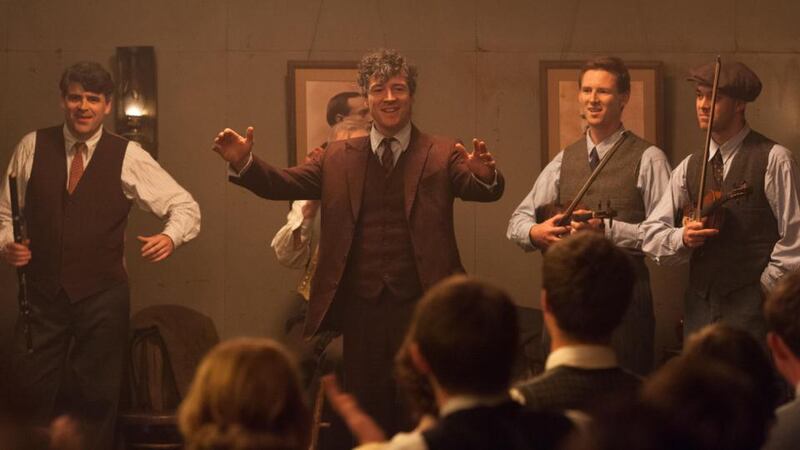
Thirteen years ago, one of the greatest filmmakers of our time, Loach, came to Leitrim to make his film. Guckian brought him and his collaborator, the screenwriter Paul Laverty, to meet her grandfather. “I told them that he had really great stories about the hall. But he told them very little. I was sitting there going, ‘What is wrong with you! Would you ever tell them the stories!’ I’d try to start one of the stories and then he’d say ‘I don’t remember that now’. I took in at him when they left, but he said, ‘Edwina, I don’t know if I’ll meet Fr Cosgrove again one day.’ It was mad to see that grip was still there.” Fr Cosgrove was the parish priest when the dancehall was in full swing.
Guckian worked as a choreographer on the film. During the shoot, the hall used – and burned – for the film, built in north Leitrim close to Sligo, took on its own life. What happened there was, she says, like “what would have happened in Gralton’s time. It was really special.“
Being in Loach’s orbit and witnessing his process inspired Guckian to leave her job as a primary schoolteacher and become a full-time artist. She resurrected the local crossroads dance, which takes place on June 23rd – bonfire night – every year.
Now Guckian and a group of eight others are determined to bring Gralton’s Hall back to Effrinagh. They have met Leitrim County Council, which said it will support the idea. They have bought the site from the Gralton family. An architect has begun design work. On June 23rd, the first sod will be turned. What they need is money, around €350,000. “I’m living in hope we might have some Leitrim people abroad to help us,” Guckian says, “It’s for our county. It’ll be a momentous thing for future generations, for solidarity, for bringing people together.”
When the hall was burned down all those years ago, Guckian says, “a space was taken from the community”. She continues: “Spaces are really important. Space is precious when an artist gets it and that’s the same for a community. It’s like the rural pub closing down. Those rural spaces going have really made an impact on connection in the community and on social health.”
The more spaces people have to gather, to socialise, express themselves, to shake off the stresses of the day, the healthier we are as a society.
Bringing back Gralton’s Hall is a great collective new year’s resolution. Guckian is a real doer. And she is determined. “That hall is going to stand, and that’s it.”
A crowdfunding campaign and more details about the project are on graltonshall.com.


