
For all the chatter about new Chinese brands, it’s Skoda’s consistent performance that catches the eye in the new-car market, particularly among established brands.
Thanks to some savvy marketing, Skoda now seems as much a part of Irish life as the spice bag and The 2 Johnnies. The last car brand to get so closely entwined with Irish society was Toyota.
Its mass-market image chimes with so many Irish motorists, and it’s appropriate it chose to mark its 130th anniversary with a special edition of the humble Fabia rather than some overdressed Octavia or Superb.
Skoda is the Clarks shoes of motoring. Yet it would have every right to reach for luxury when it comes to its heritage.
READ MORE


Some still mistakenly see Skoda as some cold war cast-off, a communist-era carmaker creating Czechoslovakia’s answer to the Trabant. In fact, Skoda’s history is rich with luxury roots. Initially as Laurin & Klement, it built limousines and touring cars for central Europe’s well-heeled industrialists and officials. When it merged with heavy engineering giant Skoda in 1925, it continued to be closer to Mercedes-Benz than Fiat or Ford. Then the Iron Curtain went up. The post-cold war reinvention of Skoda began with a joint-venture deal in March 1991, delivering a brand that blossomed from bargain buy to family favourite.
So does it shout anniversary special? Not remotely. This is celebration done the central European way – quietly and without fuss.
The signature touches to the exterior of the Fabia 130 would take an expert eye to spot, and even then they’d struggle, as most of its extras come from the current range-topping Monte Carlo version. It’s the same inside, where the major theme is hard, black plastic with only the lightest dapple of colour. Up against the bling of Asian rivals, this is central European Calvinism epitomised in car design.
The standout feature for the 130 is under the bonnet. This Fabia gets the VW Group’s 1.5-litre four-cylinder TSI – the same engine used in the Golf – replacing the usual 1.0-litre three-cylinder of the standard car. It is paired with a seven-speed dual-clutch transmission and delivers 175hp, up 60hp on the regular car. Not a massive leap, but enough to make a difference.
Yet the 130 doesn’t roar or bite. Some might have expected a hot hatch – a vRS Fabia in everything but name – but it’s really just a warmed-up supermini. It can’t match the madcap antics of Ford Fiesta STs, Peugeot 208 GTis or even the latest electric hot superminis, such as the Alpine A290 GTS.
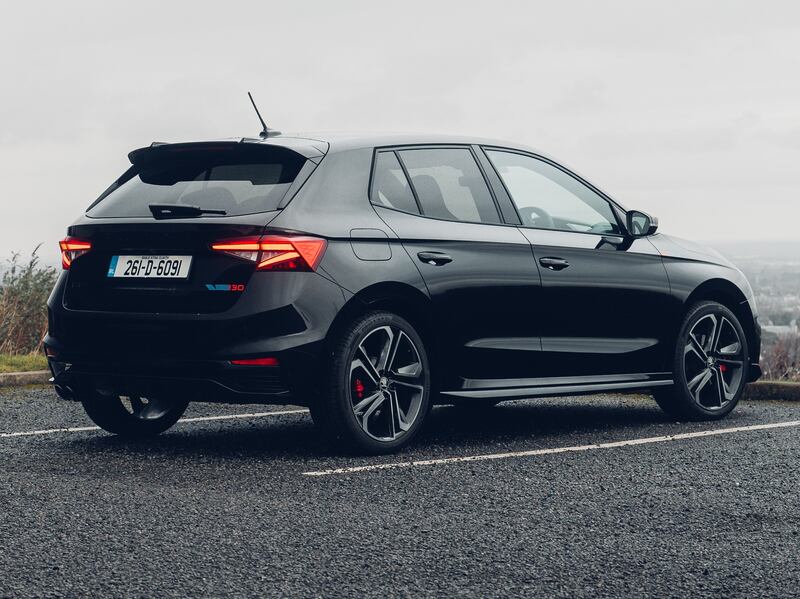

Perhaps there is one other telltale signal that this is not the usual Fabia you see outside Sunday mass. Pit it against any church lane speed bump and you’ll quickly find out.
The lower suspension, which delivers its sharper handling over a regular Fabia, means a firmer ride.
In a country where road furniture appears with little warning, this Fabia tends to bottom out early with a thud on speed bumps and potholes. Perhaps it was more noticeable to us as we’ve become so used to the ultra-cushioned suspension on EVs that we’ve forgotten what the road really feels like.
The extra power is certainly noticeable over the average Fabia, but it’s still a really easy car to drive, particularly at motorway speeds. It can be meek and mild in the city and suburbs, then dials up a level of warm-hatch engagement upon request. You could lend this car to a learner driver and they would get on just fine. Even an ardent Luddite could navigate through the touchscreen menus and figure out the essentials, like finding RTÉ Radio 1. This is an uncomplicated, small hatch with a touch of extra pep.
We criss-crossed the island in this Fabia, pitted it against numerous wet, windy and winding Irish back roads along with monotonous motorway drives. It just kept plugging away, with eager spurts of acceleration when we needed to overtake on the rural roads and enough power to comfortably cruise on the motorway runs.
And the most eye-catching feature was a digital fuel gauge that seemingly refused to budge.


Months spent driving EVs have given us a definite case of range anxiety. You find yourself fixated on estimated ranges and charging locations. It becomes the norm.
Then you jump into a petrol-engined car that promises it will take you over 700km sipping from its 42.5-litre fuel tank. Promises are one thing, delivery another. Yet even after two days of long trips and hard driving, we still had half a tank of fuel.
We were recording fuel consumption figures of 6l/100km (47mpg), but frequently they were much lower. For a perky performance car that’s eager to go, those figures are really impressive. And it’s done without any attempts to varnish the 130 with “mild hybrid” window dressing.
Not that the Skoda is flawless.
As an anniversary party gift, it’s really a missed opportunity. There isn’t a better time than now to tap into your heritage if you have one.
Amid all these EV newcomers with no history behind them, Skoda should be screaming from the rooftops about its rich and colourful heritage. This is a sparkler where fireworks were needed.
[ Skoda’s sporty Elroq RS neatly mixes pace and practicalityOpens in new window ]
Meanwhile, bridging the gap between a regular Fabia and a hot hatch may disappoint both audiences.
There are certainly faster small hatches. Some are better styled. Regular versions are lower priced. But where the 130 stands out is being able to deliver all-round appeal. And in that, it captures the essence of Skoda for so many Irish buyers.
This has the interior space to make some so-called family hatchbacks and crossovers seem cramped, a decent 380-litre boot that rises to 1,190 litres with the seats folded down flat.
The biggest hurdle remains the price (how often do we have to write this sentence these days?). Nearly €40,000 for a Skoda Fabia – even a peppy one like this – is hard to stomach. That used to buy you a raging Octavia RS, but now it gets you a quick Fabia.
Yet you can have as much fun and everyday motoring in this car as many others carrying a similar price tag.
If you are looking for hot hatch hedonism or to turn heads, look elsewhere. If you want all the practicality of the standard Skoda with just a modicum more oomph, the 130 version delivers thanks to sharper handling and punchier performance. It’s an engaging Fabia that’s ultimately fun to drive while losing none of its sensible charm.
Lowdown: Skoda Fabia 130
- Power: 1,498cc four-cylinder petrol engine putting out 177hp and 250Nm of torque
- Official consumption: 5.6l/100km
- 0-100km/h: 7.4 seconds
- Price: €37,300 as tested


