
After a few wrong turns along Mountshannon’s lanes, we find the Old Rectory, a 1905-built house perched high above Scarriff Bay, gazing across the glinting waters of Lough Derg. Its vermilion brick glows against the fertile green backdrop.
Inside, the masonry carries the same rusty hue, softened by warm light through tall sash windows. Now restored, the rectory serves as the Inis Cealtra Visitor Experience, a threshold to Ireland’s most atmospheric island monastic site.
Fresh timber scents drift through period-proportioned rooms, yet nothing of the rectory’s bones is disguised. A modest hall opens into galleries where history unfolds. The brick walls rise and curve gently, drawing the eye heavenwards until they meet in an arch around a skylight.
From there, a shaft of light falls cleanly on to the pale ash flooring below, a reminder of the building’s former calling. Across one wall, the story of Inis Cealtra plays out on a cinematic scale. Beneath it, a model of the island rests under glass, its churches and round tower miniaturised to tabletop size.
READ MORE


From neat brick alcoves, recordings of local voices recount tales of pilgrimages, drownings, folklore, and the rhythm of a community long bound to the lake and island.
Among them is the voice of boatman Ger Madden, who has ferried visitors across these waters for decades, his east Clare accent instantly recognisable. In an adjoining room, the story expands, with contributions from musician Martin Hayes and writer Edna O’Brien.
A line from her 2011 reflection is set in neat lettering on the wall: “A writer’s imaginative life commences in childhood; all one’s associations and feelings are steeped in it. When you’re young, everything is seen in wonder and detail.”
On the rectory’s first floor, a bright cafe is lit by a series of sash windows that frame the lakeside pastures like a portfolio of paintings. Below, a deck overlooks the marina, where boats knock softly against the jetty. The gardens have been lightly rewilded: foxglove and loosestrife spire in purple and pink, daisies scatter in drifts, and tiny blue speedwells hide in the grass. The effect is homely rather than manicured, a house given back to its seasons.
Mountshannon itself is unusual. It was a planned model town, founded in the late 18th century to house workers in the local linen industry. Straight streets and orderly plots once gave it symmetry, though time has mellowed the pattern into a looser plan of lakeside holiday homes with curving avenues.
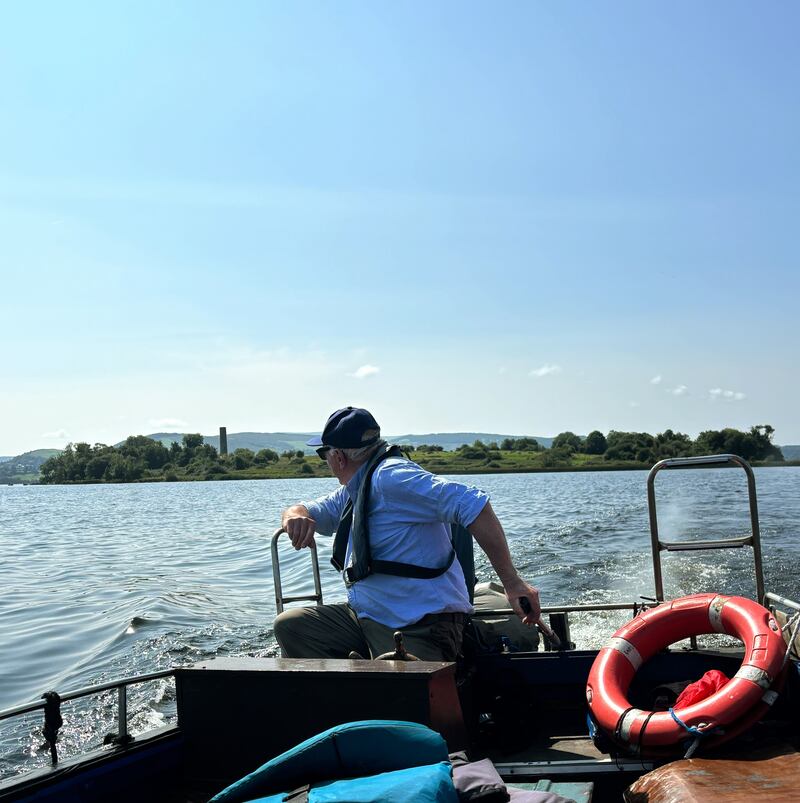
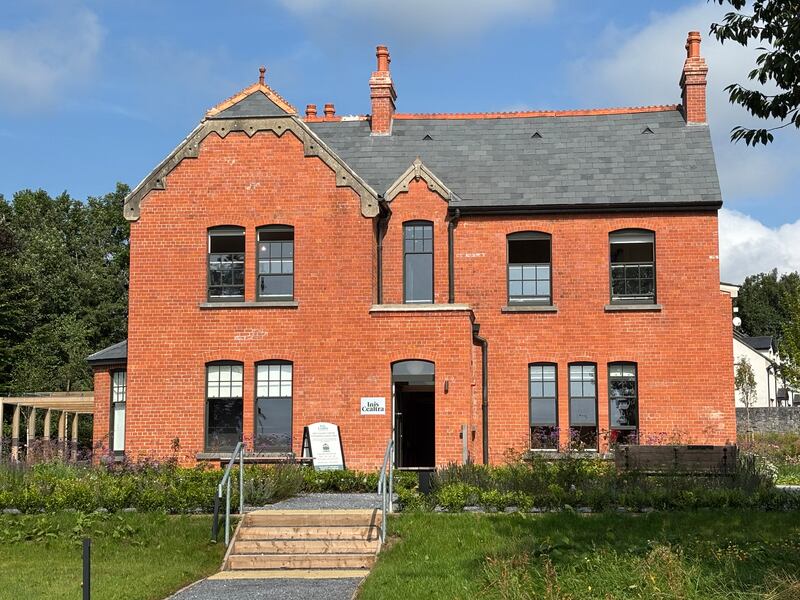
In recent years, the village has suffered a tourism lull, particularly since the closure of its hotel. “The cafes open in summer but close once the season ends,” Madden remarks, “but now, with the visitor centre, people will come again.”
Madden’s boat, a long wooden craft painted in weather-muted colours, waits at the marina. He knows the lake like the back of his hand. With practised ease, he pushes off, the bow cutting through ripples that glitter in the sun.
Inis Cealtra draws closer across the water, its shoreline blurred in the summer haze, and its high tower rising above a hilly thicket like a sword lifted to the sky. Its Irish name, Inis Cealtra, translates to Island of Churches. And churches there are, or what remains of seven of them: roofless shells, lichen-clad walls, eroded oratories bordered by grass.
The round tower commands attention in its incompleteness. Unlike most towers of its kind, it was never capped with a conical roof. Legend has it that a stonemason, distracted by the charms of a comely witch, abandoned the work before its crowning. Whether true or not, the tower feels exposed, open to the sky.
The boat drifts effortlessly past reeds to a tiny jetty. We follow a trodden grassy path that winds around wild brambles with white cabbage butterflies, berries, and low bushes. No information panels or neat arrows point the way to the island’s landmarks. Instead, we wander with only an old guidebook from the pier-side kiosk, its pages foxed and curling.
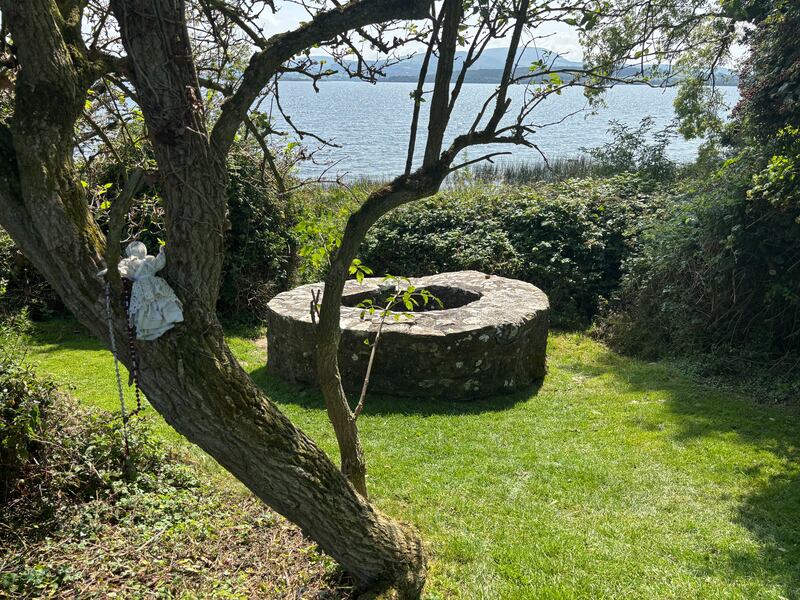
We meander between ruins, pausing at the holy well where cool water seeps from the earth. Close to the shore stands the bargaining stone, where tradition has it that a deal was sealed by clasping hands through its time-polished hole.

Bored through a pair of stones, it frames a handshake, a vow, a marriage promise cloistered in stone. As we crouch beside it, I insert my hand. The gesture recalls the Mouth of Truth in Roman Holiday, but with a resonance older and deeper.
Graves lie scattered across the meadows, their inscriptions weather-worn or sharp and new. Among them is the headstone of Cosrach, “the miserable one,” who died in 898, his resting place marked by a knobbly footprint. Nearby lies the grave of “the 10 men,” their identities lost to time, a mystery the island keeps for itself.
Some are early Christian slabs, incised with delicate spirals and crosses, their carvings as fine as those in the Book of Kells. Others are 19th-century headstones with weeping angels, and still more are modern granite markers.
A family passes by, the father lifting a boy on his shoulders. Two robust college students from Kerry circle the round tower, their two-man canoe pulled on to the jetty.
“The lake is so still, like glass,” one says. Yet the lake can turn quickly: wrecks lie below, among them once the Guinness barge 45M, lost with three men in 1946, but raised in the 1970s, its engine still operating
The students tell me that they have charted their zigzag canoe route across Lough Derg. To the south, the twin villages of Killaloe and Ballina guard the mouth of the lake before it tapers down to Ardnacrusha, joined by a 13-arched bridge where four lives were lost during the War of Independence.
Further north, Garrykennedy lies tucked in a sheltered bay, its ruined quayside tower house crumbling into oblivion, while just beyond it, the thatched snug of Larkin’s pub still welcomes boatmen much as it has for generations. On the eastern shore sits Terryglass, once another monastic centre. Today it draws boaters to its quiet quays, two old wells, and the warm evening light at Paddy’s Bar, welcoming guests for two centuries.
On Inis Cealtra, or Holy Island as many call it, the churches bear the names of saints: St Caimin’s, St Michael’s, and St Mary’s. Their walls frame sky and water; doorjambs carry weathered figures etched into stone, as if each ruin were a window on to another world.
Marcán, brother of King Brian Boru, served here as Bishop-Abbot of Inis Cealtra until his death in 1003. Since then, pilgrims have come for centuries. Yeats caught the cadence of it in The Pilgrim: “Round Lough Derg’s holy island I went upon the stones, I prayed at all the Stations upon my marrowbones.”
In August 2024, not far from her childhood home, Edna O’Brien was laid to rest here, beside the round tower. Her coffin was carried across the lake in a quiet community flotilla, adding her story to the island’s centuries of prayer and pilgrimage. The grave is currently marked with a simple timber cross with her birth name, Josephine O’Brien.
In early afternoon we step back on to Madden’s boat, and the island recedes behind us, its tower shrinking into the shimmer.
The return drive loops through Scarriff and Tuamgraney. Scarriff’s steep main single-lane street is bright with pastel shopfronts. An old cinema stands closed and for sale, but its white facade remains cheerful, holding its colour against the years. In Tuamgraney, the stone bulk of St Cronan’s Church rises square and solid, believed to be the oldest church in continuous use in Ireland or Britain.
The musty scent of centuries-old masonry seems to corroborate the claim. Inside, the nave doubles as an interpretive space; with the touch of a light switch, the stone walls flicker into life with visions of monks, raiders, and villagers. Outside, the roofless ruins of Grady Castle add another layer to the story.
By the roadside nearby, a plaque marks the childhood home of Edna O’Brien at the head of twin avenues. From here to the island, her presence feels inescapable, woven into this landscape of churches, stories, and song.
We end in Tuamgraney’s village square at Nuala’s Bar and Restaurant, where flowers spill from baskets and the low murmur of conversation drifts through the air. Here, amid the stones and the water and the ordinary life of the village, the world that shaped her novels feels palpable.
As O’Brien herself observed, “I hear stories. It could be myself telling them to myself or it could be these murmurs that come out of the earth. The earth so old and haunted, so hungry and replete. It talks. Things past and things yet to be.”
In east Clare, history is never only history; it is voices that linger, landscapes that remain unchanged, and human stories that will not fall silent.
For more details on the Inis Cealtra (also known as Holy Island) Visitor Experience, Mountshannon, Co Clare, V94 P66V, email iniscealtra@claretourismdev.ie or see iniscealtra.ie. Admission to the visitor centre is free


