

You never know what you are going to find in an antique shop. That’s the joy of it; browsing around a curated lucky dip. So it was that I found myself in Athenry Antiques on Church Street in Co Galway earlier this summer, having a look-see.
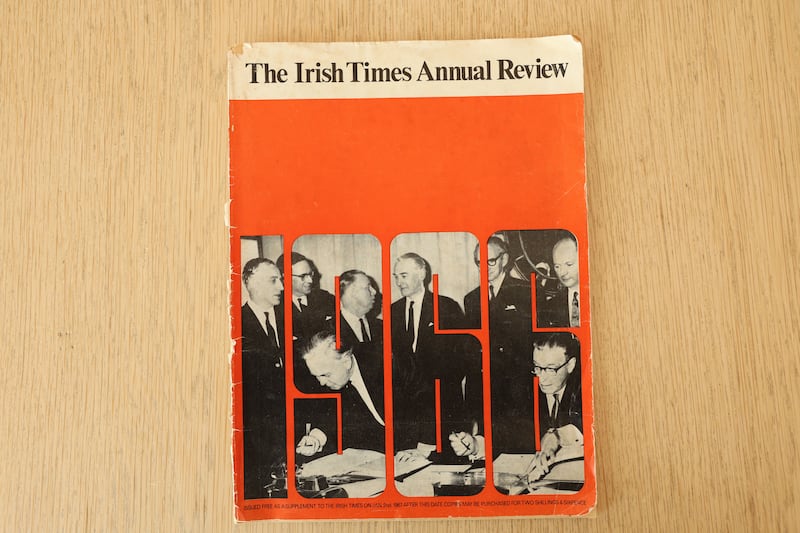
On a table at the back of the shop, there was a tattered magazine: The Irish Times Annual Review of 1966. Actually, only half of a magazine. Of its 100-plus pages referred to in the contents on page one, only 48 still remained. The magazine, “issued free as a supplement to The Irish Times on Jan 2nd 1967″, had eight men in suits on the cover. The main men in the photograph were the then recently resigned taoiseach Seán Lemass (with Jack Lynch, who succeeded him in November 1966, standing behind him) and the then British prime minister, Harold Wilson “signing the Anglo-Irish Free Trade Agreement, which came into force on July 1st, 1966”.
January 2nd, 1967 was a Monday. Then, as now, the paper was not printed on a Sunday. The Annual Review could be purchased after that date for “two shillings & sixpence”, the cover stated.
The price pencilled on the inside cover was €16, which I considered a bit steep for only around half of the magazine, but the woman behind the counter in the antique shop suggested a tenner instead, which I accepted. We both had a look around to see if the other half was anywhere nearby, but could not locate it.
READ MORE


Anyway, off I went with my half of a 60-year-old magazine. As readers will know, The Irish Times newspaper archive has been digitised. However, it seems that some supplements, such as this one, were not included in this project. If you look at the digitised paper of January 2nd, 1967, the Annual Review magazine is promoted on the masthead, but the magazine itself is not in the digital archive. So while I only have half of it, that half turns out to be a rare insight into what this newspaper thought was worth including in its assessment of the year 1966.
When I leafed through it, I was struck at once by the complete absence of women. Every byline is male: Michael McInerney, Political Correspondent; Wesley Boyd, Diplomatic Correspondent; William Hamilton; Tom McCaughren, Defence Correspondent; Garret FitzGerald; Patrick Nolan, Industrial Correspondent; John F O’Mahony; Michael J Harrington; Hugh O’Neill, Financial Editor; John Horgan, Education Correspondent.
Every photograph that featured people is of men. The sole exception - how I guffawed hollowly - is on page 23. It’s a full page ad for The Irish Times itself, “Ireland’s leading opinion-forming newspaper”. The ad quotes circulation figures for the previous years, saying circulation went up by 2.3 per cent in 1965 and 8.3 per cent in 1966. “Its comprehensive financial section makes The Irish Times of special interest to business men,” the ad states. Presumably “business women” were not a thing back then.
[ Dublin council to commission new monument honouring women of Ireland’s revolutionOpens in new window ]
In the accompanying image are four serious-looking men. One is smoking.

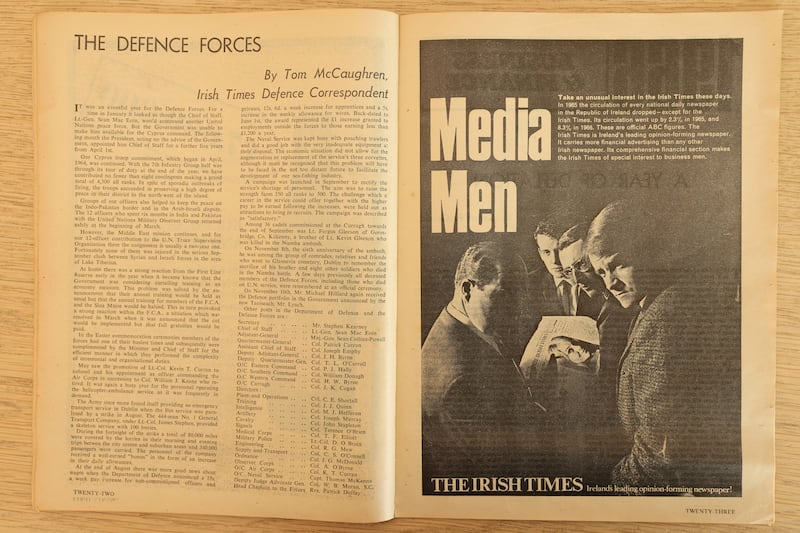
Another wears a tweed jacket. They are all frowning. They are gathered around a copy of The Irish Times. And here we see the sole picture of a woman in the 48 pages I had: the face of a smiling blonde woman on the front page, looking like the prop she was to the quartet of testosterone surrounding her.
There’s a list of the government of the time - again, not a woman among them. Lynch was taoiseach. CJ Haughey was minister for finance. Erskine Childers was minister for transport and power, as well as posts and telegraphs. Brian Lenihan was minister for justice; Neil Blaney was agriculture; George Colley industry and commerce. The inspirational TK Whitaker was secretary for the Department of Finance, under Haughey.
The Seanad had just a handful of women among its numbers. “Miss Mary F Davidson”; a Labour Party politician. She was the first woman general secretary of any Irish political party. I sincerely hope someone interviewed her at the time about the experience. Listed among the taoiseach’s nominees to the Seanad are Máighréad M Nic Phairais; Mrs Kit Ahearn and Mrs Nora Connolly-O’Brien.
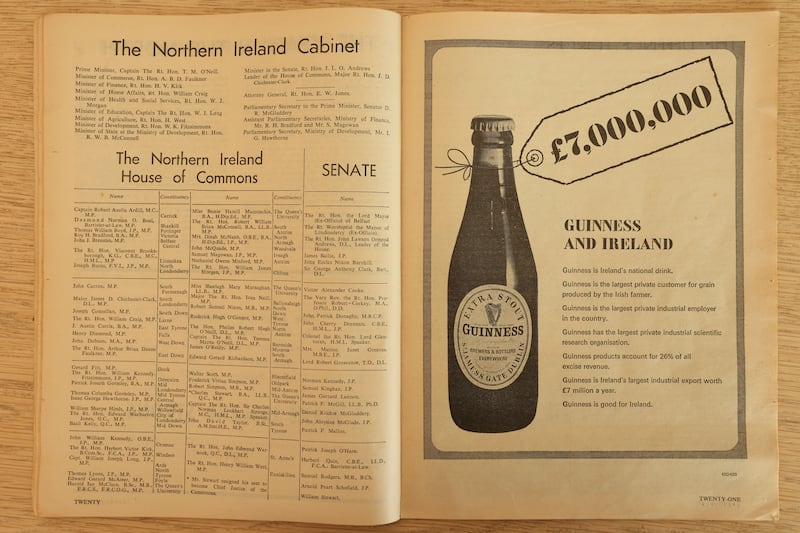
To tell you the truth, at this stage of my perusal of events of 60 years ago, I was a bit slack-jawed at the reminder of an era where the patriarchy truly ruled Ireland.
Garret FitzGerald, then a member of the Seanad, wrote the main article in the Business and Finance section, titled A Year of Deflation. The year 1966, he wrote, was the year the “growth of the Irish economy came to a halt”.
One reason for this, FitzGerald wrote, was “the disappointing performance of exports. The Department of Finance had expected a rise of about £26 million”. Instead, it was £11.5 million. He put this down to “the unfavourable market situation for cattle in Britain, and something also perhaps to do with the depressed condition of the British economy in general”. The word “stagnation” was repeated frequently.
[ Femina Culpa celebrates ordinary women in history accused of terrible deedsOpens in new window ]
Fast forward 60 years, and according to the CSO’s preliminary figures in February of this year, the value of Ireland’s exports in 2025 was €260.3 billion, up €36.6 billion from the previous year.
In the article on Labour relations, the many strikes and industrial disputes in 1966 were referred to. “A bank strike involving the whole country began on May 6th.” Some 8,000 bank officials went on strike. When did it end? “July 30th.” There was an 18-week strike at three paper mills, in Waterford, Clondalkin, and Killeen. “Over 1,250 workers were involved and the main issue was whether four-shift working, involving continuous operations over weekends, should be introduced.”
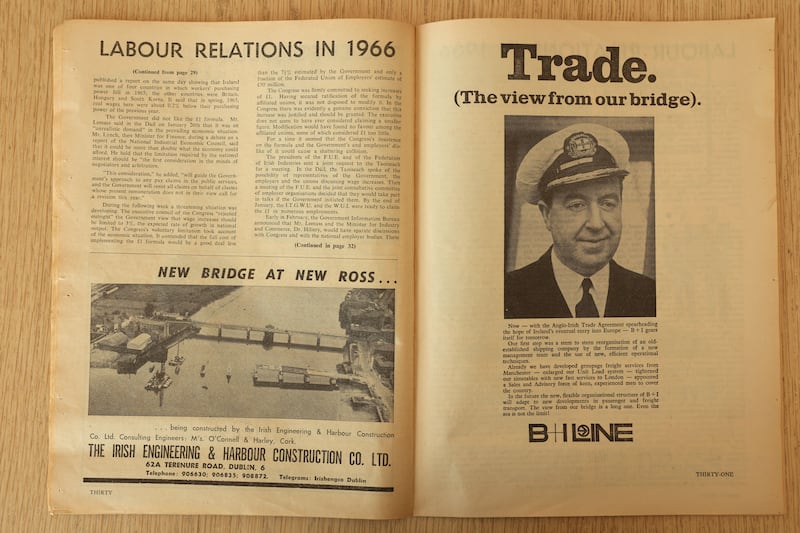
The deep-sea section of Dublin Port was closed for five weeks due to a strike by 1,000 dockers. Then 800 members of the National Busmen’s Union went on strike and “kept all the buses idle” for one-day periods over several weeks that summer. One hundred mechanical fitters at ESB generating stations around the country went on strike between April 30th to June 22nd, and “threw the country into chaos, power failing totally in many areas”.
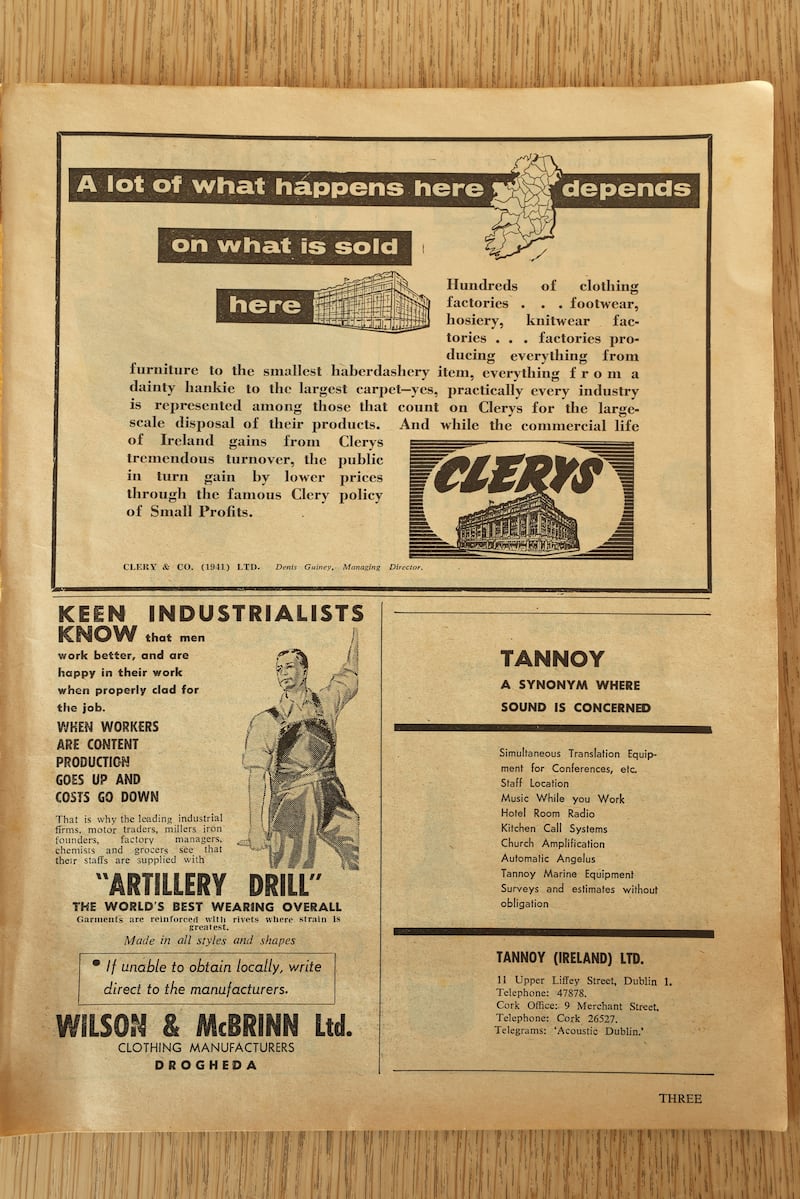
Then there are the ads, offering a fascinating social history insight into a bygone era. There’s a full page ad for Jacob’s Biscuits, which features a picture of an expanse of ocean, rather than any actual biscuits, nor even a mention of any of their names. “New industry keeps our young people at home and attracts the return of those abroad.” Jacob’s, the ad states, was “creating biscuits of such superior quality that Irish homes find little need for imported products that strain our national balance of payments”.
There’s a clear message running through all the ads that it was patriotic to buy Irish. “Make a New Year Resolution to ask for Irish Quality Goods,” runs an ad vaguely titled “Make Ireland Strong”. “You command the spending power to make Ireland strong. This is the challenge for 1967.”
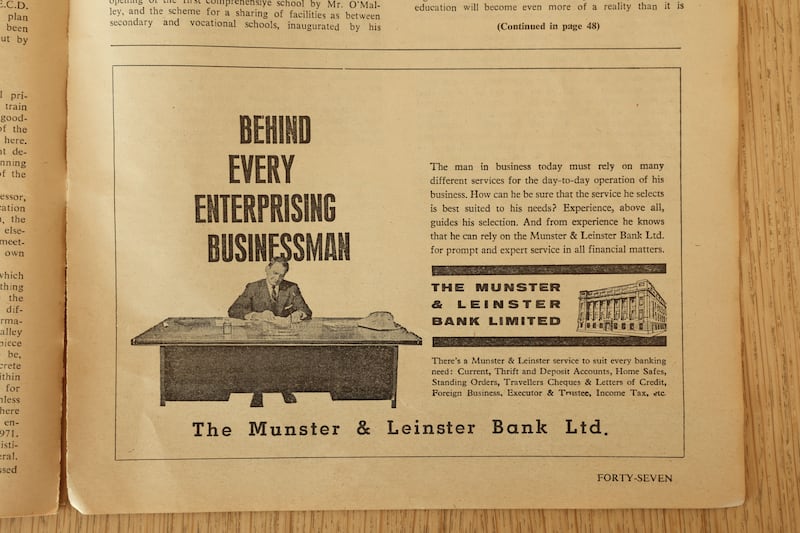
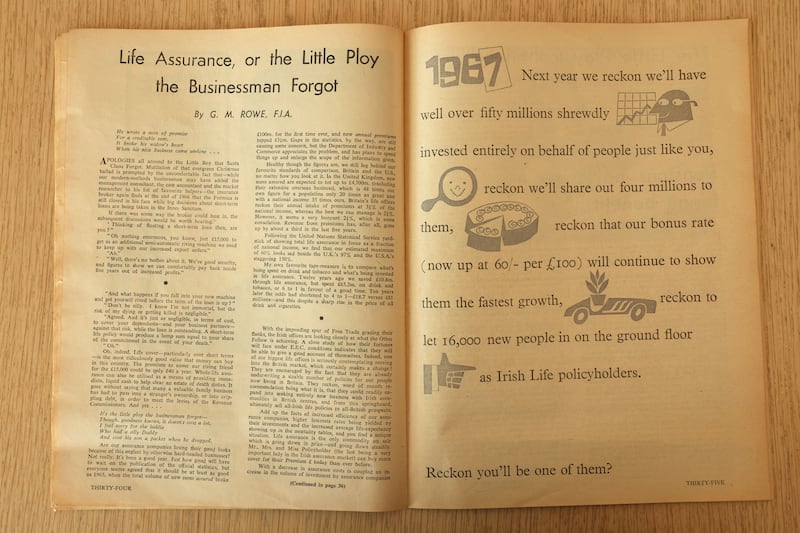
Another ad for Hibernian Insurance begins: “A wind of change has blown over Ireland. The hum of the conveyor belt has replaced the sentimental strains of the harp... But development is costly... So when you take out a policy with the Hibernian, it’s more than just an insurance cover. It’s an investment in the future of your country.”
An ad for McHugh Himself on Talbot Street, said: “If it’s Irish - put it in the parlour. That’s exactly where your new radio or television belongs. It deserves the best place in the house. It’s no longer a foreign thought to think Irish.” The ad says that McHugh Himself sells “fine models” of “Irish assembled” radios and televisions.
There are, of course, many ads for cigarettes. The Player & Wills ad says: “Many years of experience, a fund of research, the most modern manufacturing techniques - these all ensure that products of the highest quality are available to the Irish smoker.” Since 2000, ads in Irish newspapers promoting the sale of cigarettes have been banned.
As for interest rates, look back and weep. Julian S Hodge (Ireland) Merchant Bankers were offering 8.5 per cent interest per annum on deposit accounts. (Hodge, whose mother was Irish, died in Jersey aged 99 in 2004, worth £48 million.)
A colleague tells me that the paper stopped publishing this particular magazine in the early 1970s. As I wrote at the start, I only found half of the Annual Review for 1966, which ended at page 48. Therefore, sadly, I don’t know what it had to say about “Bloodstock”, “The Property Market”, “Population”, “Tourism”, “State sponsored companies”, “New Industries”, “Farmer unrest”, or something grimly titled, “Cattle trade disaster”.
As for “The arts”, and “The year in sport”, which were the final articles in the Review, they were both bundled dismissively together at the back under the heading of “Other Information”.
If anyone out there still has a full copy of this magazine, I would be most intrigued to see it. If only for the hope that there might even be some - even one - contribution, or stand-alone image, of a woman somewhere in it.
rosita.boland@irishtimes.com


