

Rebecca Dunne was walking to a shop in Finglas, Dublin with her seven-year-old twin boys and their baby sister in a pram when a man on an e-scooter collided with one of her sons, Brody. They were on the footpath, the boys a metre a head of her. “I wasn’t even a minute away from my house. He fell over the handlebars of his scooter and landed on top of Brody.”
Brody’s elbows and knees were cut and he said he felt dizzy and sick. They had to wait 55 minutes for an ambulance. On the same road another man on a scooter had collided with a road sign and emergency services were busy on that job, Dunne says. She was very upset. “I was roaring at the man ‘Why were you on the footpath?’” He said he was trying to avoid the traffic, she says. “In fairness to him he didn’t leave the scene.”
It turned out Brody had a serious concussion. A week later Dunne worried about his persistent headaches and a blackened ear, and brought him in for another scan. Brody is fine now but is scared of walking on the footpath. “What does that mean for the most vulnerable in society, if they can’t use the footpath safely?” says Dunne.
“Kids shouldn’t have to look over their shoulders. Brody is one of the lucky ones to only sustain minor injuries. Not every parent or kid is as lucky... There should be a complete ban [on e-scooters] and those who sell and supply and have them in possession should be prosecuted for having them. They are a complete scourge.”
READ MORE



“The biggest issue that we have as a football club,” says John Hayden, chairman of Belvedere FC in Dublin, “is that on numerous occasions throughout every season our pitches are being destroyed by the scramblers. Matches are called off, because there’s repair work needed...
“It’s very frustrating for the kids and the coaches on the club. We train in Fairview Park in the summer months. We’ve had the scramblers swerving in and out of kids eight years of age. We’ve had the scramblers coming through the training area, kids screaming, crying, and running. There’s an imminent danger there that the kids on the bikes don’t appreciate, and it’s terrifying. You have parents and grandparents on the sidelines who are dodging bikes, who are terrified.”
Can the gardaí do anything? “It’s an unpoliceable thing at the minute, because they’re gone by the time the guards get there. They need to bring in no-nonsense laws. If they don’t have them licensed and insured, if they’re using the wrong places in the wrong way, they should be convicted for it, and I’d be really, really strong on that. People are dying because of it.”
Social Democrats TD Daniel Ennis warns of lawlessness in the inner city. Last weekend he witnessed eight young people on scramblers on the North Strand. One nearly collided with his car. When he called Store Street Garda station he says he was told they had nobody free to come and deal with the issue. On Tuesday, at the Joint Committee on Justice meeting to discuss the use of scrambler bikes and public safety, he repeated this story.
The parents of Grace Lynch, who died from multiple traumatic injuries after being hit by scrambler in January, also spoke. They had campaigned for the proper enactment of “Grace’s Law”, which banned the use of scramblers in public places. At the meeting they said they wanted the law to be properly enforced and, also, that e-scooters be banned. Four people have died and 59 have been seriously injured in incidents involving scramblers since the start of 2021, according to the Road Safety Authority (RSA).

In June, six physicians wrote an open letter, published in The Irish Times, asking for the State to properly regulate or even consider banning e-scooters. They wrote: “Despite being illegal for use by children aged under 16 years, by mid-2025 e-scooters had become the leading cause of traumatic brain injury resulting in admission to Children’s Health Ireland at Temple Street, Ireland’s paediatric neurosurgical centre.”
At the start of July, it was revealed that six children had been put on life-support after e-scooter accidents in the previous fortnight. Between June 2025 and May 2026, 18 children were admitted to CHI Temple Street with brain injuries as a result of e-scooter incidents, a 50 per cent increase on the previous year.
This isn’t counting less serious injuries. “I’d imagine the hospitals are constantly dealing with injuries,” says Mandy Shaw, project manager of the diversion project at the Bradóg Youth Centre. “We’d be seeing broken arms, smashed faces, smashed teeth, all these things from coming off them.”
John Legge, consultant in emergency medicine at St Vincent’s University Hospital, talks about the facial, head and upper limb injuries he frequently sees as a result of e-scooters, although he says most of the incidents do not involve children and many don’t involve another vehicle or pedestrian. “[E-scooters] have a high centre of gravity, small wheels. They topple.”
He is sceptical, given that e-scooters are already banned for under-16s, about an outright ban having an affect on anybody except commuters with no other options. “Every child injured on an e-scooter is already going against the law,” he says. “Most of the people we see at St Vincent’s are [adults] just trying to get to work. It’s a symptom of a public transport system that just doesn’t work. They’re getting key workers to work at five in the morning when the buses aren’t there. They’re just trying to get to work and not get killed.”
Antisocial behaviour evolves and changes. Phone theft stopped being a big issue in the inner city when it became possible to turn phones off remotely. The recent boom in scramblers and e-scooters among young people is at least partly linked to the drug trade. While scramblers have long been a presence in working-class communities, and many people tell stories of how they’d hear them emerge early on Christmas morning, they are now, often, used to transport drugs.
‘People are basically exploiting and manipulating and trafficking these kids. And the sickening part about this is that you won’t have the big players on the scramblers’
— Jonathan Dowling, youth work team leader
Anecdotally, that trend began in Finglas, where dealers had to traverse larger areas, but was soon adopted in places where it made less sense logistically, based largely on drug-trade fashion. Scramblers and scooters are now often used to carry narcotics and as part of the criminal grooming process. Mandy Shaw says she knows of kids as young as 10 being told: “Just bring that up there and I’ll give you a shot on the scooter.”
They are also part of the mechanism for indebting young people. If e-scooters and scramblers are seized by gardaí, for example, teenagers can end up in debt to the drug dealer who lent it to them. “Scramblers are expensive, about €4 or €5,000,” says Shaw. “We’re seeing an awful lot of young people being entrapped in some sort of low-level criminal activity.”
Johnathan Dowling, a youth work team leader at a youth club in the north inner city, explains how the behaviour typically progresses: “You might start off on an e-scooter at the age of nine, 10, 11, 12. You get to 14, you progress to a scrambler. When you get to 16, you might progress to a bigger bike and you might progress to having a team of people driving around e-scooters and bikes.
“People are basically exploiting and manipulating and trafficking these kids. And the sickening part about this is that you won’t have the big players on the scramblers. [Those bigger players] are not going to lose their life and lose their freedom… Then this young person is feeling ‘I have the best bike, the best clothes, the best girlfriend, and I’m flying around selling drugs’. But little do they know, [for] anybody that is in that ‘business’, longevity is not something that is going to be sustainable. They’re going to end up in prison, dead, or they could end up in debt to these people that have them flying around.”
Gardaí have orchestrated “days of action” where, based on intelligence, homes have been raided. Some 382 vehicles were seized in Dublin alone this year. Often the vehicles are quickly replaced. In some cases, gardaí may lack the pursuit training, protective legislation and equipment that might allow them to chase scramblers and scooters and enforce the law safely.
At the Oireachtas committee, Garda Commissioner Justin Kelly cautioned that there would be limited progress on pursuit training due to the demands of policing EU presidency events and meetings in the city for the rest of this year. There were also calls to regulate, license and track these vehicles as well as calls to ban e-scooters outright. The Commissioner supports such a ban.
But legislation is typically a slow process. It means that, in the short term, youth and community work are among the few means of tackling this problem. Most politicians, youth workers and members of the community see a combination of “robust policing” and youth development and educational programmes as necessary to tackle this issue.
Keith O’Driscoll, youth justice project leader of the KEEP diversion project for Belmayne and Clongriffin, tells me how the project recently arranged for three young scrambler users to sit down with community gardaí to discuss the issue. It worked, he says, because the gardaí were in the teenagers’ space and were willing to listen.
“Young people don’t think about the broader implications of their choices because they haven’t developed the cognitive skill. The guards were coming at it very much from a harm-reduction perspective. They wanted to build a relationship with the lads. They were trying to empathise with them, saying ‘imagine it was your granny or your younger sister’, and that hits. And the lads, in particular, two of them, were really engaged in that conversation. It was like a penny dropped with them ... Young people are always looking for an outlet ...
“There’s been a report called Forgotten Communities by [sociologist] Dr Maria Quinlan, and it recognises that there’s a lack of activities and pro-social and recreational activities in the area. Because they haven’t got the life skills and the decision-making skills, they look for any sort of avenue, and that has been scooters and e-bikes and scramblers.”
Diversion projects work, O’Driscoll says, but they need to be properly resourced. He has seen many young people who were formerly associated with self-destructive behaviour and crime who are now in college, in apprenticeships, starting barbering businesses or who have been in receipt of Gaisce awards from the President.
Later he texts me a video of a well-designed bike track he discovered at an adventure centre while on a trip with some teenagers in Monaghan. The teenagers he was with were really excited by it, he tells me.
At Belvedere Youth Club, I meet some young women who tell me about the fear ongoing scrambler and e-scooter use causes small children and older people as the machines careen up and down their streets. “But you get used to it,” says one with a sigh. They say most locals are too scared to confront these young men.
Another young man I meet there was a user of scramblers himself from the age of eight to 14. “I just loved the adrenalin,” he says. He had no conception of how dangerous it was for himself or others back then, he says, and now, at the age of 20, he feels anxious just thinking of it.
At the age of 14, with the help of the Belvedere Youth Club, he “straightened up,” he says. “I had the best times of my life in here.” Many of the young men he once hung around with are now involved with drug dealing and criminality and are still driving scramblers around the city. “The minimum wage is 13 quid. You can make 50 quid in one [drug] sale. How do you deal with that?”
John Hayden from Belvedere FC tells me about the Alfie Byrne project, a plan for sports facilities and a club house for both Belvedere FC and East Wall FC and the nearby Dublin City Motocross Club. He shows me a 3D video of the proposed facility. It will bring sports clubs, community services and addiction services all together in one place. There are also plans for the Motocross club and the probation services to run a scrambler education programme there.
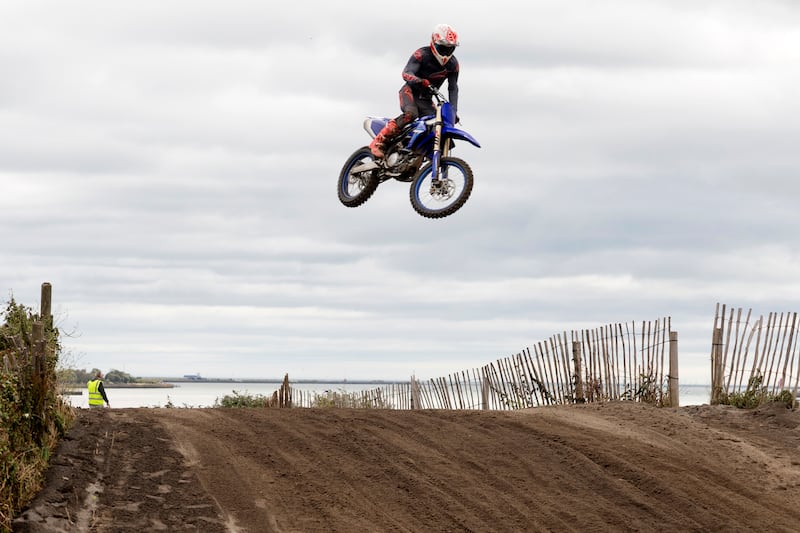
When I visit the Dublin City Motocross Club’s track on the Alfie Byrne Road, it’s a race day and there are children, teenagers and young adults in helmets and full protective gear, cheering families on platforms, plenty of stewards in hi-vis jackets and a burger van. Brian Harte, the cofounder of the club, tells me how events like this were stalled for several years by insurance issues and have only just recommenced. In the past, the club ran educational pilot courses for young people in collaboration with youth centres and sports clubs. “The motto was ‘put them on the right track to take them off the streets’,” says Lar Byrne, who says he used to ride scramblers here 30 years ago, when it was a disused dump.
[ The Irish Times view on scramblers and e-scooters: lawlessness on two wheelsOpens in new window ]
“We would cover first aid, mechanics, and then a self-awareness course on drug, alcohol, and fitness,” says Harte. “We’ve proven it works. Education is the key… We’re trying to put a programme together now [for schools] that will incorporate [scramblers, motorised e-bikes and e-scooters]. It makes them aware of the impact that the bikes have on the environment and everything else around them.”

We watch from a platform as 20-year-old Alex Ivanov, a mechanic from Blanchardstown, takes part in a race. “You get on the bike and you’re just free,” he says. “You get into a flow state. You get to a point on the bike when you’re riding it and you’re not thinking about anything… You’re just flowing.”
He thinks that dedicated tracks and educational programmes would divert lots of young people away from using the bikes for antisocial behaviour. His friend Callum Maher, who lives in the city centre, notes that some people would probably still prefer “doing wheelies, getting chases from the guards”.
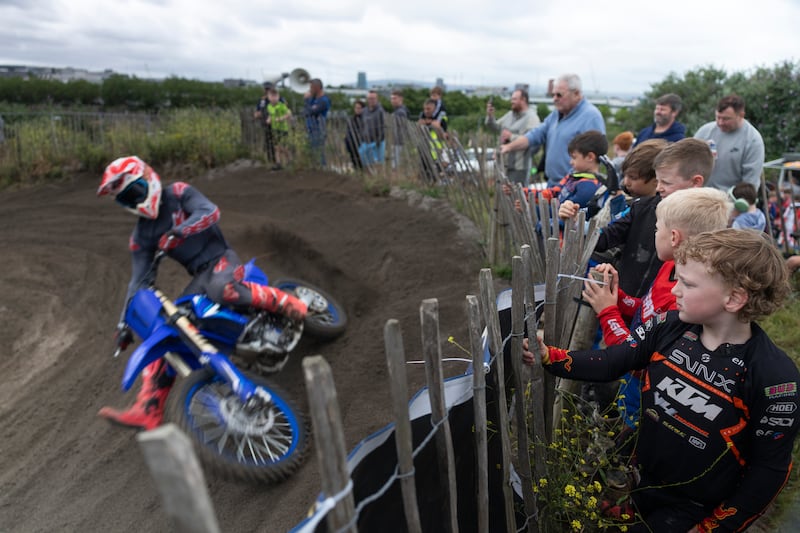
We watch a race that includes Jake Farley, a builder, and his cousin Ryan Carter, who is still in school. Like Ivanov and Maher, these are focused young men who are not inclined towards antisocial behaviour. That doesn’t mean this activity is entirely safe. I involuntarily say “oof” when Carter hits a fence. Farley tells me he’s broken his leg four times. But they love the sport. “If the lads on scramblers doing wheelies on the road – if they give this a chance they’ll find something more enjoyable,” says Farley.
Brian Harte feels strongly about this. “I’ve been trying to get a message across to everybody, and they didn’t seem to understand, there’s nowhere in Dublin or Ireland where kids can go and actually try this sport in a structured way and a managed way. That’s why the antisocial behaviour happens.”


