


The plan was simple: to point the car west and drive through the weeks of frigid, dreary February. The route would take me across from Washington DC through the middle-west United States as far as the Rockies and then down into Texas, where some interesting elections were under way, and through the southern states ahead of Ireland’s annual Come-All-Ye at the White House.
The journey would cover about 4,000 miles and hopefully offer some kind of superficial survey of how America, through its voices and landscapes and bewildering scale and beauty and elusiveness, is coping with turning 250 years old. The car, a redoubtable Ford Escape, was an inheritance from our previous Irish Times correspondent here and its boot contained a collection of mystifying totems which Martin Wall himself was bequeathed by his predecessor: a box of wine glasses, a busted printer, a plastic bag filled with well-thumbed and expertly folded Rand McNally maps, and a box of dinner plates. There was no silverware to speak of.
The problem was that the good old Escape was fast stuck. Like thousands of other cars in Washington DC, it remained wedged in its parking bay in the street, boxed in by mounds of snow which had compressed into ice. Enda, a friend from home, had sent a terrific playlist which included Gil Scott-Heron’s Winter In America and that felt like the perfect soundtrack for this country in the first weeks of 2026.
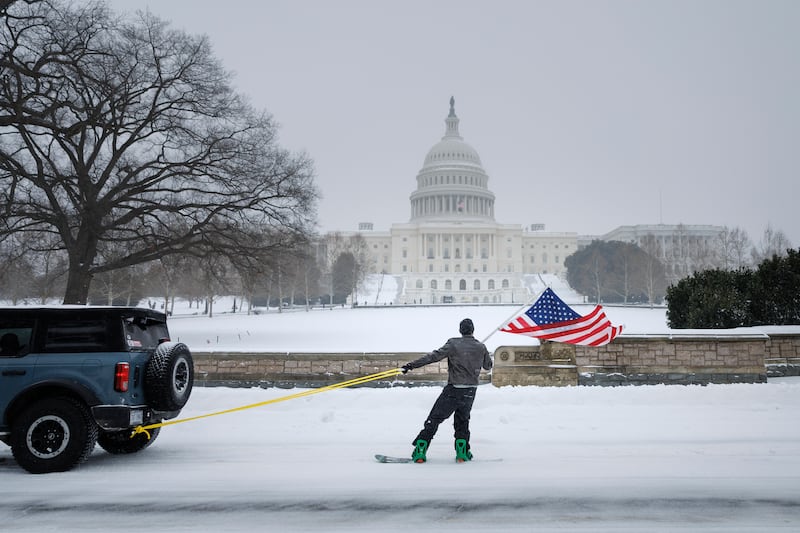
The weather was atrocious and it was stunning to discover that the extreme snow plan for Washington, the epicentre of US power, appeared to amount to little more than four woebegone snow ploughs and a few guys dispiritedly scattering salt on the main thoroughfares. The side streets were a mess for weeks, and treacherous.
READ MORE


The good part was that hacking through compressed ice is an oddly enjoyable activity and it brought the often-silent residential streets of Washington to life. Social media became filled with happy reports of civic volunteers properly meeting their neighbours for the first time.
Trump kept talking, and talking, and doing things – Venezuela, Greenland – and the killings in Minneapolis seemed to mark a new low in the national morale. It wasn’t until the weekend of the Super Bowl – which the president announced he would not attend – that I finally got going, on a dismal Friday evening, when it was still minus 10 and beginning to sleet again.
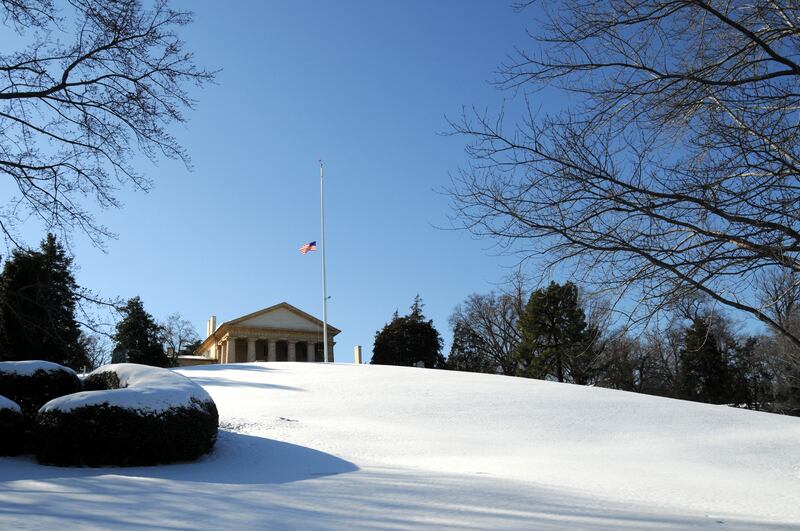
Anyone who has visited Washington might well have seen the view from behind the Lincoln Memorial across the bridge where Arlington House, the home which Confederate Army commander Robert E Lee left, never to return, in 1861, sits on its perch above the cemetery and city. Items of furniture left behind by the Lee family are still contained within. Its unchanging presence always feels like a mirage: a touchstone and a sort of unofficial gateway to the vast country behind it. Exits to the interstate are a short clip away from the potency of Lee’s dreamland and it’s impossible to overstate the jolting concrete grimness of the main arteries out of the city. The big roads are a constant snarl of traffic and mired by enormous repair works which appear to have being going on since the Nixon administration.
With the beginning of the interstates comes the phenomena we all associate with US road trips: the endless forest of roadside neon advertising signs dominating the landscape for the 2,700 miles of highway from east to west.
Sixty years have passed since Lyndon Johnson called his cabinet together and groused at them for not passing Lady Bird’s Beautification Act.
“Now, she wants that Bill,” he told them.
“And if she wants it, I want it, and by God, we’re going to pass it.” The First Lady of the day was alive to the despoiling of the US roads network through commercial huckstering and car junkyards. The ’65 Act was a noble attempt at limiting the neon forests. But it never worked and now the constellation of familiar signs, the ubiquitous McDonald’s, Texaco, Arby’s, Motel 6, Quality Inn, Hamptons, Shell, Dunkin’ Donuts, Exxon reappear endlessly, vying for attention with the small, independent adverts and impromptu biblical signs and warnings and prayers which festoon the continent. They have a hypnotic effect, those signs, and for night drivers, when the roads turn quiet, are as reassuring as lighthouses to seafarers. Because it remains a wild country.
The problem with the interstate is that it blurs the individual personalities and quirks of the states. You can still see mind-blowing landscapes – the industrial grind of Northern Virginia cedes, after five or six hours, to the lush mountainous regions of lower Appalachia. And all the cliches deliver: Kentucky really does feel like driving through a never-ending Kildare stud farm; the isolated homes on the straight roads of Kansas do have those outdoor basketball hoops which birthed the myth of the Midwestern pure shooter; and the sky west of the Mississippi becomes enormous and wonderful, even in the drab light of February.
But here’s the thing. There are 342 million people in the United States and as you drive you constantly wonder where everybody is. The hearts of American towns are often extraordinarily empty. The country at large is diametrically opposed to the wanton energy and tourist-thick crowds of Manhattan. Across the real America, nobody walks. The transport system is often poor to non-existent so the car is king. The boulevards are too long and too wide for pleasure walking; towns and cities designed by 19th-century local planners drunk on the conviction that the agrarian and industrial booms would last forever.
To find what’s going on, you need to go specific meeting places. In Abingdon, Virginia, an artsy, pretty town of 8,000, I stop in to the local farmers market on a Saturday morning and fall into conversation with Dylan House, who is manning a meat stall. We talk about what this year means to the United States.
We got into the saying that you just don’t talk about religion and politics. And that’s a problem
— Dylan House, Virginia
“I am excited,” he says brightly.
“Two hundred and fifty years. And I do have some trepidation, too. Most empires – that’s the average life span! Look, I’m born here, raised in this country and I have always had a love for the concept of what this country can become. The Olympics are a great example. When the team from China comes out, you know, it’s clearly the Chinese team. But when the USA team comes out, it’s all kind of folks. That’s special to me. People need to have more conversations ... The tribalism is ... I think one of the things that happened in this country is we got into the saying that you just don’t talk about religion and politics. And that’s a problem. Because we all retreat to our bubbles.”

In Hermann, Missouri, a chocolate-box immigrant German town which is a summer draw for its local wineries and beer-brewing, I call in to John who is from Minneapolis but came south decades ago to open up an antiques store. “And it’s been all downhill since,” he jokes.
In Kansas City, I meet a local man who is converting a century-old railway bridge into a state-of-the-art restaurant and bar and public facility. In the bar where I meet Ronan, a friend from home, the barman wants to know if you can drive Harleys in Ireland. The next day, Rosemary Hope tells me about her childhood memories of Truman Capote in the years when her father served as his attorney in Holcombe.
In Garden City, Kansas, the motel in which Capote and Harper Lee stayed while he was researching the book that would become In Cold Blood still exists, although it is no longer named the Wheat Lands. Like many American motels, its owner is of Indian descent. The transformation of US hotels and motels into Indian-American ownership is among the more extraordinary US immigrant stories of the last century. A documentary film from last year set out to tell the origin story of how this demographic has come to own over 60 per cent of US hotels and chains, from roadside budget motels to prestige brands despite representing just 1 per cent of the population.
It apparently started with one man, Kanji Desai, who came to California with a business visa before lapsing into the life of undocumented immigrant. After the second World War, a Japanese friend asked him to look after his hotel. He eventually leased it and began to advise other Indian friends, and people at home: If you are a Patel, lease a hotel.
[ ‘He intends to subvert the elections’: Pressure grows on Donald TrumpOpens in new window ]
The Garden City motelier’s English was infinitely superior to my Hindi but our conversation was a struggle. I asked him about the Capote backstory but he was unaware of his motel’s prominent cameo in the story. The communities of Holcombe and Garden City have acknowledged the terrible slaughter of the Clutter family, and the global sensation of Capote’s book, through understated, dignified memorials. But it was a long time ago.
I tried to jog the motel owner’s memory with the bare outline of the awful story: that an entire family had been murdered in the nearby town of Holcombe, at which news he put his hand to his mouth.
“Last night?” he said, looking horrified.
“No. No!” I said, trying to quell his alarm. “Many decades ago. 1959.”
“1959,” he repeated, in acute relief before giving me a meaningful look to convey his wish to end this line of conversation, which was fair enough.
It feels as though the era of the motor hotel is drawing to a close. Closed-down inns are commonplace. Visually, roadside motels retain a cinematic appeal – those dreamy signs, sunsets, all that – but inside, the decor is tired and often dated to the point of retro.
Numbers are sketchy: one report suggested that from a peak of 60,000 motels operating in the US in 1960, just 16,000 remained by 2012. And anyhow, the film version of No Country for Old Men may have hastened the death knell for the appeal of the roadside motel. Anyone who has seen that film even once, let alone more times, cannot check into one without experiencing that moment when the lamp is switched off and you hear the cars outside the road. And you realise that you wouldn’t be entirely surprised if the door lock was air-blown open to reveal the bowl-haircut, be-stockinged silhouette of Anton Chigurh standing in the doorway.

Too many motels carry worryingly specific instructions on the key-card glove. Do not answer the door to strangers! Do not leave valuables in car! No, easier to go for the relative safety and dullness of the multi-storey chain hotels that crowd the edges of US towns and cities. But you can, thrillingly, still check into the motel used in No Country: it’s the Regal, in Las Vegas, New Mexico, and there is availability.
In Lemar, close to the Colorado border, I passed four students standing on the main street and brandishing anti-Ice placards on a hot, silent Sunday afternoon. “This is a very Red area,” one of the protesters tells me.
“People blow exhaust at us and car horns and are yelling ‘Go home’. ‘Trump is still your president.’ And I’ve gotten two Nazi salutes.”
With perfect timing, a guy driving a mega truck slows and lowers his window so he can holler “f**k you” at the group.
“No, thank you,” one of the protesters shoots back, and they laugh. But they are ploughing a lonely furrow.
Bent’s Old Fort, a historic trading post on the Santa Fe Trail in Otero County, comes with warning signs about avoiding dead bats and live rattlesnakes: no need to say it twice. There’s a gravestone for a stagecoach driver who keeled over from exhaustion while ferrying passengers westward-ho. Inside, the tour guide asks a couple where they are coming from and his face lights up when they tell him Wichita.
“And it’s true Wichita is the centre of the world,” the guide declares.
“That’s what they say,” the visitor says, sounding dubious.
“I say that because in 1542, Francisco Vásquez Coronado reintroduces the horses,” the guide tells him.

“So, the Spanish bring back the horses to the Americas and Wichita is one of those areas where the Spanish lose horses. And we know what happens: if you lose horses, someone is finding them. And the Plains Apache and buffalo hunters get horses. And once you get a horse ... you can be 5ft 3in and once you get a horse you are living larger than life. And that’s why I say Wichita is the centre of the world. Because in 1542 the world changes. Yeah, I’ve family in Wichita. How’s everything been over there?”
“Oh, you know. Hot as hell! Yesterday it was 82.”
The guide speaks as though, in his mind, 1542 was not that long ago. But then, America has an intense relationship with its past. Fort Bent, a white man/Native American trading post, is just one of innumerable historical sites and markers which dot the landscape. It was built on a brutally desolate patch of land, was completely washed away when the Arkansas river flooded in 1926 and painstakingly recreated for the 1976 bicentennial. America is always rushing towards tomorrow while gaping back in amazement at its epic past.
The constant markers for Daniel Boone country, for the Lewis and Clark expedition, for the pioneers on the Santa Fe Trail, for the homesteaders; for the memorials and birthplaces and battle grounds of the Civil War which still stalks the subconscious here, for old movie stars (Middlesboro, Kentucky, announces itself as “The Home of Lee Majors”, which may well be the single best road sign in the entire the United States): all of this reverence towards the past and the myths serves a purpose. It reminds Americans of the savage toughness and resilience of their predecessors who claimed the land here during the westward expansion, through sensationally tough winters, when there were no signs for Arby’s, or Comfort Inns, or anything else.

In the 2,000-odd miles of driving on and off the interstates, I saw exactly one Trump sign. It was on a ranch on the sublime mountain drive to Taos, in New Mexico. This ranch was like a mythical homestead, except for farm machinery and junked cars scattered around the house and, presumably, indoors, all the mod cons and wifi. The further west you drive, the further away from the White House, the more distant and unreal Donald Trump becomes. But his energy fills the sky. There is no escaping his presence. He is like a gargantuan figure from a fairy tale: a work of imagination now as much as the actual living, functioning president. Little wonder that so many people have stopped talking about politics.
“You just don’t talk about it,” a hotel manager in Colorado Springs confirmed. “Not at work and not at home. Not if you can avoid it.”
This has been going on for a decade. It is easier to talk about other things.
Some of them live pretty primitive. Almost off the grid. I assume they just scrabble along
— Bill Nevins, Taos
In Taos, the former hippy enclave turned ski-and boutique arts Valhalla, I ask Bill Nevins, who with his partner Jeannie Allen is part of a tight, pretty mountain town that somehow seems immune to the madness, about this. Bill, a poet and teacher and activist, grew up in New York and understands Trump. But he’s as mystified as everyone by the uncanny power through which Trump managed to connect with Americans in the heart of the heart of the country, of which he knows nothing. We talked a bit about the evolution of Taos.
“Georgia O’Keeffe was here and then the hippies came in, including my cousin Barbara. But yeah, it’s creative and it has become expensive to live here. And a lot of people are out on the mesa, maybe two hours drive, and some of them live pretty primitive. Almost off the grid. I assume they just scrabble along. There’s a couple of little stores out there. But not much.”
In other words, it is still possible to get away from the noise. It’s still possible to lose yourself. The actor Dennis Hopper discovered Taos during the making of Easy Rider, moved to the town, caused a few scenes of outrageous civil disorder before settling into late-life amicability. Hopper’s grave at the isolated Jesus Nazareno cemetery, set against the spectacular backdrop of the Santo de Cristo mountains, is decorated by neckerchiefs and curios left by fans over the years. The drive down through the Rio Grande gorge is marked by too many similarly ornate grave markings and memorials bearing immigrant names.
In Roswell, where it’s warm, I ask Jim, who runs a bric-a-brac store filled with military memorabilia, if he believes in the alien-landing origin story which made the town a universally recognised name place.
“I mean, there was definitely some funky s**t happened,” he opines.
“At that time, we came out of World War Two [sic] militarywise flying planes with propellers. We went into the Korean War just a couple of years later. We went from washing clothes by hand to toasters and by the Korean War there were already microwave ovens. So, in that 10 years we went from Stone Age to oh-my-gosh in terms of aviation technology. There was something going on back then.”

Always something going on now too, although on a four-hour drive across the west Texas oilfields through Artesia and Lovington and Plains, there wasn’t a sinner about. I suspect that all of these places were livelier 20 and 30 years ago, before everyone disappeared into their phones and before the old reliable talking point of politics became such an uneasy and volatile subject for Americans.
Look, so many of the traditional American human qualities – the generosity, the friendliness and the curiosity about what’s going on out there, the deep down toughness and optimism are all abundantly alive. The spirit is intact.
But the country is in the grip of a long winter and an extended moment of uncertainty. I think back to John, the antiques dealer in Missouri, and of what he had to say about the big birthday year.
“I think we’re in big trouble. I don’t think there’ll be a November election. Everyone is convinced that the Democrats will take back Congress – both Houses. If that happens, he’ll be shut down on every damn thing he wants to do. And I don’t believe he will let it happen. He’ll dream something up.”
No need to clarify who John meant by “he”.
And it is still the land of dreams.


