Alan Betson

I arrive to the Laytown Races early, wipers beating hard in a downpour, hoping to get the lie of the land. It has been a couple of years since I last covered the annual beach races and, truth be told, horse racing has never been one of my strong points. Still, the rain eases and a few horses begin to warm up in the distance, creating nice silhouettes against a sky split between bright light and a brooding black cloud. An atmospheric opener, a photograph, but not the photograph.
I walk the course. Any promising pools of still water, potential mirrors for something arty, are promptly cordoned off by stewards, each barrier slicing neat reflections in two. I scan the horizon for the sports agency shooters, who always find the best angles.
Instead, I see a large amount of camera club photographers. Perhaps they were listening at one of the many camera club talks I have given, advising that the Laytown races can make great photo opportunities. Now I have to live up to my own advice.
By 4.30pm the first race gets under way. I hedge my bets with a combination of shots. A long-lens head-on shot is promptly wrecked by a trainer’s family who wander straight across the view, oblivious. I switch to a low reflection in a shallow pool, crouching low, camera hovering millimetres above salt water, its mortal enemy, while my boots sink deep in the watery sand. The horses thunder past, but increased wind breaks the water’s surface, tearing apart the reflection I’d hoped for. Another fail. After the opening race, the wind softens and the reflections look perfect. Horses gallop to the start line of the second race beneath blue patches and drama-laden clouds. For a moment, it feels within reach. But as the minutes tick by, the breeze stiffens, and the sky slumps back to grey. Again the water shivers, and again the picture dissolves. The deadline has already nudged past me; it’s 5.10pm and I’ve little to show.
READ MORE


Rain returns, but with it, suddenly, some magic. A great semicircular rainbow appears over the seascape, spectacular on its own but useless to me without a race. Ten minutes out from the third race, it begins to fade. Three minutes out, and half of it is gone. One minute to go, and only a sliver remains. Still, it’s just enough. All or nothing. In this job, the elements often align only for the briefest of moments.
Nick Bradshaw
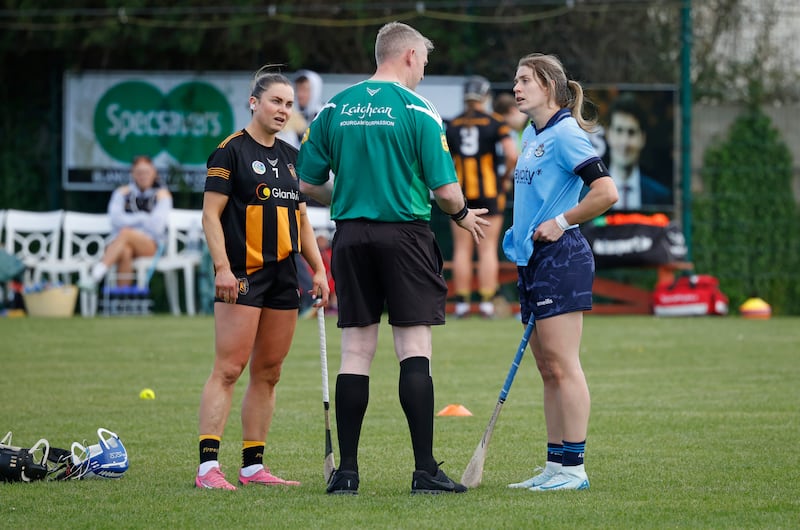
As photographers we want to create images that have an impact. On the multitude of assignments we cover we strive to make something different, something visually striking, and compositionally balanced. Whatever the situation, we are always chasing a photographer’s photograph.
My choice for this year’s photograph is an image that lacks many of these traits.
I was assigned to a senior intercounty camogie match in west Dublin, with Dublin captained by Aisling Maher and Kilkenny captained by Katie Power. The teams had agreed in advance to wear shorts, contrary their association rules. After the warm-up and just before kick-off, referee Ray Kelly called both captains in for the coin toss and pre-match photo. During this he, also wearing shorts, insisted that all players return to the dressingrooms and change into skorts or the game would not go ahead. The teams deliberated for a minute or two before agreeing.
[ In Pictures: Families reunite at Dublin Airport for ChristmasOpens in new window ]
The players’ action on the day, along with the pre-kick off image of all three in shorts highlighted a long-standing issue. The image immediately gained traction, drawing significant public and political support for the players and their cause. Later that month, the Camogie Association agreed to revisit its position and held a special congress. Delegates voted by 98 per cent to allow players the choice of wearing either shorts or skorts.
Dan Dennison

With this job, you never know where a particular assignment will lead you. One Friday morning back in September, my phone rang. It was Shay, our irrepressible logistics master on the photo desk, the custodian of all our time. His message was clear, as ever: “Head out to the Northside. You’re meeting some OAP weightlifters.” And so, I met Phil Browne (65) and others, in the huge, bright space that is CrossFit Bua in Whitehall, Dublin.
Phil told me how it all began back in 2018. She had been looking for an activity to keep the usual aches and weaknesses of ageing at bay. When she was younger, she’d kept active with aerobics and yoga, but this time she wanted something that would help her carrying the shopping and staying steady on her feet. She was keen not to repeat the falls her mum had gone through. It was all part of her why.
I hope my photo conveys the sense of calm confidence around her. She was completely in control for each lift, in a bubble of concentration and focus. I could see that all of this was no longer a hobby, but a lifestyle. Phil talked about wanting to train for as long as she was physically able, not wanting to be a burden on her children. But she also talked about simply loving the feeling of being strong in her own body.
My thanks to Phil, and to Breda, Denis and Christine, for letting me into their lives for a few hours. I hope others can draw inspiration from their stories.
Dara Mac Dónaill
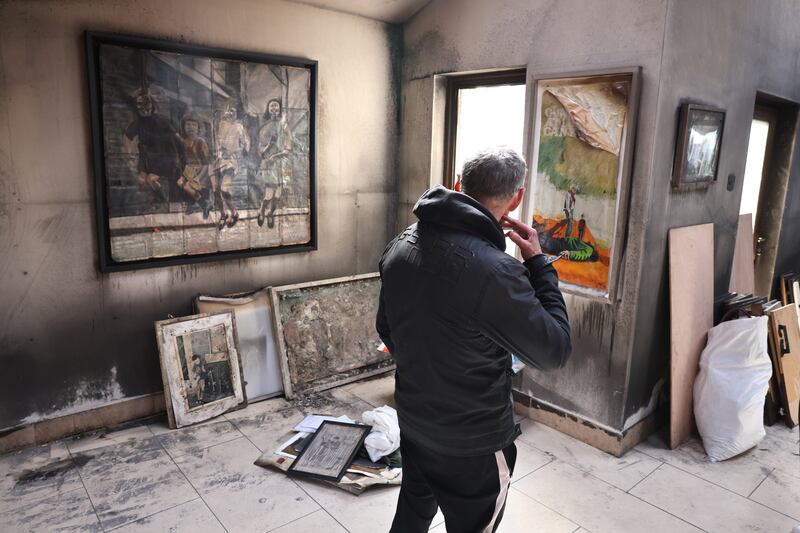


On a daily basis, photographers cover a variety of jobs, often calling to an address for a once-off encounter. Sometimes, returning to a neighbourhood or working nearby brings back memories of previous assignments and the people briefly met.
In May of this year, I was on assignment with reporter Sarah Burns at the home of Pat Curran, an artist whose house had been firebombed and extensively damaged the previous week. In the early hours of May 25th, Pat, who had fallen asleep downstairs, woke to the sound of breaking glass and spreading flames. He screamed to alert his wife Breda and son Luke (20) upstairs. The family escaped but their dog Zach died in the blaze.
When I photographed Pat in his kitchen with some of his damaged artwork he was still in shock. He did not want his face shown, and I respected that completely.
Two months later, I met him again, assigned to photograph him setting up an exhibition for the Liberties Festival. The change in him was remarkable. He was smiling. His art, much of it drawn from his youth in Dublin flat complexes, seemed to give him something steady to hold on to. He had first considered exhibiting fire-damaged pieces but chose instead to focus on work that represented a new beginning.
Our third meeting was a month later, back at his refurbished home with Breda. They had no insurance at the time of the attack but a GoFundMe raised about €55,000. Builder Mark O’Neill heard what happened and offered to help, overseeing a full renovation. With support from subcontractors and suppliers and relying only on the GoFundMe funds, all costs were waived. Refurbishment was estimated at between €170,000 and €200,000. Mark said seeing the family return home was payback enough.
My encounters with Pat Curran were very unusual, in that I got to meet him on three different occasions, during which he was experiencing very contrasting emotions. I found it heartening to see that such goodwill exists among people such as Mark O’Neill, family, friends, neighbours and GoFundMe contributors. It was their combined efforts that positively affected the life of a family following the attack on their home.
Chris Maddaloni

Last April, Patrick Freyne and I were working in Chad to cover the plight of Sudanese refugees fleeing the war in their homeland. Travelling with the United Nations, we visited the Farchana refugee camp, a dusty collection of huts that hosts thousands of displaced people experiencing severe humanitarian needs.
While Patrick was interviewing people, I took a walk outside, often a good opportunity to stumble across candid situations. I met a group of small children playing football. Their enthusiasm for the sport was the same as any child the world over.
However, I noticed that the ball was made from layers of plastic and string, a home-made solution for their love of the game. It also seemed to be a symbol of much more, greater than the sum of its parts.
Bryan O’Brien
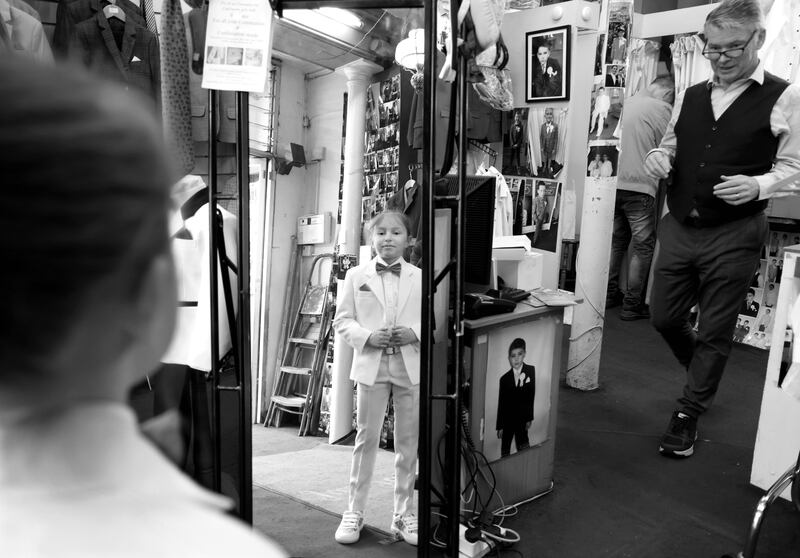
This is a photo of Cherry Cassidy-Kelly (nine) as she adjusts a bow tie in front of a mirror. She is in the shop of Jas Fagan Tailor, which sells Holy Communion Suits on Dublin’s Thomas Street.
Cherry is a small white bundle of calm and cool in the middle of a very busy shop. Leonard Fagan, the owner, is at the right of the photo coming towards her.
I spent a day at Jas Fagan’s at the end of April as hundreds of children were fitted for their suits. Most clients are still boys, but increasingly girls like Cherry are opting for a trouser suit rather than the traditional dress. “There’s no way she’d wear the dress,” her mother Caitriona tells me.
It was busy that morning. There were babies in buggies, children, parents, and grandparents. Leonard was measuring, pinning up and adjusting out front, while at the back his uncle Tommy worked at a sewing machine and his brother Eugene steamed and ironed. Leonard’s children Lewis and Jennie were helping boys and girls in and out of suits.
Generations of Dubliners have been coming here since Leonard’s father, Jas, opened the business more than 56 years ago. It is a tradition, with most customers coming from Dublin. Leonard takes orders between December and March, fittings begin in April, and it’s all quiet by the end of May.
Leonard’s father was a trombone player with showband The Cadets when he started the tailoring business, making band outfits. Joe Dolan was among his clients. When the showband era ended, Jas adapted, branching into First Communion suits.
The business has two traditions that I love. The first is that everyone who buys a suit has their photograph taken, and this picture is added to the shop’s photo wall. The second is that before a suit leaves the shop Leonard drops a two-euro coin into the breast pocket before placing it in a suit bag: “It’s a handsel tradition that my father began’, he explains. It’s for good luck.”
Enda O’Dowd

In January I left my family home in Mayo at around 6am and drove straight into Storm Éowyn. The winds had whipped trees across roads and on to houses, homes and phone towers. With the phone networks out, there was no way to tell which route to take. I was back on analogue maps trying to send in any pictures I could from whatever pocket of coverage I stumbled upon.
Three days later, I was in Cavan covering the aftermath. Driving up a country road, a journalist and I spotted Bernice Wheatley’s home. Two trees had blown on to it, one of which had landed against her bedroom window. Standing in her sittingroom with the weight of two trees bearing down on her, she described the previous few days as “hell”. It was a humbling moment, a reminder of how vulnerable we are to nature and its events. In the space I went from cursing phone networks to appreciating a structurally sound home.


