

Crates of fresh bread, pancakes and soda farls are stacked high at the entrance of The People’s Kitchen in north Belfast.
It is breakfast time at the city’s only drop-in food centre for the homeless a week before Christmas, and it’s a slow start.
“Morning, there’s the boys,” shouts a volunteer to group of regulars signing in. Only first names are required, and within an hour the spotless diningroom is heaving.
One young man asks what time they are opening on Christmas Day for dinner.
READ MORE


More than 110 hot breakfasts are served by 11am and it is a tight squeeze at the premises on the ground floor of a former Ulster Bank building, a short distance from the city centre.
A homeless woman in her 20s from the Aran Islands is among those seeking help; she’s not seeking food, but clothes and toiletries, after arriving in Belfast two days previously.
Another man is waiting for his laundry to be dried.
“If it wasn’t for here, I would be dead. I would have died of hunger or exposure,” says the 32-year-old, who lost his job and ended up sleeping rough before the charity found him temporary accommodation.
“I never expected to be homeless. I know nobody does. I’m a university graduate and worked for 10 years.”
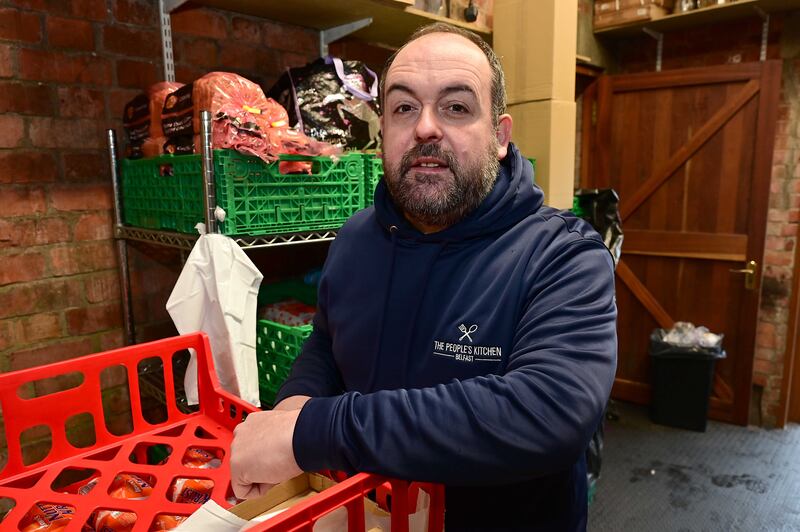

Demand has never been greater, according to The People’s Kitchen founder and co-ordinator, Paul McCusker, an A&E nurse and Independent councillor in Belfast City.
Not everyone who uses the service is homeless; some have their own accommodation but can’t sustain their tenancies because of addiction and mental health problems.
“Numbers are continuing to rise – people are in more desperate situations,” says McCusker. “We started off feeding 10 people a week nine years ago. Now it’s well over a thousand contacts a week. That’s not just food, that’s outreach on the streets and wraparound GP services.
“Last month we helped place 27 people in temporary accommodation who were on the streets. As a charity, we paid for that. We know homelessness is more than a housing issue, but the question I have asked politicians is: ‘Why are there people dying?’”
Official figures on homeless deaths in Northern Ireland were published for the first time earlier this month and showed there were an estimated 58 deaths last year.
Around three-quarters of those who died were men, and half were aged 45 and under. Belfast recorded the highest number (20 deaths) and the most common cause was drug use, according to the Northern Ireland Statistics and Research Agency.
But the estimated figures “aren’t reflective of what we are seeing”, says McCusker.
“These are people who die in hospitals or temporary accommodation. They don’t record street deaths,” he says.
In the last six weeks alone, three people have died on Belfast’s streets.
“I have lost count of how many funerals I have been at in the last couple of years,” adds McCusker. “The thing is too, if outreach groups weren’t working on the streets and providing support, there’d be a lot more deaths.”
He points to a photograph on his phone – taken by his outreach team the previous Sunday evening – showing seven people huddled in sleeping bags on Royal Avenue, the city’s main shopping thoroughfare.
In the corner of the photograph is a wheelchair.
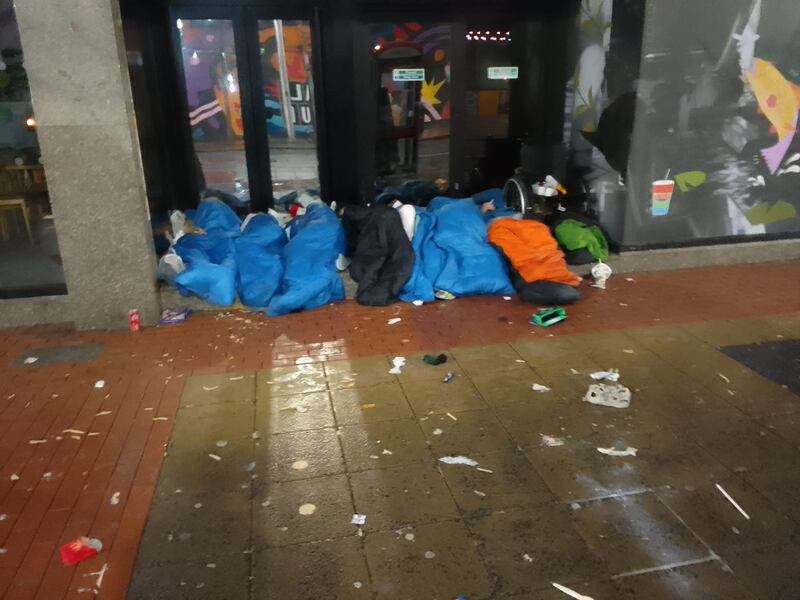
“I suppose this highlights the realities of the streets. This guy in the wheelchair had a broken pelvis and was lying on the streets in Belfast,” he says.
“They’re all huddled together trying to keep warm and safe. That’s one area of Royal Avenue; there were 17 in total that night.”
McCusker sent the photograph and a letter calling for urgent intervention to Stormont ministers, MLAs and the Northern Ireland Housing Executive.
Access to emergency ‘crash beds’ – there are 16 in Belfast – is becoming more difficult for vulnerable people, he says.
Phone lines open at 5pm for the one-night-only beds, and there are often 50 people waiting to get through.
“There are some people who are entrenched and want to sleep on the streets, but for most it isn’t a choice,” says McCusker.

The Northern Ireland Housing Executive, the main statutory body for housing in the North, says it is “fully committed” to addressing and preventing homelessness.
There has been a “dramatic increase” in its temporary accommodation to more than 5,000 units, with a further 16 high-support beds for vulnerable women opening in coming weeks, according to the head of the executive, Grainia Long.
The housing authority’s focus is on “outreach and prevention” in responding to rough sleeping, as well as finding “sustainable” housing solutions, she says.
There are no plans to create a “night shelter” for the homeless in the city, according to the executive chief, a decision which McCusker describes as “disappointing”.
“Very much the opposite position has been adopted in Westminster, where millions have been invested in a night shelter transformation fund,” he says.
Back at The People’s Kitchen, there is a queue of people arriving with boxes of donated food and sleeping bags. Staff are expecting more than 100 sit-ins for dinner on Christmas Day and more than 300 meals will be delivered in the community.
Joe Murray (74) is wearing a Santa hat and tucking into his scrambled eggs. He lives in east Belfast and has used the service for years. “I get two buses to come here,” he says. “The staff are great company and you meet a lot of good people. It’s outstanding.”


