

In July, Vanisland Limited, a subsidiary of the well-known developer Ballymore, applied to Kildare County Council for a large-scale development of new homes in Leixlip.
The 272-home development at Confey is a mixture of homes and apartments, along with a childcare facility, three commercial units and a restaurant/cafe.
It is part of the Confey master plan for a town which is in the Dublin commuter belt, but also the home of Intel for many decades.
In support of its planning application, Vanisland Ltd submitted 1,000 pages of documents to Kildare County Council.
READ MORE


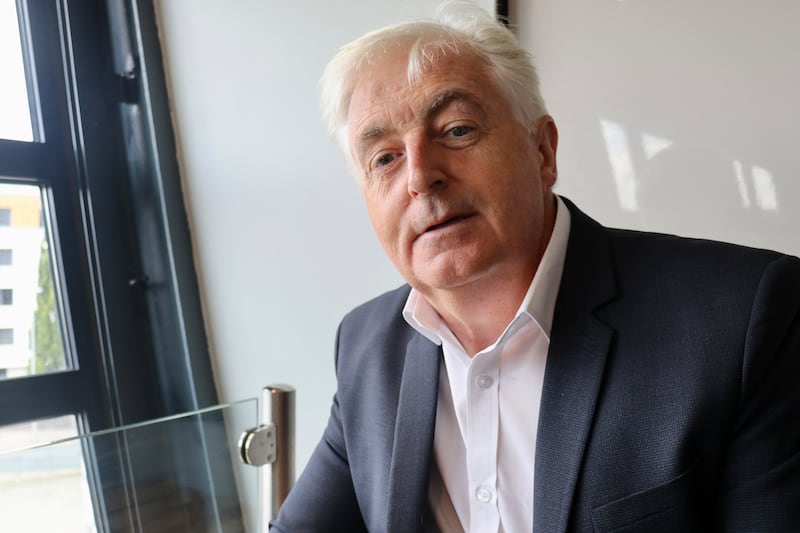
But that’s only the start of it, according to Michael Prenty, the director of residential operations at Ballymore and chairman of the Irish Home Builders Association.
“Getting planning from the local authority takes at least 14 months and then you might have an appeal to An Coimisiún Pleanála which has time lines on it,” he says.
“You could be a year and a half to two years in the planning process alone.”
The Central Bank published a stark warning last month about the planning process, which is putting attempts by the Government to deal with the housing crisis in jeopardy.
“For homes completed so far in 2026, the average duration from lodgement of planning application to completion was four years, twice as long as a decade ago,” the report states.
It went on to state that in 2016, house building took between 21 and 26 months based on housing type; those completed so far in 2026 took 44 to 50 months.
One-off houses and apartments now take around two-and-a-half times as long as in 2017 and scheme housing nearly twice as long.
“The rise is gradual and continuous rather than a break at any single date,” it stated.
Between 15 and 20 per cent of schemes completed in 2024 went to An Coimisiún Pleanála and they took an average of 13 to 14 months to process. The Central Bank did not measure how long it would take for schemes that go to a judicial review.
The bank’s report chimes with the experience of Ballymore and other housing developers, big and small, Prenty says.
“All the schemes we are building at the moment took at least a year and a half to two years to get through planning,” he says.
[ Planning system shifts to ‘culture of facilitation rather than restriction’Opens in new window ]
A decade ago, it took a year to get through planning, even if it was appealed, and then six months to build the houses.
“You didn’t have as many reports, you didn’t have as many meetings,” Prenty says of the changes that have occurred in the intervening 10 years.
Large scale residential developments (LRD) require three meetings with local-authority planners; the first happens after six weeks and then the builder must go back – it all takes time, Prenty says.
“The whole thing is strung out and the resources aren’t there in the local authorities. A lot of the senior planners went to An Coimisiún Pleanála or out to the private market. There’s huge demand for planners.”
Getting builders to speak on the record about housing developments is challenging.
You purchase your land, you get your design for your houses, you then apply for planning permission and the local authorities are under stress and duress to assess planning applications
— Conor O’Connell
Not many of them are as big as Ballymore and they are reluctant to speak publicly about planning delays as they do not want to be seen criticising planning authorities that they are dependent on to get their developments built.
David* is part of a small family firm specialising in building houses on brownfield sites – land previously earmarked for development but which has lain idle or been underused. They are currently building a small developments of 30 houses in south Dublin.
We do “small bespoke sites,” says David. “They’re not for everybody.”
The Central Bank report did not come as a surprise to him. “The planning system is particularly bulky; it’s not at all streamlined,” he says.
He is particularly exercised over a two-and-a-half-year delay in getting planning permission from the then An Bord Pleanála (now An Coimisiún Pleanála) for a housing development of 30 homes in south Dublin.
The application became caught in the slipstream of the turmoil that affected the board in 2022 when the then deputy chairman Paul Hyde resigned after questions were raised about his work.
The disruption prompted a breakdown in board decision making on big housing and infrastructure files. New laws followed to overhaul An Bord Pleanála and planning.
David says he spent that time in the planning process “over nothing”.
“It was a case of ‘Nimbyism’ – complaints of an observational interest, not of substance,” he says, referring to the “Not in my back yard” label used to describe residents opposed to developments in their locality. The delay cost his business interest payments of €320,000 on a €4 million bank loan, he says.
He acknowledges that the Government has sought to clean up the mess by clearing the backlog of planning applications and reconstituting An Bord Pleanála as An Coimisiún Pleanála, but does not believe the changes have been effective.
He also says frustration with utility providers such as electricity and gas companies is proving to be a drag on getting residential developments built.
“You are dealing with 11 or 12 different utilities. A bit of joined-up thinking for utilities would be helpful too,” he says.
John*, who works for his family building firm in west Cork, says they bought a site in the 1990s and secured online planning permission for 60 housing units.
“It’s now 2026. We are still trying to complete that housing estate because of wastewater capacity concerns,” he says.
He says Úisce Éireann has confirmed that there is sufficient wastewater capacity; however, Cork County Council is still requesting additional information which only Úisce Éireann can provide, adding that the two bodies “don’t seem to be seeing eye to eye.”
“It’s very frustrating. We’re there as a contractor based in a rural west Cork town with 100 people employed, and there are people in the town crying out for housing.
“They are looking for us to deliver it and we can’t do it. It’s infuriating. The last house in our town was built in 2021 or 2022 and there’s been nothing since.”
Construction Industry Federation director of housing, planning and development Conor O’Connell says local authorities are taking 12 months to assess developments with 100 homes or more.
“You purchase your land, you get your design for your houses, you then apply for planning permission and the local authorities are under stress and duress to assess planning applications,” he says.
At the same time, they are being asked by the Government to reopen their local authority area plans to zone for more housing.
“They have a large number of planning applications hitting their desks all at the same time,” he says.
“To compound things, there was a recruitment campaign by An Coimisiún Pleanála and by the Office of the Planning Regulator, so we have a shortage of planners. That’s not being critical; it’s just a fact.”
In response, An Coimisiún Pleanála says the statutory objective period to decide an large residential development case is 16 weeks, though the timeline may be extended if there is a statutory requirement to seek further information as part of the appeal process.
The commission says all LRD cases last year were decided within the 16-week timeline. To date this year 56 LRDs have been decided, with only one missing that deadline. The one that missed the deadline did so by two days.
* Not their real names


