
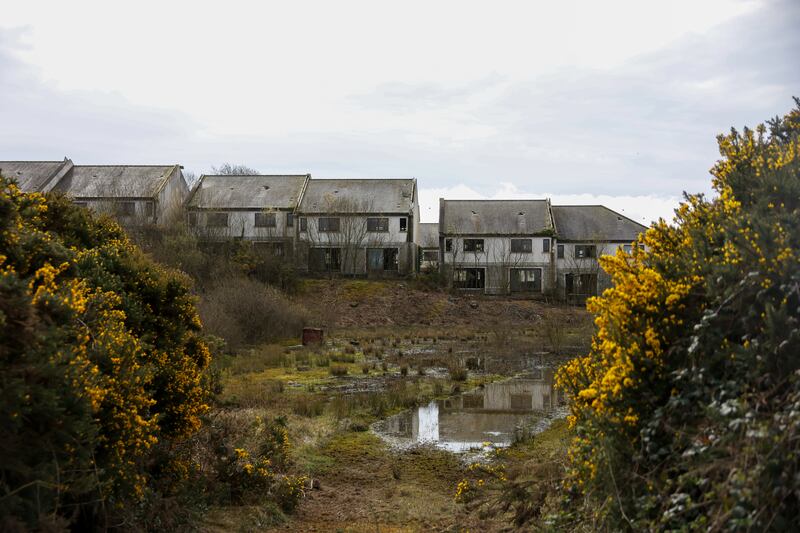
Overlooking the Rock of Cashel in Co Tipperary sit 52 partially complete houses that have lain idle for close to 20 years.
The houses at Ballypadeen were meant to be holiday homes linked to a hotel that never materialised, and are due to be demolished by Tipperary County Council.
Many of the three-bedroom homes, about 2½ km northeast of Cashel, have smashed windows and front doors removed. Trees impede the entrances of some.
Inside the properties, there is evidence of first-fix electric and plumbing installations, with piles of untouched plasterboard in several of them.
READ MORE


Planning permission for the “holiday suites” on an elevated 15-acre site and a 120-bedroom four-storey over-basement hotel and leisure centre, complete with bus and car parking and a helipad, was granted to Co Laois developer Liam Campion in November 2004 by what was then South Tipperary County Council.
Construction began in 2006 but halted the following year after the council alleged that the houses were not being built in compliance with planning permission.
Campion denied breaching planning rules and, in December 2008, the claims against him were dismissed by Cashel District Court because the council could not prove its case.
Complex planning and legal engagement between the parties ensued, including Campion pursuing the council for damages. Last July, a mediated settlement between him and Tipperary County Council was agreed.
As part of the agreed remediation, the council is progressing a Part 8 planning application to remove the houses. Once that is complete, the site’s future development will rest with Campion.
An application for an environmental impact assessment screening determination was made to An Coimisiún Pleanála by a third party in January. The commission determined this week that the referral was “invalid” and informed the local authority.
A report on the proposal to demolish the houses must go before elected council members within eight weeks, and the councillors will have six weeks to consider it.

Campion says he would be “disgusted” if the houses, which were about “70 per cent complete” before construction stopped in 2007, end up being razed. He is unsure what he would do with the land, but would likely sell it.
“Planning was granted. It does appear they [the council] always have had regrets granting planning and it seems to have been a mistake, in their view,” he says.
“I was very involved on the site itself and this was a huge development for me. I had my full heart in the whole thing. It was a lovely development. Unfortunately, what happened, happened and it shouldn’t have happened.”
Campion says he is “not sorry” for agreeing to a settlement with the council as it was “a big relief to my health ... I was so fed up with the whole thing, I would have agreed to anything.”
Speaking in the Dáil last month, Independent TD Mattie McGrath said the situation “defies logic in the middle of a national housing emergency”.
The Tipperary South TD said hundreds of families and individuals are on the county’s approved housing list and “here are 52 fine three-bedroom houses ... which the council seeks to knock down”.

“When there is huge housing demand across the county, it is indefensible that viable housing stock is to be destroyed rather than repurposed for private, social, affordable or indeed health accommodation,” he added.
McGrath claimed that an independent quantity surveyor’s report estimated a cost of €8 million for the demolition and remediation. He said the local authority had “continually refused to release full costs to my office via Freedom of Information requests”.
The council said any proposal to complete the houses and change their use to permanent residential accommodation would require planning consent and would be considered contrary to national, regional and local planning policy.
[ Housing and planning: All you need to knowOpens in new window ]
“The units have remained incomplete and vacant for almost 20 years. And even if zoning and servicing were appropriate – which they are not – the cost and extent of works required to meet modern residential standards would be prohibitive and likely necessitate demolition and full reconstruction,” it said.
“It is not considered that there is a viable option to adapt the units for residential use.”
Minister of State at the Department of Public Expenditure Frank Feighan repeated in the Dáil, in response to McGrath, that the land was “unzoned, poorly serviced and located outside the settlement boundary of Cashel”.
Were it deemed suitable for long-term social housing development, the council may have considered a compulsory purchase order, he said.
The council’s advertisement for contractors, published on the Government’s eTenders website, estimated the value of site preparation, demolition and clearance at €400,000.
In its planning report for the Part 8 application, the council said the removal of the houses would result in a “substantial improvement” to the visual amenity of the area in addition to the setting, and “views to and from the Rock of Cashel, one of the Royal Sites of Ireland”.
There is “a huge appetite to knock them” among people living in proximity to the site, says one local.
“The houses aren’t fit for purpose. People have been asking for some time when those houses would be knocked. There has been some antisocial behaviour as well over the years.”
Forty-seven submissions were made by members of the public to the council in relation to the Part 8 application.
One was from a resident from Cahir, some 23km from Ballypadeen, who said, having viewed the site in its present state, felt it would be “wrong to demolish what is presently built there in view of the present housing crisis that exists in Tipperary.
“We feel that the expenditure on the demolition of the partly built homes would be a complete waste of taxpayers’ hard-earned money, which should be spent on other more urgent and demanding areas.”
Local Fine Gael councillor Declan Burgess says the community of Ballypadeen and the wider Cashel area have witnessed significant dereliction and neglect at this site for many years.
“I welcome the conclusion of two decades of litigation and the fact that, through a mediated agreement, both the owner and the local authority have now reached a resolution,” he says.

“It is important that we now turn our focus to the next chapter for this site. I’m committed to engaging constructively with those who have concerns, as well as the many people who wish to see the demolition proceed.”
The Department of Housing said it had received no proposal or funding application from Tipperary County Council in respect of the properties.
However, it said it is “understood from the local authority involved” that the units were never designed, permitted, or intended for permanent residential use and there is “no viable value for money option to adapt the existing structures for residential use.
“Even if the required statutory zoning and servicing infrastructure were available – which they are not – the extent of works required to meet current residential accommodation standards would be prohibitive, likely necessitating full demolition and reconstruction.”


