
The repatriation of cultural artefacts is one of the thorniest issues in the museum sector across the world.
The saga over the Elgin Marbles, known in Greece as the Parthenon Marbles, has soured relations between Britain and Greece despite the passage of time.
The sculptures from Athens’ Acropolis were sold to the British state by Lord Elgin in 1816 and have been in the British Museum since, much to the chagrin of successive Greek governments.
After decades of pressure, the Benin Bronzes, decorative cast-metal plaques from a royal palace, are finally being returned to Nigeria from museums around the world.
READ MORE


The Egyptian government has been demanding that the exquisite Nefertiti bust, depicting the queen of a pharaoh, be returned from a German museum.
These are only some of the many valuable cultural commodities that are not in their country of origin. “There is no more important question for western museums today than restitution,” the museum curator and author Dan Hicks wrote in his 2020 book The Brutish Museums.
Ireland is clearly both a perpetrator and a victim when it comes to cultural artefacts.
Last week in the Dáil, Fianna Fáil TD Cathal Crowe revealed there are 6,445 Irish artefacts in the British Museum alone, most of them held in archive boxes.
One noteworthy Irish item held in the London institution is a gold bracelet from the Mooghaun North Hoard, discovered in March 1854 by labourers working on the construction of the Limerick to Ennis railway. Others include the 9th century Londesborough Brooch and St Conall Cael’s bell.
There is no inventory anywhere of Irish objects held abroad, according to a report published by the Heritage Council entitled Restitution and Repatriation of Cultural Heritage.
An advisory committee, under the chairmanship of Northern Ireland jurist Donnell Deeny, has spent three years examining the vexed question of what to do with culturally sensitive objects from other countries.
The report audited 107 institutions in both the Republic and the North that have collections.
Not only is there no inventory of Irish objects kept abroad, 90 per cent of Irish institutions do not have a comprehensive online catalogue of what they hold, according to the report.
Digitisation levels are generally low and 77 per cent of institutions have no trained provenance staff. Only a minority have looked into what they actually have. The main barrier to that approach is a lack of staff and a lack of funding.
The report recommended a national provenance research programme to determine what Irish institutions possess.
Irish Heritage Council chief executive Virginia Teehan described the 90 per cent figure as a “startling statistic” though understandable in the context of Irish collections.
“It was always clear to us that there’s an absence of basic cataloguing and documenting. This is because people are busy doing general services and the Irish museum sector is relatively young compared to other European countries,” she said.
Of the institutions surveyed, 35 per cent said they had items which might be subject to a claim. Many collections include items acquired through colonial-era activities.
This is not surprising, the report concludes. Though Ireland was colonised it was also part of the British Empire and many objects that were brought to London during that period of British rule in Ireland ended up in Irish museums.
“In light of this history, Ireland’s responses to issues of restitution and repatriation must involve more than addressing claims as they arise,” the report states.
“Ireland should embed the principles of transparency, accountability, and ethical stewardship in an active and sustained approach to restitution and repatriation. It demands sustained, respectful engagement with claimant communities and communities of origin.”

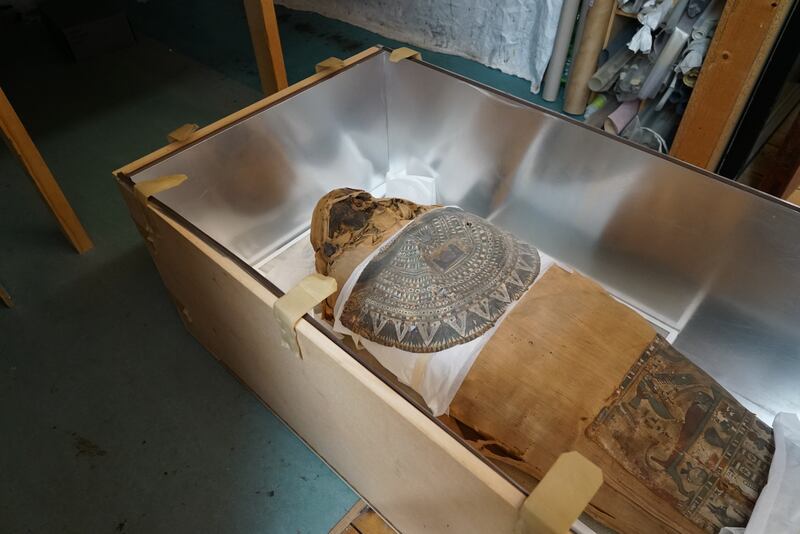
There are already precedents for Irish institutions returning culturally sensitive objects. In 2009 the University of Galway handed back the Grandfather Akwiten canoe to the Maliseet community in New Brunswick, Canada. In 2024, University College Cork returned mummified remains and a sarcophagus, along with other objects from Ancient Egypt to the Egyptian Minister for Tourism and Antiquities.
A group called Haka Hoki Mai Te Mana Tupuna (“return the ancestral mana to Rapa Nui”) is looking for at least five wooden figurines held by the National Museum of Ireland and the Ulster Museum which were taken from Rapa Nui, also known as Easter Island, in the early 1800s, though no official request has been made for their return.
Teehan says the report is not suggesting Irish institutions hand back everything that is not Irish in their collection.
“We have established a framework for individuals if they wish to make a claim that there is a process that they can do this. Before this, there wasn’t anything,” she said.
“We want to make sure the claim is established and fair on both parties. If it is the case that the outcome cannot be reached satisfactorily, that there is an opportunity to have an advisory panel and that they can make representation to the minister.”
“There needs to be a recognition that Irish institutions need to be resourced for this task.”


