
Archaeology is full of stories of ancient civilisations being rediscovered having been buried under centuries of vegetation.
In Ireland’s case a significant piece of history disappeared – not from some remote location, but arguably the most salubrious address in the country.
Vico Road and its environs in Dalkey, south Dublin, is home to Bono and The Edge from U2, Enya and the film director Neil Jordan, among other prominent people. During Covid, actor Matt Damon spent some time in the area, which is known as Bel Éire for its celebrity count and expensive seafront housing.
The second World War Eire sign in Dalkey disappeared from public memory at the end of the conflict and nature did the rest, covering it in metres of seagrass and other vegetation.
READ MORE


The discovery of the remains of a red-brick lookout in the area in 2019 suggested the presence of some second World War era history. A search also uncovered the foundations of a hut, which turned out to be lookout post number seven.
Therefore, it was established, it had to be close to one of 83 such Eire signs dotted around the Irish coast, signalling to Allied and Nazi aircraft that they were passing over neutral Ireland. But where was it?
Fortunately, local resident Orla de Cogan found a 1950 Air Corps reconnaissance photograph which showed the chalky remains of the sign. Dalkey was the seventh location of the 83 around the coast, denoted by the number 7.
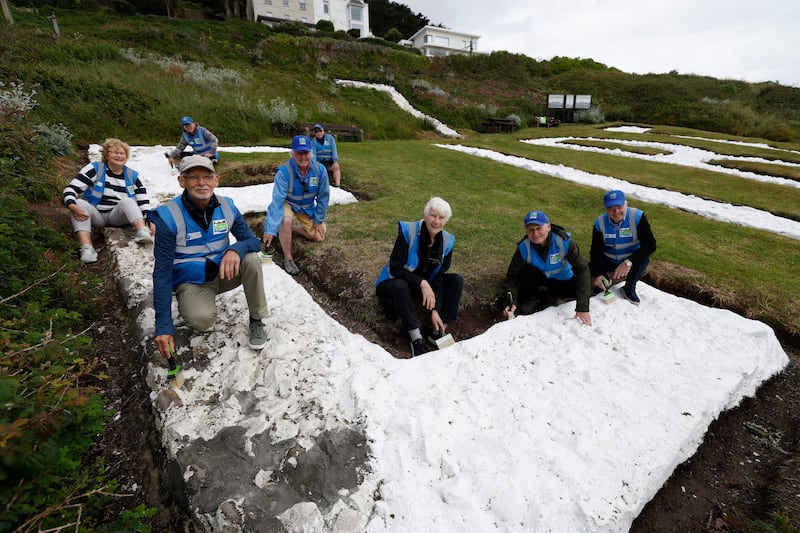
It was finally restored in 2019, but given its location, the salty sea air has eroded the paintwork, and it also became a victim of its own popularity. It is right beside the long steps down to Dalkey’s well-known Vico Bathing Place and swimmers frequently walk across the sign passing by.
[ Work to restore WWII Eire sign on Howth Head Opens in new window ]
Dalkey Tidy Towns committee member Des Burke-Kennedy said the sign had become “scuffed” with people walking over the lettering.
“We could put a fence around it, but we are appealing to people’s better nature not to walk across it. It is now a second World War memorial,” he said.
Over the weekend, dozens of volunteers from Dalkey Tidy Towns have been out with their paint brushes in fair weather and foul repainting the stonework.
Twenty-four volunteers turned up on Friday to begin the process. Specialist paint called Sika, also used on lighthouses and other locations subject to salty air, was applied.
A few days ago the sign appeared in The New York Times in an article about Ireland’s neutrality. Burke-Kennedy said Dún Laoghaire-Rathdown County Council had agreed to cut the grass around the memorial, but the rest is up to locals.
[ WWII Eire sign discovered on Bray Head after 70 years Opens in new window ]
The sign will need repainting every two years or else all the work done to restore it will have been in vain. “We hope others will take up this task in the future,” he said.


