
“It’s a lethality competition,” said United States army colonel Justin Harper last week about the Sullivan Cup, an American military tournament to find the best armoured vehicle crew.
“Lethality is really what the army is all about, so we’re here to learn things about the best competitors in the army, about the platforms and how to display combat excellence in this environment,” he told Stars and Stripes military news organisation, echoing the bellicose language of the US secretary of defence Pete Hegseth.
Over the course of a week, the Sullivan Cup pits various branches of the US military against each other, along with a handful of international teams.
In the end, the most “lethal” team came not from the US military but from Ireland.
READ MORE


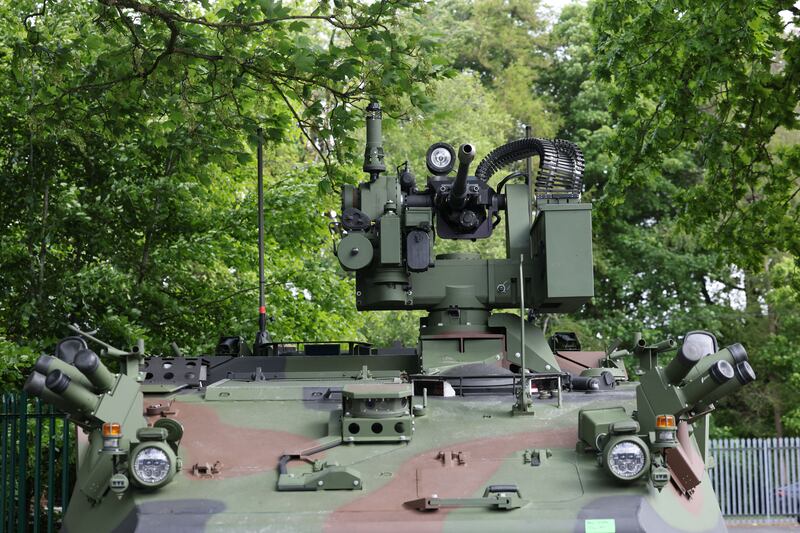
Earlier this month, a five-man crew from the Irish Army’s Cavalry Corps beat six US teams in the operation of the M2 Bradley, a 35-tonne tracked vehicle. Though it bears a strong resemblance to a tank, the M2 Bradley is technically an “armoured fighting vehicle”.
What made the achievement even more remarkable was that the Irish Army does not operate any tracked vehicles, much less any Bradleys. None of the crew had even seen a Bradley in real life, meaning they had to learn from scratch how to operate the platform in advance of the competition.
“The country had never competed in that competition before, never even seen the Bradley. We never expected to win,” says Sgt Shane Molloy, the gunner on the Irish team.
Even getting to the competition in Fort Benning, Georgia, was a challenge. Ireland had been invited previously to the Sullivan Cup as observers, but this was the first year it had been asked to compete. “Everyone wants to be involved and have a go at that competition. It is a high level,” says team leader, Lieut Colm Meade.
“It’s the Super Bowl of armour competitions in the world,” adds Molloy.
Before setting out for Georgia, the team spent a month training in Ireland. This included an in-depth study of US cavalry doctrine and intensive training on the Mowag Piranha armoured personnel carrier, the closest thing Ireland has to a Bradley.
As well as operating and maintaining the vehicle and firing its weapons, the competition tests crews’ physical fitness, proficiency with small arms and medical skills. There would also be extensive classroom exams in tactics.
The Army Ranger Wing provided pistol training; the Central Medical Unit gave them medical training and the Artillery School taught the crew how to call in shell fire.
Key to the Irish strategy was to “control the controllables”, says Meade. The crew did not have a Bradley to train on but they could make sure the basic skills common to all militaries were honed to a fine art.
This would allow them to “pick up points in all the auxiliary stuff” the US teams were likely to ignore.
Once in the US, the crew continued training in simulators and had to pass a number of qualification rounds before they were allowed on the range.

Despite never seeing a Bradley before, much of the Irish team’s training transferred seamlessly to the new platform. “The basic skills are all the same, regardless of platform,” says Molloy.
As they were being instructed by US personnel, they realised they knew much of the information already, he recalls.
The competition itself was a gruelling seven-day event. Molloy, Meade and the vehicle driver, Trooper Tristan Regan, were tested in various real-world scenarios before sitting classroom exams in the evening.
At night they slept in their vehicles before starting again at four the next morning. “To be honest, you didn’t sleep too much,” says Meade.
The crew was shocked when the final scores were announced. “They’re not going to let an international team win because it looks terrible on them,” Meade recalls thinking at the time.
Ireland won with a score of 699 out of 1000, beating the US 155th Armoured Brigade Combat Team by five points.
“It was embarrassing for them but they came up after and shook our hands. They knew how professional we’d held ourselves. They enjoyed our company. We enjoyed theirs,” says Molloy.
Though it was Ireland’s first win in the Sullivan Cup, Defence Forces teams have a long history of punching above their weight in similar competitions.
Last year, an Army Ranger Wing team won the Latvian Special Operations Tactical Sniper Competition, while Defence Forces Medics won the British medical competition Arduous Serpent for the second year running
An infantry team won silver in last year’s Cambrian Patrol competition in Wales, while teams also placed highly in the American Best Warrior competition in 2025 and 2026.
Winning competitions such as the Sullivan Cup validates Irish training methods and “sharpens an already sharp sword”, says Meade.
As the Defence Forces looks to modernise its armoured fleets as part of a deal with France, it also shows the crews can perform effectively no matter the vehicle, he says.


