

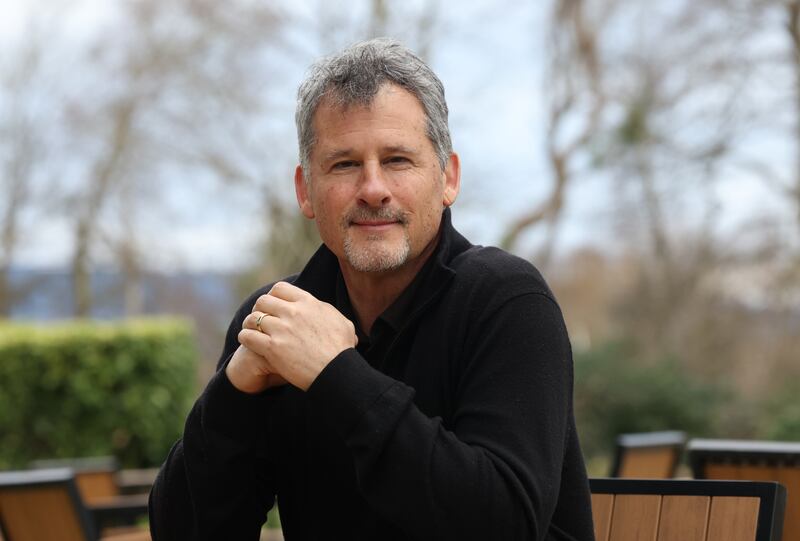
What John Kinyon experienced in a troubled household as a small child engendered a lifelong interest in how to shift human conflict into connection.
Born in the San Francisco Bay Area of northern California, he was only five years old when his mother took her own life during a traumatic time for the family. He traces his “deep draw” to looking at what disconnects humans back to that big, personal loss.
As a little boy, you want to “make things better, make things okay”, he says. That desire continues to this day, with a conflict resolution method he has developed called “Mediate Your Life” (mediateyourlife.com). It can be applied to a person’s internal conflicts as well as to friction with others. Such is his international reputation within interested circles, a recent workshop that he led in Tullow, Co Carlow, attracted participants from 13 different countries, including Ireland.
In hindsight, Kinyon believes post-natal depression was a large factor in his mother’s mental illness, after the birth of his brother who is 15 months younger, but that was not a condition much recognised then. “I must have experienced a tremendous amount of turbulence and conflict and uncertainty. I think that experience was so formative for me to then want to understand conflict and human connection and disconnection,” he tells The Irish Times. “It wasn’t until I started to go into college that all the stuff I hadn’t dealt with really started to come up.”
READ MORE


He did therapy, which interested him in clinical psychology, as he began to understand how his issues related back to that loss.
But after graduating in psychology, he felt it was not the right path for him. Drawn to the work of Mahatma Gandhi, who used nonviolent resistance at a time of political and social upheaval in India in the first half of the 20th century, Kinyon toyed with the idea of working in mediation.
“But I wasn’t finding anything that appealed to me. It seemed very strategic, very mental, very outcome focused, and I was looking for something that had more heart to it.”
He found that when he heard Marshall Rosenberg, the founder of nonviolent communication (NVC), speak at a mediation conference in 1998. “It just blew my mind. Oh my God, here’s somebody speaking everything that I cared about, all woven together,” he recalls as we talk in a Co Dublin hotel.
Even devotees acknowledge that the term NVC can be off-putting. For people who don’t understand its roots in Gandhi’s work, Kinyon likes to call it “empathic communication”. Humans have a natural tendency to be friendly and caring towards each other – when we’re not threatened, he says. It is perceived threats, real or imagined, that raise the hackles and lead to enemy-making. Common sense would suggest that climate change is a compelling case for global collaboration but, instead, he sees divisions being exploited for political power.
“I think in a way that’s probably driving a lot of the deeper divides and conflicts. People not feeling safe in various ways environmentally and sensing, even if unconsciously, that we’re less secure. Instead of coming together, it’s actually what triggers people to feel unsafe and then go into those patterns of tribalising.”
[ Really getting lost in a good book is one way to find better mental healthOpens in new window ]
People feel safe in their group, he points out. “Leaders can use that to make ‘others’ the enemy” and the flames of conflict are fanned on social media. Algorithms that silo us into information bubbles, where we don’t hear other perspectives, heighten the instinct to group against a perceived enemy.
“My tribe versus yours – it’s very evolutionary.”
It is why he believes finding what he calls “the third side” more important than ever. In “Mediate Your Life” Kinyon has drawn on NVC to devise a triangular, three-chair model. It represents two sides of a conflict and then a third for the perspective of what connects, rather than divides, the other two.
Emotions and behaviours are driven by personal needs, around wellbeing, connection and self-expression, being met – or not. When we are triggered by somebody else, it can be very instructive to reflect why – and, vice versa, to consider reasons others are reacting to us. Despite the differences, there will inevitably be needs in common and recognising those can be the way out of a stalemate.
On a global scale, “I feel like it’s a time where we either do that, or we maybe don’t make it at some level, right?” says Kinyon. “Like the stakes are so high with the power of our technology, what we’re doing to the environment, all the stakes are getting to crisis points. But if we can work together, if we know how to connect across our differences, our common humanity, there is a way to do it, that’s the thing. There really is.”
Zohran Mamdani doesn’t use rhetoric and language that’s derogatory about the other side. That’s language we get into when we don’t feel safe
— John Kinyon
The need for what he teaches has surely never been greater – particularly in his home country? His easy flow of quiet responses to questions momentarily falters. “There’s so many things I could say about the US…” he starts, before trailing off, choosing to leave them unsaid.
While many politicians appear to thrive on division and use it for their own ends, he singles out Zohran Mamdani, the mayor of New York city, as an encouraging exception. “He doesn’t use rhetoric and language that’s derogatory about the other side. That’s language we get into when we don’t feel safe.”
Kinyon believes if more leaders, be that in politics, business, religion or the non-profit sector, could take this approach, fundamental change is possible. But it is at grassroots level where understanding language that connects us empathically might be most important. “To open our perspective” and to recognise “we’re different, we’re individual, and yet we are part of larger systems together”.
Glenn Treacy, a Dublin-based Gestalt psychotherapist and certified trainer in nonviolent communication, believes there is a movement away from NVC “as a pseudo-personal growth” into practical applications. “The culture of NVC can be seen as ‘alternative’. I think there’s a drive now, this is so powerful, let’s bring it into organisations.”
He cites how Satya Nadella, after he became CEO of Microsoft in 2014, insisted that his senior leadership team all read Rosenberg’s book Nonviolent Communication. “He brought this sense of empathy into Microsoft, which had not been there,” says Treacy, who gives the book to students he teaches at the UCD Michael Smurfit Graduate Business School. Often their response is that the nonviolent communication approach is unrealistic, that there is too much focus on empathy.
“Then I say, ‘well, do you realise that this is a core training for the Dutch police’? And that really silences people,” adds Treacy, who organised Kinyon’s workshop here. Such is the level of interest, repeat dates for 2027 and 2028 have already been scheduled, with a view to Ireland becoming Kinyon’s European training base.

Amy Peake, founder of the UK charity Loving Humanity and a participant in the workshop, describes Kinyon’s approach as “nonviolent communication on steroids”. She had come across NVC in 2016 when she was having a difficult time in her marriage “but also working with the UN, who were being incredibly difficult to communicate with”.
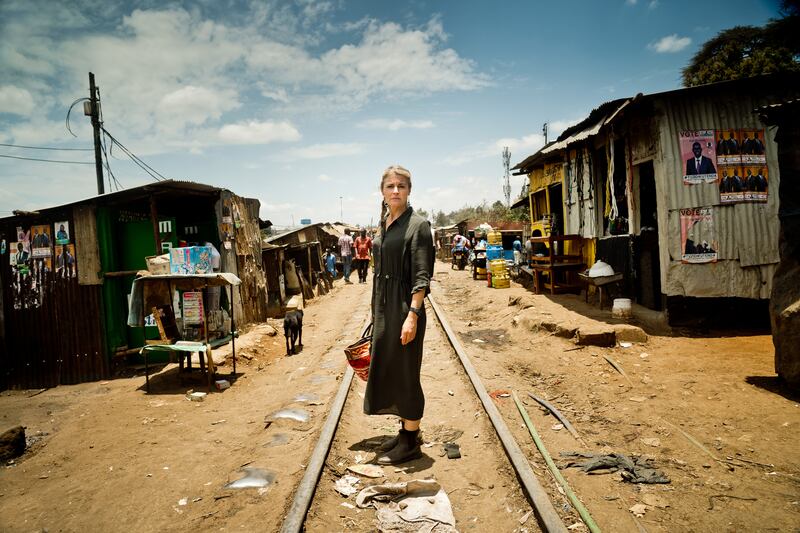
Peake’s life had changed the day she picked up a magazine in her GP’s waiting room in 2014 and saw a photo of 18,000 people queueing for bread at a refugee camp in Damascus. Living in Cornwall and the mother of three children, then aged between five and 10, she tried to imagine how she would cope in such circumstances. Her wondering about how women managed basic needs, such as periods, in conflict zones propelled her into action.
Long story short, within two years she had opened a micro factory in a refugee camp south of the Syrian border to make washable sanitary pads and nappies. This has been replicated in several other countries since, including Jordan and Burundi. The distribution of pad kits helps to keep girls, who previously may have been missing five days of school a month during menstruation, in education.
Peake had never done a mediation course and not met Kinyon before coming to the workshop, she tells The Irish Times. “To watch him in action was something I wasn’t expecting because there’s so little ego there. So much presence and the holding of space for people to enable them to communicate, which I find incredibly powerful.”
So much in life, whether personal or professional, comes down to communication, she says. “If I can communicate effectively and/or help others to communicate, then goodness me, it’s transformational.”
If everybody could communicate clearly, “we wouldn’t have war and women would be equal to men”, she suggests. Instead, we’re “stuck in this sort of patriarchal, non-listening society where, I mean, it’s a wonder that we function at all, quite frankly”.
Kinyon sees his role as a guide to people in conflict. “I’m leading, and I’m sort of following where they want to go, but I know the pathways of this often difficult terrain and have the equipment and the tools.”
The steps will be different, depending on the scenario, but there is always “the I, the you, and the we. Moving through the three core perspectives that the three chairs represent. If you can make that journey, it’s so powerful.”
Another element is as a healing space for trauma. “That overlaps somewhat with the neuroscience understanding of how we carry trauma in us, in our minds and bodies – generational and collective traumas, as well as our own personal trauma.”
Even though Mediate Your Life is not therapy, it can have therapeutic aspects. Without this dimension, some conflicts just won’t get resolved, he says, “there’s too much pain”.
He also acknowledges that for this method to work, there has to be a willingness to shift from a desire for “power over” to “power with”. It requires understanding that the latter is mutually beneficial and “can be way better than any other kind of ‘power over’ strategies. But people have to see the wisdom of that.”
Therein, perhaps, lies the rub.
[ Childhood exposure to poor food can lead to lasting changes in brain functionOpens in new window ]


