

Brian Hogan reads books with his ears now, after a single-punch assault left him blind and living with a brain injury.
Audio books are his escape from the world, he says, after he goes to bed in the evenings at home in Clarecastle, Co Clare. A wheelchair user, he has been able to live independently in a new, purpose-built bungalow for the past year and a half, with the daily support of carers.
“My life isn’t rock-and-roll, but I have a smile on my face,” says Hogan, a native of Limerick city, whose life was upended at the age of 32 after a night-time attack in Nottingham, England. He was working there at the time as a quantity surveyor on construction projects.
“It was a whole combination of unfortunate events,” he says of that night, 16 years ago. His best friend, who he usually socialised with, was on holidays abroad that weekend and he ended up in the company of the “wrong people”. One of them invited a stranger back to Hogan’s house.
READ MORE


“I didn’t know this person,” he says of the man who hit him with one punch to the head. Not realising the extent of the damage done, Hogan went to bed. “That was my biggest mistake. I didn’t get to the hospital until the next day. My brain had been bleeding for the night.”
A housemate discovered him unconscious after he failed to appear out of his bedroom the following morning.
In awareness-raising about brain injuries in recent years, one message Hogan hammers home is the importance of getting any head injury checked out straight away. It is a lesson he learned in the hardest of ways. He was left in a coma and his family was told he had only 10 per cent chance of pulling through, but Hogan survived against the odds.
After rehabilitation in hospitals and time spent in a Co Limerick nursing home for the elderly, he says he was “rescued” by Acquired Brain Injury Ireland. He lived for almost 12 years in that charity’s Anvers Housing in Clarecastle. “I worked really hard; I was given goals to reach,” he says, slowly progressing to the stage of being able to move into an independent unit.
Ahead of Ireland Reads Day on February 28th, when everyone across the country is encouraged “to get lost in a good book”, Hogan says being able to listen to a variety of books continues to feed his imagination and intellect. Having paid a subscription service for audio books, he was delighted to find out from his local library in Ennis that he could listen to them free through BorrowBox. This digital resource is available to any member of the 330 public libraries in Ireland.
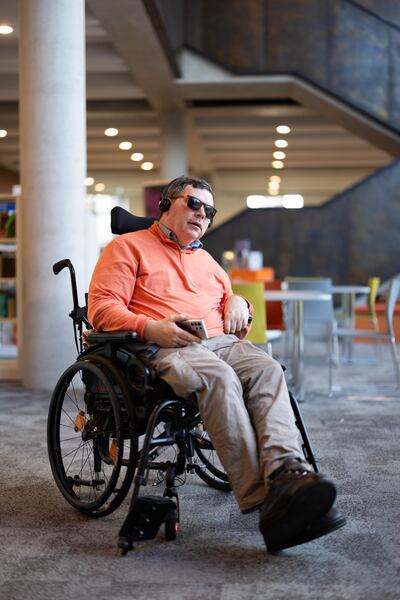
Once a month he goes to Ennis’s De Valera Library to attend a group run by Headway Ireland, which provides services in the community to people affected by brain injury. The library moved into a brand new building in November 2024 and is now fully accessible to people with disabilities, and has suitable bathroom facilities.
Not only is the building physically suitable for the Headway group, but “then extra richness came from the relationship that they built with the staff”, says senior executive librarian Cora Gunter. She has worked in the library service for 23 years and was in Galway before moving to Co Clare.
“We’re one of those few free services that are open and available to everybody. That has its rewards, but then it has also its challenges.” While people traditionally think of a library as a very quiet, safe place, staff of modern-day libraries have to manage the impact of being available to all communities, including people who may be homeless or have addiction and mental health issues.
“We particularly want to reach out to those who most need us. Being accessible is so important because they are the cohort that probably most benefit from the service and being out in the community and being able to be independent for themselves in our space.”
Public libraries, as one of the few “cradle to grave” resources, are still underused, she believes. People may be unaware of the diverse range of services and activities that are now available within, and beyond, the walls of their local branch.
[ Inchicore library: ‘Empty, gorgeous art deco’ building faces uncertain futureOpens in new window ]
One big change Gunter has noticed is the rising demand for study facilities. The 100 spaces in the De Valera Library are full nearly all the time.
“The increased need for space is immense because so many people haven’t got spaces in their homes,” she points out. Teenagers studying for State exams or adults returning to education are among those seeking a seat at library desks. The family-friendly nature of a library is also very important for attracting the youngest of readers.
“We’re busy on Saturdays because we have the fathers – the mothers go shopping and the dads are sent over to the library [with the children],” says Gunter. A reader all her life, “books would be like a comfort to me”. Whenever she moved into a new phase or place, “I always used to bring Lord of the Rings and it kind of made me feel safe from that change. You could go back into another world as you got used to that space, or whatever.”
She echoes Brian Hogan’s feelings about books being a refuge. He loves to revisit, for instance, the scenes of All Creatures Great and Small, in the James Herriot books about a rural vets’ practice, which he was introduced to by his late mother. She was a keen reader who frequented second-hand bookshops and would bring him and his five siblings to the library.
The Herriot books are set in the Yorkshire dales, a landscape very familiar to Hogan, as he worked in the adjoining Derbyshire dales when he lived in Nottingham. That was a time in his life when he thought “having the nicest clothes” and other material things were important.
“Having good associates and good friends, having good relationships. That’s what’s far more important,” he says now. His Christian faith helps to sustain him and he attends weekly meetings of Jehovah’s Witnesses.
“It’s important,” he adds, “to have hope for the future.”

Adults who have fallen out of the habit of reading books are particularly encouraged to pick one up this Saturday (February 28th) on Ireland Reads Day.
The campaign is a government initiative to celebrate the joy of reading. Funded by the Healthy Ireland programme and supported by public libraries, a key message is that relaxing with an enjoyable book boosts wellbeing by relieving stress and improving cognitive development. Research shows that reading for pleasure enhances empathy, improves social connections, combats loneliness and keeps people mentally active. Various local libraries will host special events to mark the day (irelandreads.ie).
[ Planning permission granted for new library to serve Crumlin and DrimnaghOpens in new window ]
“Just jump in, find something, talk to other people [for recommendations],” says arts broadcaster Rick O’Shea, who 12 years ago set up an online book club which now has more than 43,000 members. A couple of years previously he had realised he was not reading as much as he wanted to.
“I’d get these little moderate panic attacks every time I went into a bookshop because I’d realise there was so much stuff coming out that I would never get to.” At that point he was getting through about 15 books a year.

“The great enemy of reading is screens. That’s the same for adults as it is for kids. It’s the same for me.” If he wants to make proper inroads into a book, he finds it best to leave his phone somewhere else in the house. “Physically not have it somewhere where you can reach it easily, to look up something that you’ve just thought about.”
Typically he reads for 30-40 minutes after he goes to bed at night, which also helps him with one essential pillar of health, sleep. He recommends setting a target to cultivate habitual reading, as he did in 2014, when he announced he was going to read 100 books that year. Probably not practical for most people, he concedes, “but set yourself the target of, like, one or two a month, or whatever you think is doable”. Blogging about the 100 as he went, led to the setting up of the Rick O’Shea book club on Facebook. Don’t persist with books you hate, he says, because that leads to resentment and procrastination over continued reading. Whereas, he adds, “I’ve read 90 pages of the new book that I started yesterday because it’s great.”
He read to his three children, now adults, when they were babies, “before they were capable of understanding what it was”. But he treasured the time with them, as they grew to learn that a story came out of the book open in front of them.
‘The libraries are a brilliant resource and I think as a country we need to celebrate them’
— Sarah Webb, children's writer
As presenter of RTÉ Radio 1’s arts programme Arena, O’Shea reads books for work as well as pleasure, “but hopefully the two intersect”. And he makes clear that reading, for him, is not a hobby.
“It’s not something that I do for fun. It is woven through me for all of my adult life. So that’s why I’m always such an evangelist whenever I get the chance.”
Family psychotherapist Richard Hogan is also passionate about reading books, which, he believes, are more important than ever for mental health, to counteract the superficiality of social media.
“I just think it’s such a sustaining gift through life, no matter what age – but particularly in adolescence when you might be struggling. You think you’re the only one in the world going through this particular feeling or particular emotion – and then you read and see that you actually aren’t.”
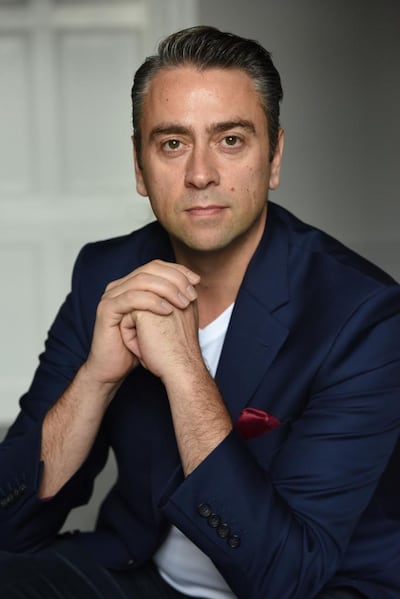
He grew up in a Cork home full of books but, as a child with dyslexia, took no interest in the ones he was being given. That was so until the day he pulled The Catcher in the Rye off the shelf in the library that his late father, Irish Times journalist Dick Hogan, had built up.
“It just blew my head off,” he says of the 1951 JD Salinger novel. “It spoke straight to me, that recalcitrant, teenage, idealistic kind of cynical voice that we have as teenagers. It sent me off down the rabbit hole of reading and devouring books and just loving it.”
In meeting characters in books who struggle, “you figure out who you are”, he says. “Novels bring us into contact with the human condition: to struggle, to strive, to fail, sadness, relationships ending; massive existential themes like good versus evil. I think we need that probably more than ever.”
[ Travel books popular in libraries as Ireland Reads gets under wayOpens in new window ]
Children’s writer and bookseller Sarah Webb works part-time in a bookshop in Greystones, Co Wicklow, where she sees parents and grandparents increasingly seeking advice on how to keep children reading. She champions the printed word, believing that “reading on a screen or online doesn’t have the same escapism”.
The closeness of the bond that is created when a parent reads to a baby or child is a vital part of the experience. Outsourcing bedtime reading to a phone or children’s audio player, she says, is not the same at all.

“I couldn’t read until I was nine and a half so I really relied on the adults in my life to read [to me]. I was able to read comics because I was reading the pictures, so comics like the Bunty became incredibly important to me.” To this day she regards comics as a vital art form, especially for children, because they are so visual.
As soon as Webb started to read, she also started to write. “I realised I had stories that I wanted to tell that weren’t in books.” She has been doing vast amounts of both ever since.
To lapsed book readers, she suggests listening to an audiobook might be a good way back, along with novellas such as those by Claire Keegan, as they are short.
Advice that applies equally to children and adults is “to read things you like. If you’re interested in history, read history; if you like a romantic novel read that; or if you’re interested in poetry, read some poetry.”
People who have not been in a public library for many years may not realise there are no longer fines for late returns, which takes stress out of borrowing. There are now likely to be multiple copies of popular books, she says, rather than just one or two that always seemed to be “out”. A library card from one local authority area can be used in any public library across the Republic.
“The libraries are a brilliant resource and I think as a country we need to celebrate them,” she adds, “because a lot of countries are closing theirs.”


