

Of the advice Daniel Pender thought he might offer in his first term as a councillor, he did not expect pothole claim procedures to top the list.
“I’ve never had so many calls about burst tyres,” says the Fianna Fáil member of Carlow County Council who ran for election on concerns about housing and mental health.
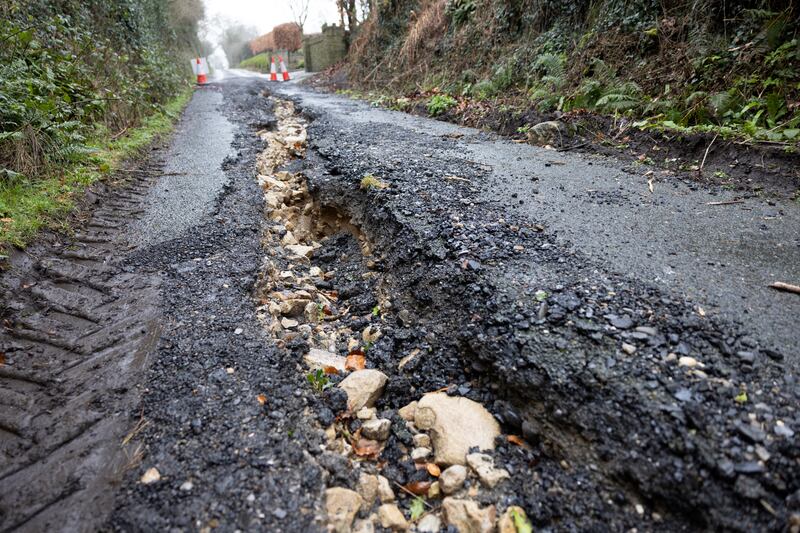
“There seem to be potholes on every road and ones that were there before have grown – it’s a bit of a disaster.”


Like other counties battered by the relentless rains of recent months, Carlow is feeling the impact in the form of a badly scarred road network.
READ MORE


It will cost at least €4 million to fix and a request for special funding has been submitted to the Department of Transport.
The department has numerous such requests, relating to 500 roads it says suffered “significant damage”, mostly in eastern counties.
Wicklow County Council’s initial estimate is €15.5 million, Wexford is seeking at least €12 million and Kilkenny’s provisional ask is for €4.5 million.
The total requested by seven of the most severely affected counties is running at €56 million, but is expected to rise.
“The department is liaising with affected counties, who are continuing to compile and assess damage on the ground to enable proper estimation of the total damage caused and the estimated cost of remediation,” says a spokesperson.
In some cases, full assessments cannot be made yet because roads are still flooded. More than 100 remained impassable up to last Wednesday.
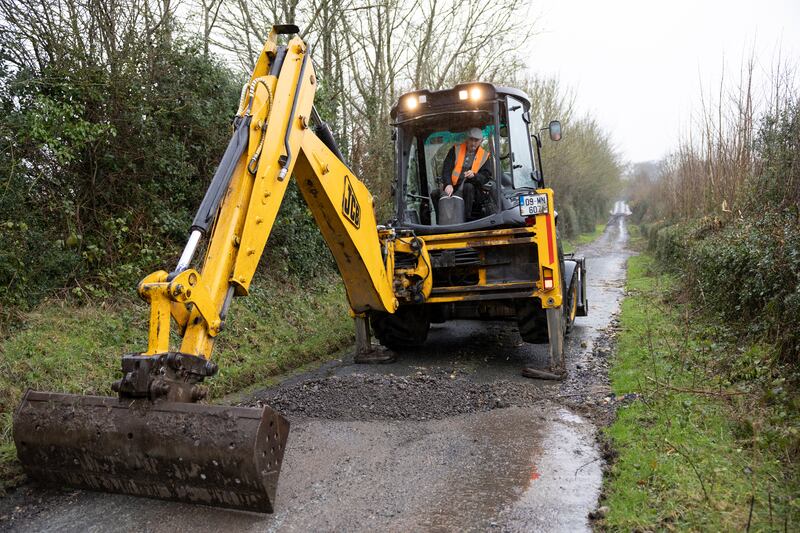
Carlow County Council chief executive Coilín O’Reilly has prioritised clearing impassable roads.
“Some are very small roads, but they’re vital to those living on them for getting to work, getting the kids to school, getting to the farm,” he says.
“We can do go-arounds for a while, but you don’t want people going 20km out of their way to get somewhere just up the road.”
Living outside Leighlinbridge in the rural west of the county, Pender endorses that approach.

“We don’t have the luxury of being able to walk to work or into the town. People need the car and if anything happens to that – or to the road – they’re stuck,” he says.
There will be no quick solutions, however. Many repairs will be patch-ups until conditions allow for more thorough reconstruction.
Modern roads have at least three layers of hard-core, concrete and asphalt but smaller, older roads can often be a thin strip of asphalt laid directly on bare ground.
“A lot of the smaller roads go back to the 1940s, 30s, 20s,” says O’Reilly.
“When it’s fine and dry, it’s grand, but the land got so sodden that the mud and clay did not support the tarmac,” he says. “It began to collapse into the mud. We can’t repair those roads properly until that mud dries out fully in the summer.”
Potholes are not the sole preserve of rural Ireland. Dublin Airport is shutting its south runway for three days this week for repairs to the main taxiway.
“The urgent repairs on the taxiway, which handles upwards of 150,000 aircraft every year, are required due to surface break-up caused by the recent exceptionally heavy rainfall,” said airport operator DAA.
The airport has received more than double its typical rainfall this year – 229 per cent of its average for January and 255 per cent in February.
“This led to more wear and tear than usual on the taxiways, essentially [the] break-up of the surface, which can lead to safety issues with loose debris potentially being sucked into plane engines,” said DAA.
During the closure until Thursday, all flights will use the north runway, which DAA said would mean residents in the vicinity experiencing more noise than usual.
Potholes and noise are relatively minor inconveniences compared to the enormous losses from Storm Chandra, which hit at the end of January, and the non-stop rain and flooding of homes and businesses that preceded and followed it, but it is indicative of the wide reach of the extreme weather.
While the wet weather hit a relatively small number of people extremely hard, it also affected – and continues to affect – a large number of people in many smaller ways.
“People have lost three weeks of grazing,” says Joe Patton, dairy specialist with Teagasc, the national farm advisory body.
“Generally, by this time you would expect 15 to 20 per cent of land to be grazed, but a lot of farms have not done any.”
That means cattle are stuck in their winter sheds and feed reserves are running low, so there are extra costs from buying in fodder.
For an industry that bases its prestige on livestock being grass-fed in the open air, that’s not ideal.
Slurry storage is also a problem, with many farmers running out of tanker space to keep the manure from their housed livestock.
Slurry, liquidised manure, is sprayed on fields as fertiliser but that is not allowed during wet weather as it runs off sodden soils into nearby waterways.
With half the country’s rivers, lakes and estuaries already in poor condition from agricultural and other pollution, a deluge of slurry would be disastrous.
Tillage farmers are also behind schedule, with 30 per cent of beet crops and 10 per cent of potatoes still in the ground in conditions too soft to support harvesting machinery.
Teagasc crop specialist Michael Hennessy says half those crops were likely to be lost.
Winter barley is also waterlogged and may not survive. “It doesn’t like to have wet feet,” says Hennessy.
Spring planting will also be delayed if conditions don’t improve fast and, in some instances, may be abandoned as harvesting would be pushed late into autumn and risk running into more bad weather then.
It’s not wet feet but dry boots that’s bothering Mick Kennedy, general manager of the Dublin and District Schoolboys’ and Schoolgirls’ League.
Many of the 3,500 soccer teams in the league rely on grass pitches that are swamped. And some of the 53,000 players haven’t had a match since before Christmas.
“It’s been the worst experience we have had weather-wise in the last 30-odd years,” says Kennedy.
Every effort has been made to squeeze more matches on to astro pitches where they exist, but logistically, it’s difficult.
“We have midweek games starting in April as we normally do after Easter and we’ll be having more of them to try and catch up, but they have to be in the evening and we have rules about how late kids can play,” says Kennedy.
“And we can’t have them too early because of midweek traffic. If you have Home Farm [in the north of the city] coming to Knocklyon [in the south], they won’t be making a six o’clock kick-off. It does affect the kids when they can’t train or play. If anything comes out of this, it’s that the FAI, the councils and the clubs all have to try to provide more astros.”
Other outdoor activities have also suffered. Walkers and trekkers heading back to their favourite tracks and trails may find some off-limits.
“The saturation of ground and the intensity of runoff caused rutting, surface deterioration, and structural damage at a number of forest locations,” says Coillte, which manages the State-owned forest parks.
Dramatic social media footage of part of the Wicklow Way at Ballycurragh Hill gives an idea of the forces unleashed, with the track looking like an earthquake ruptured it, leaving a deep cleft filled with gushing water.
“This represents an extreme example of the type of damage caused by the combination of Storm Chandra and the prolonged rainfall,” says Coillte. Other affected areas are still being assessed with diversions in place until repairs are finished.
“Assessment ongoing” is a refrain much-used by public bodies as the effects of the rain continue to emerge.
Irish Rail expects it will cost €200,000 to repair signalling equipment, embankments and boundary damage, but final bills are not in. Fingal County Council is still assessing coastal damage at Skerries and Balbriggan.
Met Éireann’s long-range forecast, meanwhile, advises – with the caution that attaches to any period beyond the coming week – that March may also be wetter than average.
Meanwhile, the procedure for pothole damage claims is to get a pin number from the relevant local authority and then complete a form on the Irish Public Bodies Insurance website, ipb.ie.
Given the adverse weather of recent months, the service will be busy.


