
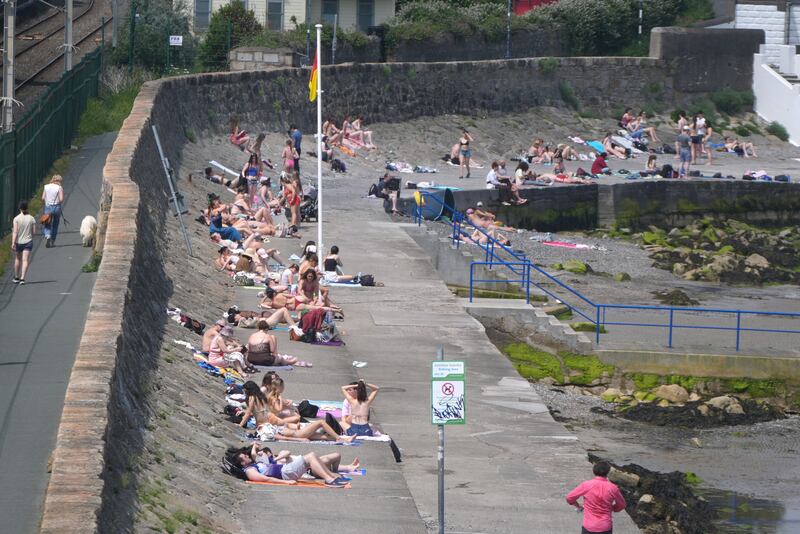
The punishing heatwave that has swept across Europe, during which temperatures have climbed to unprecedented highs, is set to continue on Thursday. Moreover, Ireland is bracing for the hottest day of 2026, possibly smashing a 140-year record.
Soaring temperatures in France, Italy, Spain and England and other countries in western Europe have put significant strain on tens of millions of people. One analysis estimated that close to 100 million people in Europe are facing temperatures of more than 35 degrees.
Temperatures climbed to 41 degrees in Nantes and surrounding areas in western France on Wednesday, with Paris experiencing similar highs. That left one-third of France’s administrative regions on notice for an elevated risk of forest fires due to the spiking temperatures, low humidity, winds and dry ground conditions.
Spain’s forecasting agency Aemet warned that parts of the country faced “significant danger” from the extraordinarily high temperatures, which surpassed 40 degrees in some northern regions.
READ MORE


The highest temperature in Ireland yesterday was 27.9 degrees at Moore Park in Co Cork, followed by 27.7 degrees at Oak Park in Co Carlow. But Met Éireann’s Holly O’Neill warned a new heat record was “possible” today.
The highest temperature ever recorded in Ireland was in Kilkenny in 1887 when the dial reached 33.3 degrees. While Met Éireann’s predicted value range for today is between 25 and 31 degrees, it could go higher in the west and midlands.
“It is possible that we could see that temperature record being broken today,” said O’Neill. “It’s just a case of seeing how it develops throughout the day and whether or not we see those temperatures climb.”
She noted that even if that long-standing record is not breached, the high temperatures have been significantly warmer than June norms, when values hover between 15 and 18 degrees.
According to O’Neill, Thursday will be hot and humid with the status yellow heat warning effective until Friday. She said there was some uncertainty as to whether thunderstorms would develop and, if they do, “it’ll most likely be along that west and northwest coast. We are obviously keeping a close eye on it and they could be potentially impactful if they do occur.”

Heatwave chaos in Europe; and the extradition of US millionaire Jason Cardiff
The weather has been “exceptional,” said meteorologist and emeritus professor at Maynooth University John Sweeney. “This supercharging of these extreme events adds 2 to 4 degrees on top of the normal maximum temperatures that we would have experienced over the past 40 or 50 years. So it is a change to something that’s the new normal and is likely to be more commonplace in the years ahead.
“We’ve seen it with floods, we’ve seen it with windstorms, and we’re now seeing it with heatwaves. It is a message that the regime has changed.”
He said there was no question the scorching weather was a direct consequence of climate change and said normal heatwaves were being “topped up by climate change. We had extreme events before, but these events are climate on steroids, in a sense.”
Alan O’Reilly of Carlow Weather said there were two weather stations that would be watched closely: the appropriately named Newportfurnace in Co Mayo; and Athenry in Co Galway.
“It is going to be hotter in the midlands and the west as the edge of the heat dome moves over Ireland and Newportfurnace is the one many people will be looking at. That is the one to keep an eye on,” he said.


