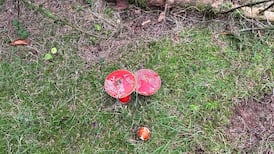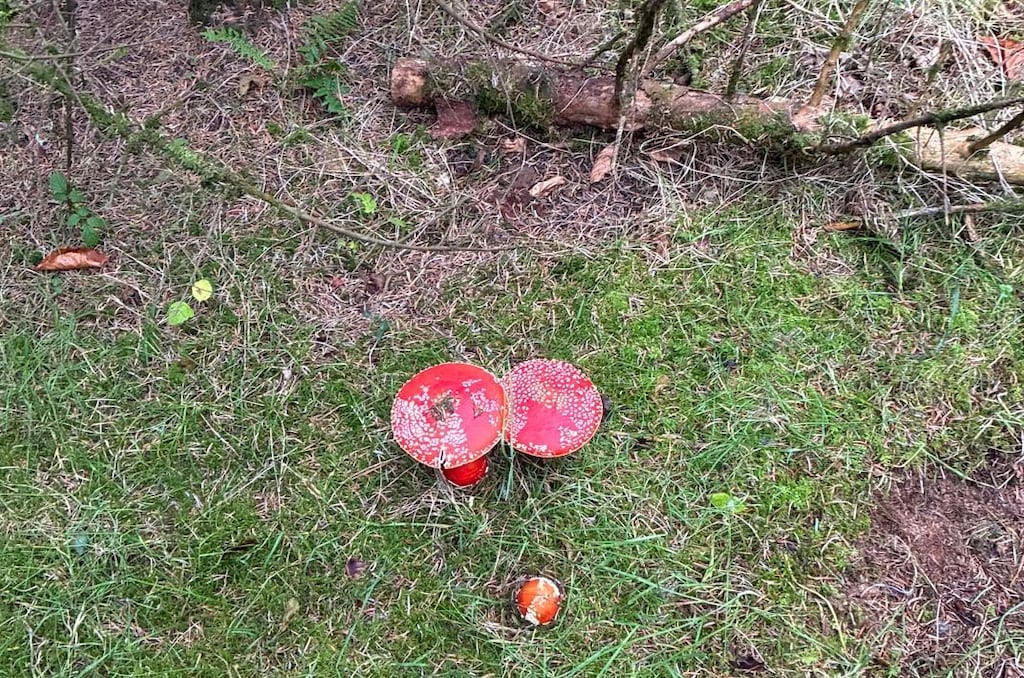
I found the attached in a semi-wooded area on a farm in Co Monaghan and would welcome some information please. Brendan Burke
This lovely red mushroom is the fly agaric, Amanita muscaria, so-called because a fly killer could be made from it. While it might look like a harmless mushroom that often appears in illustrations in children’s storybooks, it is anything but. It contains psychoactive compounds which can induce hallucinations and is considered to be deadly poisonous. Reindeer in Lapland can eat them, apparently, and their herders discovered that if they drank the reindeers’ urine after such a meal, they would get high and see such marvels as flying reindeer.
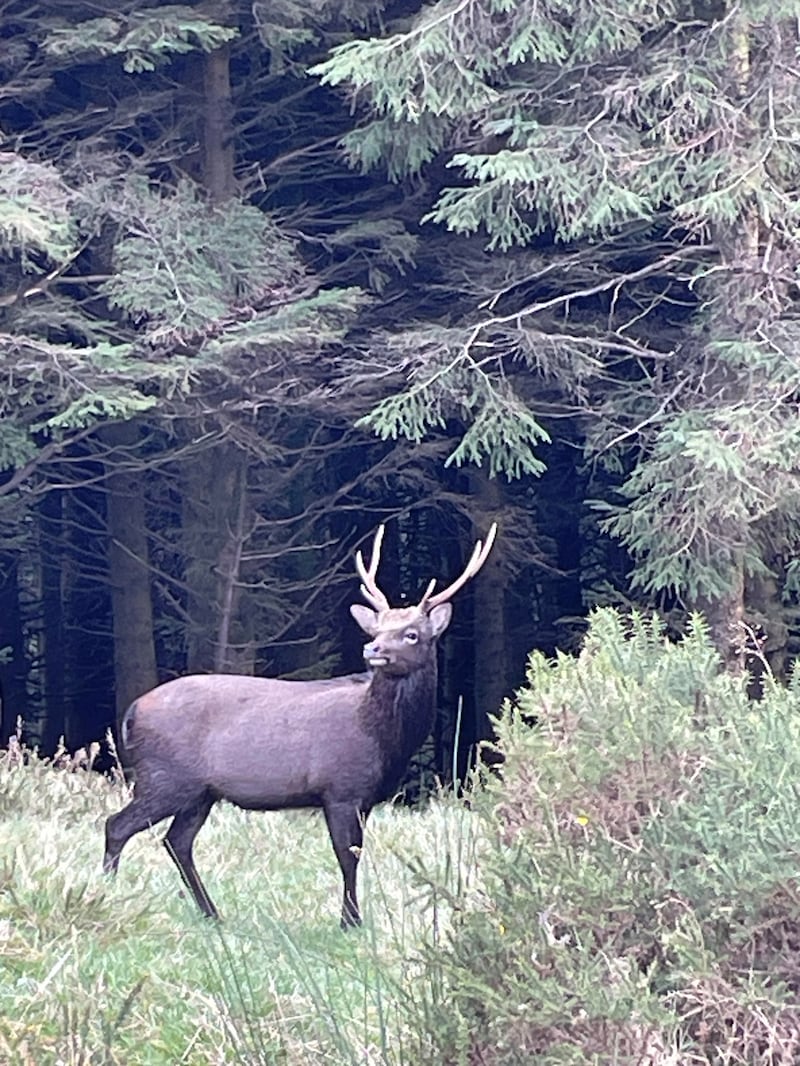
I saw this deer in Ticknock in the Dublin mountains. He didn’t seem to be aware as the wind was behind him. Jeanne Flanagan
Oh, he was aware all right, but it wasn’t you he was worried about – but another male sika stag who might be trying to cut in on his territory and his harem of females. The rut which ended at the end of October left the strongest stags with territory to defend and visiting hinds to attend to. He will shed these antlers in March or April and then next year’s ones will begin to grow.
READ MORE


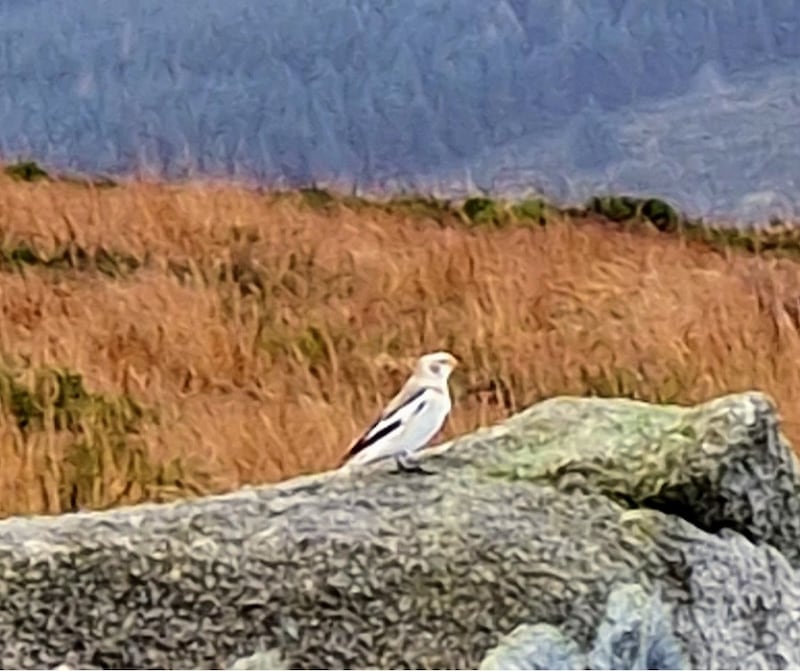
In late November on the way to Fairy Castle in the mountains of south Co Dublin, we first saw this bird in flight and noticed the full beautiful white plumage. Landing on a nearby rock, we managed to get this bird’s eye view. Is it a snow bunting? P Condon, Dublin
It is. Several of these uncommon winter visitors have been reported from around Bull Island. They are much less commonly seen in mountain areas. The snow bunting breeds in Iceland and Scandinavia and mostly winters along the coast in the northern half of Ireland. This is a male, which, even in its duller winter plumage, is still much whiter than the female.
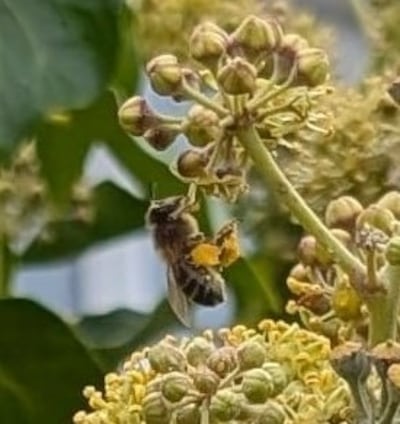
I took this photo of a honeybee foraging on an ivy plant in my garden in late November. Its pollen stash is clearly visible. Can you tell me if this is our native black bee, Apis melifera melifera? Someone suggested to me that it could be a different species, ie an ivy bee. Doireann Eames, Donnycarney, Dublin
This is a honeybee, and she looks dark enough to be our native black species. She is using the combs on her hind legs to pack her pollen baskets. In Ireland only honeybees and bumblebees have proper pollen baskets on their hind legs. All the other bees use some form of “hairs” to hold the pollen against their bodies as they collect it. But your friend is on the ball about the possibility of ivy bees. This recently discovered (2021) species of solitary bee is a late flier, timing its activity to coincide with the flowering of ivy in late autumn.
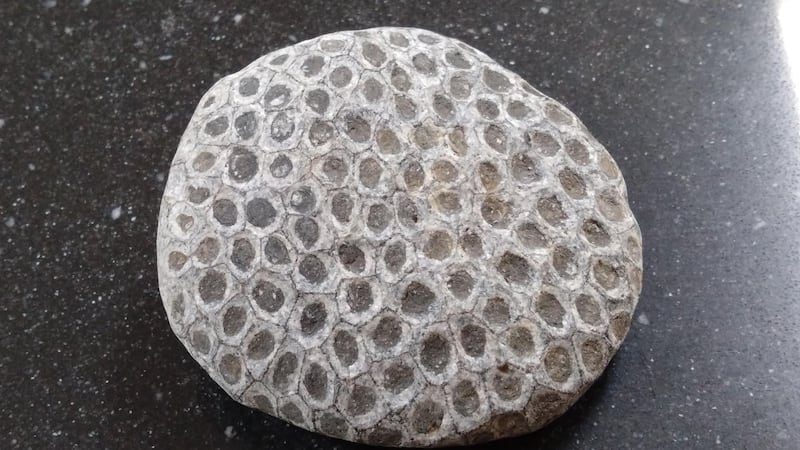
I found these fossilised limestones on a stony beach in west Wexford. Can you possibly shed some light on these striking items? Philip Delahunty, Cork.
Around Hook Head there are limestones from the Carboniferous period, which are often rich in fossils. These cobblestones were eroded away from cliffs by the waves of the sea bashing up against the coastline. Once eroded, they were then tossed about by the tidal movement of the sea, thus causing the edges to be smoothed out. They contained crinoid colonies that were fossilised and left their distinct angular shape, and the erosion of these, which were softer than the surrounding limestone, highlights them. Crinoids were ancient marine animals, some species of which are still extant today.
Please submit your nature query or observation, ideally with a photo (NOT a video) and location, via irishtimes.com/eyeonnature or by email to weekend@irishtimes.com