
It would be wrong to say the deal was clinched in Fletcher’s pub in Naas, but the traditional Irish music session organised for the visiting European Commissioner certainly didn’t hurt.
Minister for Agriculture Martin Heydon had spent the last year lobbying officials in Brussels to grant Ireland a further extension to dairy farmers’ coveted nitrates derogation, which allows them to spread higher amounts of manure and nitrogen fertiliser on the land than European counterparts.
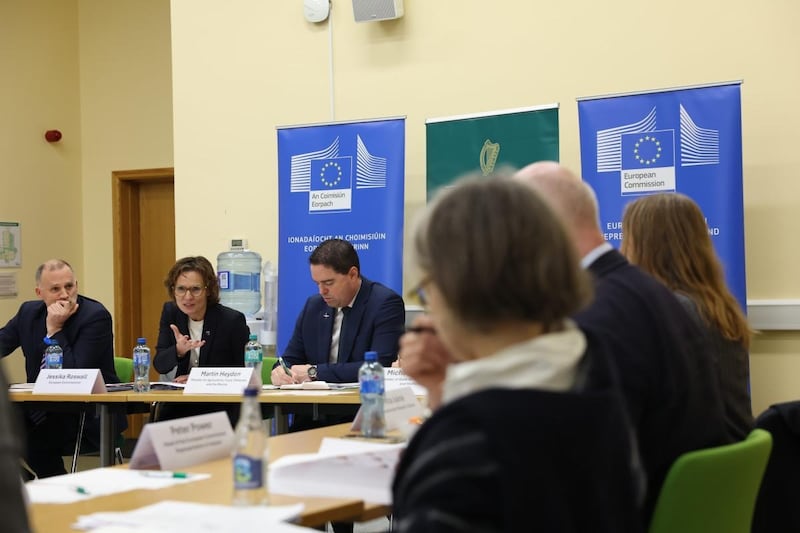
Jessika Roswall, European commissioner for the environment and water quality, had to be convinced Ireland deserved to retain the derogation.
The Swedish politician is a music fan, so time was set aside to showcase a bit of trad during her Ireland visit, at a crucial point in negotiations last month.
READ MORE


The nitrates derogation gives about 7,000 Irish dairy farmers leeway on European Union laws that protect waterways and rivers from agricultural pollution and excess runoff.
Come next year, Ireland will be the only EU state which still enjoys a derogation from the rules, a point criticised by environmental campaigners concerned about pollution in rivers and lakes.
A three-year extension was secured this week following an intensive campaign by Government to renew the derogation.
Ireland has long argued that its rainy climate and pasture-based system makes it a special case, because livestock graze in the fields for much more of the year than in other European countries.
Retaining the exemption to the nitrates law has become harder over the last two decades, as EU officials put increasing emphasis on environmental standards. The European Commission, the executive body that enforces EU laws, was clear that a rollover of the derogation would come with strings attached.
[ What is the nitrates derogation and how does it impact Irish farmers? ]
A memo Heydon brought to Cabinet in July, seen by The Irish Times, outlined what some of those new conditions would be. Brussels wanted assurances farms benefiting from the derogation on fertiliser spreading were not hampering separate efforts to protect natural habitats and species.
Heydon told Government colleagues this new ask would have significant implications and require a lot of extra work by the State.
The Government pushed for the maximum four-year extension to the derogation, but Brussels favoured a shorter time frame, at one point suggesting a single year.
Discussions between Irish and EU officials became tense as they inched closer to a deal in recent weeks. Heydon was all smiles showing Roswall around a Co Kildare dairy farm run by a father and daughter during her visit in early November, but behind the scenes officials were at loggerheads.
The commission sought to add more conditions, such as a ban on new farmers availing of the derogation. The Department of Agriculture felt these were unacceptable and succeeded in getting EU officials to drop several contentious demands.
Ireland’s water quality record was a key criteria in the assessment.
Officials from the Environmental Protection Agency (EPA) travelled to Brussels in March, to address the EU’s nitrates committee, who would eventually be voting on whether to approve any extension.
The regulator told representatives of the other EU states that there had been “little change” in the concentration of nitrates in Irish waters since 2012.
EPA monitoring shows nitrogen levels in Irish waters grew with the post-2015 expansion of the dairy herd and hit a peak in 2019.
Overall levels reduced since then, despite a slight increase in 2022 and a standstill year in 2023, but not sufficiently and, in some places, not at all.
Agriculture was putting more pressure on water quality than any other sector, the EPA said in a presentation released to The Irish Times following a Freedom of Information Act request.
High nitrates levels in the southeast of the country were a particular problem, slides prepared by the EPA for the March 20th meeting state.
The day before, chief executives from several big meat and dairy processing companies, including Dairygold and Dawn Meats, were also in Brussels to meet Roswall and Ireland’s commissioner, Michael McGrath.
The industry executives used the opportunity to stress the work done to improve water quality, minutes of the meeting state.
A joint paper backed by the Irish Farmers’ Association, Meat Industry Ireland and other organisations representing farmers and processors, warned the commission not to underestimate the economic impact ending the derogation would have on rural Ireland.
The Government spent a lot of political capital to get a deal over the line. Taoiseach Micheál Martin raised the derogation in private conversation with European Commission president Ursula von der Leyen.
Noses were put out of joint in Fine Gael when McGrath stole a march on Heydon, to announce the commission’s support for a further derogation on RTÉ’s Morning Ireland a fortnight ago.
McGrath said the nitrates decision was “entirely separate” to an upcoming vote to approve the EU-Mercosur trade deal, where the commission would be looking for Ireland’s support.
Speaking this week after the three-year extension was confirmed, Heydon said renewing the derogation had been his “top priority” when he took over as agriculture minister. The final deal agreed was “challenging but balanced”, he said.


