

On a breezy October afternoon in a former cow shed in Co Galway, a twisting column of serpents rises in writhing forms. A pair of figures half-fashioned from wire and steel will soon whirl as enormous girls in a Halloween parade. This is the workshop of Macnas, the theatre company whose work has travelled the world but whose spiritual home lies in the realms of wild fantasy.
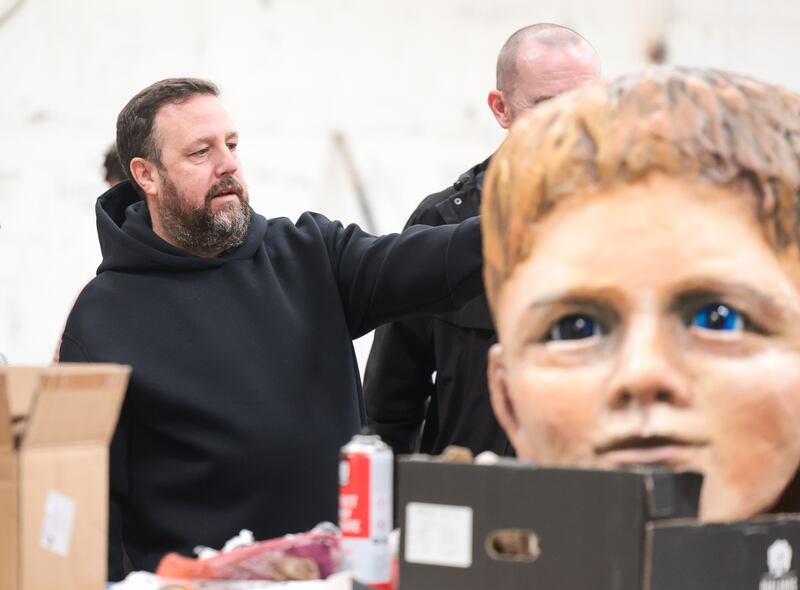
The serpents are made from judiciously burned foam swimming noodles. “We shopped around,” says Johnny O’Reilly, the company’s director. Some noodles go snaky; others simply shrivel. They’re obviously a hot commodity in these parts, as they also support the neck of another giant: The Boy. He currently lies sheltered from swallow droppings – always a hazard when working in a rural barn – by a large tarpaulin.
When I meet The Boy he is headless, although he is fully dressed in a green velvet jacket and brown breeches, and almost as eerie as the serpents. His head sits on a separate bench, where his eyes are being painted a hypnotic blue.
Artistry is everywhere. Fantastic drawings are pinned to boards; there are paint pots, spray cans and bits of metal. Heads and body parts of mythical creatures line the ledges of industrial shelving. One alien figure will soon be off to appear in Science Week.
READ MORE


Anyone who has marvelled at a Macnas parade would be in heaven here, meeting old friends. That said, many of their creations are recycled, either appearing in fresh guises or having their mechanisms gutted and repurposed. The theatre industry is remarkably profligate with set materials; Macnas show how much can be reused.
Macnas themselves are one of Ireland’s international success stories, their work resonating across generations. Founded in 1986, they were behind the enormous Gulliver figure that floated up the Liffey to be beached on Dollymount Strand for the celebrations of Dublin’s millennium, in 1988, and millions rocked to the huge heads they created for U2’s Zoo TV tour, in 1992.
These days Macnas are synonymous with storytelling through spectacle. And it is spectacle with purpose, as their characters carry a backstory. In 2024, in a parade directed by Richard Babington, Alf, a huge newt, was on a journey to find a habitable home. Alf has journeyed far: having set off in June, he has been performing for audiences in Osaka, in Japan, as part of Ireland at Expo 2025.
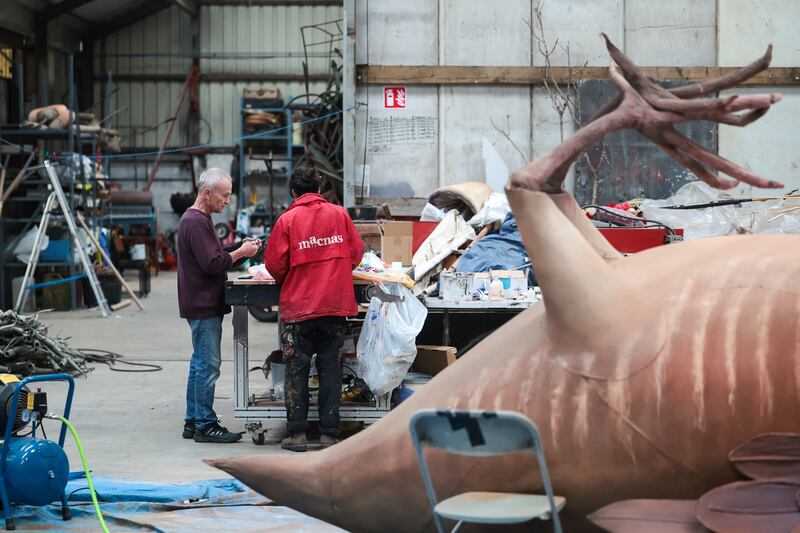
Back in Galway we pause beside a huge upturned bird. “That’s our corncrake,” says Owen Boss, the guest lead designer of the 2025 parade. “There is a legend that the corncrake lay on his back and held up the sky,” he adds, pausing as he imagines the visual possibilities.
By Halloween the huge bird will flap its wings, brushing the heads of the watching crowd. This year’s Macnas parade, An Treun – Irish for Corncrake – takes place in both Galway and Dublin, and finds its inspiration in a recently discovered short story by Bram Stoker, the Dracula author. Macnas have teamed up with Boss and Louise Lowe, the creative team behind the ground-breaking theatre company Anu, to bring it to fruition.
But wait: are Anu not best known for immersive theatre, where intimate personal encounters implicate the audience in the unfolding of the story? Are they not most at home performing to small groups – sometimes to one person at a time? And have they not achieved renown for their work exploring inner-city Dublin’s darker past?
Formed in 2009, Anu have led audiences through highly charged personal encounters in city laneways, a former Magdalene laundry, and, in The Book of Names, at Dublin Port’s Pumphouse.
“It is a whole new departure in some ways,” says Lowe, the parade’s guest director. She admits she took time to consider what she could bring to a parade for thousands of spectators before agreeing. “What can I offer that somehow catches and captures the essence of the work I love to do?” she says. “How do you transfer what is entirely intimate to a spectacle that has a huge impact on a city?
She soon discovered certain similarities, and ideas began to chime. “The truth of it is that, whether it’s for an audience of one or an audience of thousands, the audience has to be central, the linchpin of it all. So how do we make the audience matter? How could we make something that can really matter itself?”
The answer lay in Stoker’s long-lost story Gibbet Hill. It had made an unlikely appearance in an 1890 Christmas supplement to the Dublin edition of the Daily Express before falling so deeply into obscurity that it was unknown even to ardent Stoker scholars.
It popped up in 2016, then languished again, until Brian Cleary, an amateur researcher, found a copy in the archives of the National Library of Ireland. (Such are the glories of the library, and of the National Archives of Ireland, that they hold untold treasures still to be unearthed, with poems and stories folded into forgotten envelopes, lurking in laundry lists and hiding in plain sight, albeit in bound archives of otherwise unread papers.)
What passes for Christmas entertainment has clearly changed. A little like Dracula, which would be published seven years later, Gibbet Hill is one of those stories that have you wanting to scream at the protagonist: “Don’t do it! Don’t hang out at the site of ancient murders, don’t go for a picnic under a gibbet, and if you meet a trio of sinister kids, run like hell!”
Satisfyingly creepy, Gibbet Hill mingles strangeness with nature, light and dark, beauty and the uncanny. The narrator hears what he believes to be the cry of a corncrake, which summons him somewhere he later comes to regret. Spoiler alert: no corncrakes are to be blamed for what happens next, but the now almost extinct bird became Lowe’s way into creating the parade.
It was Boss’s daughter, then 10 years old, who had brought the story to Lowe, after studying it at school. (There is a great deal to be said for an education system that has a healthy respect for children’s capacity to deal with alarming themes.) Boss and Lowe go way back, having met on a postgraduate course in youth arts at Maynooth University.
“We fell out spectacularly on day one,” Lowe says, clearly enjoying the memory. “It was about what was art. He said, ‘Art can be anything,’ and I said, ‘Does it not have to have intention behind it?’ Thankfully, this was in the pre-iPad days, because I threw my notebook on the floor with a flourish, and I said, ‘Is that art?’ And he said, ‘It could be.’”
Lowe describes going home to the friend she lived with. “I said, ‘Debbie, there’s this wanker in my class. It’s going to be a long year.’ Apparently, he went home and said something very similar about me to his friend Tom.”
Twenty years on, Boss is married to Debbie, and, Lowe says, “I became best pals with Owen, and we have worked together on many, many projects, and never had a sharp word since.”

Driven and articulate, Lowe is eloquent and persuasive in conversation, adding a forthright charm to warm what is an undoubtedly steely resolve.
I have found a quiet space in the Macnas network of sheds and barns for a Zoom with her, as she is between scenes as a director on Fair City, the RTÉ soap opera. If that wasn’t enough, alongside Anu’s work – they are rehearsing The Dead, by James Joyce, for Museum of Literature Ireland this December – she is also in her first year of a PhD, exploring “interception and proprioception, or how meaning is made and felt in the body between performer and audience”.
She relaxes, she adds, by baking. Lemon drizzle cake is a speciality. “I think everyone who has ever been in a rehearsal room with me has been fed lemon drizzle cake.”
Lowe and Boss embody the balance that makes for a great creative team, bringing a mutual respect for their differences to the mix. “I’m tempestuous in the opposite way to him,” Lowe says. “I will be wanting things to be done immediately or quickly. I want to make decisions fast, and he doesn’t. He makes me see and feel things differently. He has a deep consideration for how a work needs to be told, so the process we normally abide by is more akin to a visual-art studio than a rehearsal room.”
Boss’s background is as a visual artist, and Lowe remarks that he and Macnas are “a match made in heaven”. “I think anything is possible here,” Boss says, a huge smile on his face as he describes the skills of the team bringing his drawings to vast and vivid life.
The parade they are shaping is not a direct retelling of Gibbet Hill. “I pulled apart all of the images, sounds, smells, textures and tastes that were in it,” Lowe says. “And one of the things that stood out was the sound of the corncrake. When you listen to it, it’s very large. It sounds like an electric shock.

“Eugene [Finnegan], one of the makers, said to me, ‘The corncrake was the sound of my childhood.’ And that stayed with me for ages, because it’s not ancient times, but now it’s missing.”
Returning to the folktale of the corncrake, Lowe wonders: “Who are we asking to hold up the sky now? What would bring a corncrake back?”
Citing initiatives around the west of Ireland that are helping to increase the bird’s numbers, she has written a short story to accompany the parade, which will be available on the Macnas website and in local press, and is inviting children (and adults) to make guiros, those ridged percussion instruments that can, in the right hands, sound remarkably like the corncrake’s rasping cry.
“That is the critical part: in the work I like to make best, there is always the demand on the audience, whether that’s of their time, energy or position. I never demand answers inside the work but always after, for questions. Here is a reminder that culture and climate aren’t separate things: they’re entwined.
“It’s something,” she says, “that Macnas do best. It’s not a nostalgic echo but a force, a form of protest, or a hope or a dream to reclaim folklore as resistance.”
[ Eight spine-chilling spots around Ireland to visit this HalloweenOpens in new window ]
Alongside the makers and actors, Macnas work with community groups, training performers, while co-ordinating all the elements it takes to “turn civic space into arts space that is available to everyone”.
[ In search of the Congolese corncrake Opens in new window ]
Lowe recalls her own previous years of experiencing the parades as an audience member. “My connection to Macnas goes back to seeing Gulliver on the beach and thinking, ‘There’s magic here’. You just get a sense, after meeting the team, that you’re in the hands of genius.”
Macnas stage An Treun: The Summoning of the Lost in Galway on Sunday, October 26th, and, as part of the Dublin City Council Bram Stoker Festival, in Dublin on Sunday, November 2nd. Science Week runs from November 9th to 16th. Anu’s production of The Dead, with Landmark Productions and Museum of Literature Ireland, is at MoLI, in Dublin, from December 5th until February 1st, 2026


