

In the photograph, broadcaster Marty Whelan is resplendent in a turquoise shirt, gold chain glinting at his neck. Beside him smiles the pop star, Sade, in a crisp polka dot shirt. Behind the pair is a large artwork that can, strangely enough, be described as both futuristic and wildly dated. Everything about the image screams the 1980s. The photo was taken in 1984, when Sade was promoting her Diamond Life album, and the maker of that space-age image, Michael Ashur, was one of the most successful artists in Ireland.
The soundtrack that comes most to mind, looking at Ashur’s work today, isn’t Sade but the French band Space, with their synth pop Magic Fly, or Pink Floyd’s The Dark Side of The Moon, both from the 1970s. Stanley Kubrick’s 2001: A Space Odyssey had been released in 1968, and Neil Armstrong had set foot on the moon in 1969. Suddenly the stars had taken on a different aspect, closing in on our imaginative reach.
Ashur, who died in 2024, had a career many artists could only dream of. He showed at the hugely influential Irish Exhibition of Living Art, the Oireachtas Art Exhibition, at the RHA and the RDS, and has works in the collections of The Hugh Lane, the Arts Council and IMMA. For years his vast canvasses hung in corporate offices, local authority offices and at RTÉ’s headquarters in Dublin 4. Curator and director of Limerick’s Ormston House, Pádraic E Moore, had an exhibition of Ashur’s work in mind for more than a decade.
“I met him just once,” Moore recalls. “He was very unassuming, very quiet. He had a big husky dog. Now I have got to know him instead through his niece, architect Roisin Hanley.” The impetus for the exhibition came from the realisation that “a lot of these artworks were just languishing. There’s an amnesia in Irish art history, particularly around the 1970s. Ashur is one of those figures, like Evin Nolan, that deserve more attention.”
READ MORE


The 1970s were not, as Michael Keegan Dolan’s recent dance piece 1975 / Naoi Déag Seachtó Cúig also shows, a brown-toned cultural desert in Ireland. Set up by Michael Scott, and championed by Charles Haughey, the ROSC series of art exhibitions brought big names including Roy Lichtenstein, Jim Dine, Alexander Calder and Gerhard Richter to Dublin. Ashur and Nolan were, Moore suggests, looking at works like these and adding their own layers of locality and sensibility.
“I had included some of his ephemera, exhibition cards and things, in a small exhibition I curated in 2012, The Temple of Psychic Youth, at the Kevin Kavanagh Gallery. I thought he was dead,” he says. “But then he came to the opening.” Moore had been trying to reach the artist but could find no website, no contact, no links. Perhaps it was the kind of reincarnation that Ashur, who had been born Michael Byrne, but who changed his name to favour the eponymous Babylonian sky god, would have approved.
“We met and had a chat, and I began to realise that these works were dotted around in collections, including, serendipitously, Limerick University. A visit to The National Irish Visual Arts Library [NIVAL], the remarkable resource hosted at NCAD of exhibition invites, flyers and press clippings, showed Moore how frequently Ashur had sell-out exhibitions at his Dublin gallery, the David Hendricks.
Then he more or less disappeared.
As Moore notes, “many of the acquisitions of Ashur’s work in the 1970s and 1980s were by corporations with large, newly built premises.” Telecom Éireann and RTÉ were buying monumental artworks for their head offices and, as Moore puts it, “such was the ubiquity of his work that, for a time, it could have been described as campus or foyer art, cosmic decor for newly built cavernous environments.” Later, as office design began to favour glass, spaces for huge art works diminished.

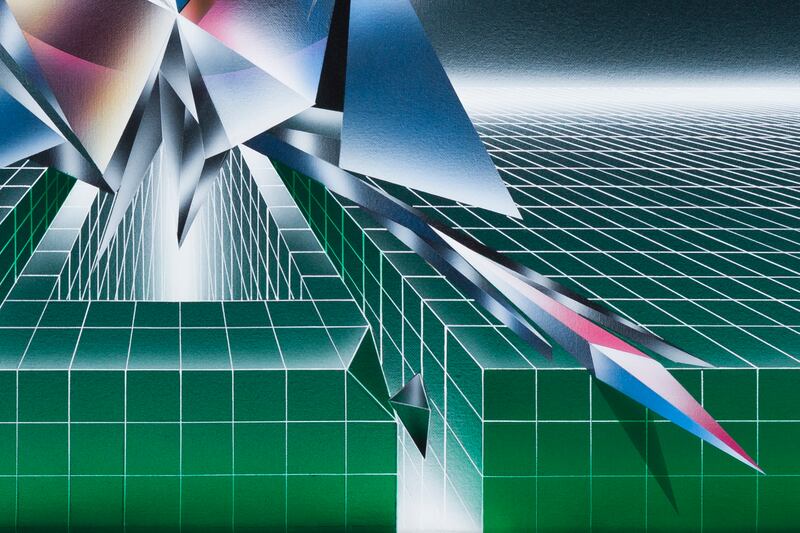
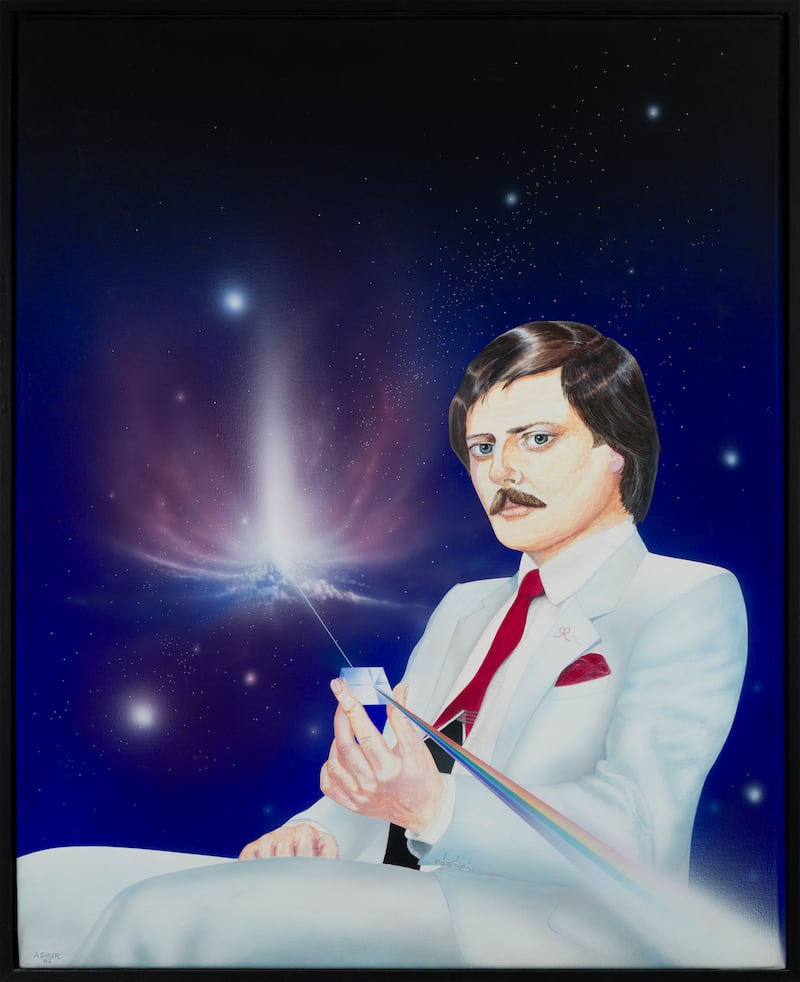
When Ashur died, his work hadn’t been exhibited for many decades, so this exhibition is the first time pieces, including Galactic Probe (1972) and Auto-Portrait with Prism (1982), originally commissioned for the National Self-Portrait Collection of Ireland, have been shown together since the 1990s. An RTÉ clip from 1991 features Ashur describing his painstaking process, masking off, airbrushing, paring back to get the flatness he wanted from his prismatic canvasses.
Explored in detail, some of them seem almost, but not quite, strikingly contemporary – if only you exclude the central fractal explosions from your gaze. I’m reminded of the collection of unfinished works by JMW Turner, on show at Tate Britain beside works by Mark Rothko. Separated by a century, they could be siblings in time, the difference being that Turner died before he had a chance to add in the shipwrecks, or as in his 1842 painting titled War. The Exile and The Rock Limpet, the jarring (to today’s eyes) figure of Napoleon to mar the luminous poetry of his mists of colour.
Ashur, raised in an era of psychedelic visual culture and science fiction stories in books, film and TV, as well as accelerating technological advances, was painting a future that many believed would come to pass within their lifetimes. His astral paintings, he wrote in a 1988 exhibition text, reveal the “immutable laws of crystal formation at the centre of exploding stars.”
Bringing things into a more contemporary context, Energy Made Visible includes works by Ann Maria Healy, Sean Lynch, Thaís Muniz and Garrett Phelan. Lynch’s contribution is a zine-style booklet following that artist’s genius for gathering ephemera and weaving it through with stories and insight. Blurry newspaper cuttings show the great and the good, including actor Maureen O’Hara, and the then RTÉ director general, George Waters, at his exhibition openings.
In his intriguing text, Lynch quotes critic Brian Fallon writing about Ashur’s 1991 RDS exhibition: “These are semiconscious folk memories of prehistoric cosmic catastrophes in which our small planet was involved […] Potentially, our earth is now a taking-off point rather than a terminal.” Then there is Ashur saying, “what I’m doing, I think, is almost like somebody painting America before it was discovered ... I think these paintings will seem timeless 1,000 years from now, because that’s what we’ll all be painting then. They’ll be our landscapes; they’ll be out there.”


That notion of time is fascinating. We have this idea of art being somehow eternal, even though we know it is as subject to fashion as the cut of a pair of jeans. Over the centuries artists who were once household names have disappeared from the narratives of history. Still, as another look at art and anthropological history shows, some images and forms do seem to have a touch of the eternal about them. Visitors to the National Gallery of Ireland’s Hilma af Klint exhibition from this October will see echoes in form, if not aesthetics, with Ashur’s work, played out, as with Turner and Rothko over a gap of 100 years.
Brazilian-Irish artist Muniz picks up on this with her iron sculptures of geometric diagrams that refer to the Yoruba cosmology and spiritual system. As Moore notes, “while outer space has come to be regarded through the lens of science, it was traditionally viewed across all societies as the domain of the divine – hence the idea of ‘the heavens’”. Whether story, myth, belief or truth, the past bleeds into the present, and informs our future, an insight elegantly expressed by showing these works together.
Ormston House is an innovative art space, and Moore is unafraid to take risks. His commissioning of “plain English” versions of his exhibition texts are a deft and welcome touch. In this exhibition, a different risk is showing Phelan’s sound piece as a red vinyl disk, alongside drawings the artist had made as a child – in 1975, the heydays of Ashur.
The sound work was made by “translating” Ashur’s painting Fragment of Orion by means of synthesising the image and turning the data into audio. It was broadcast as a one-off on Lyric FM and will be played again at the conclusion of the exhibition. The results are more along the lines of sonic experience than melody (and there’s nothing wrong with that), but it does seem counter to the spirit of accessibility of plain English texts to show a piece of red vinyl and take on trust there’s an artwork in there. Perhaps the intrigue lies just out of reach in the nature of it all, an echo maybe of Ashur’s exploding stars?
Sound does float through the space, courtesy of Healy’s animation, Gabhlán Gaoithe-Dara Sraith (Swift – Second Series). While Ashur described his works as “complex dramas, the plots of which vary from cosmic to molecular”, Healy turns her focus inward, to the mechanics of the human brain, in which neural pathways take flight. “As within, so without; as above, so below,” quotes Moore, getting to the heart of the matter.
Many of Ashur’s canvasses are so large they are difficult to store properly and some, Moore says, appear to be damaged beyond repair. Auction results from deVere’s show a pair of his large canvasses fetching just €550 and €650 apiece in April of this year. Is it time for a re-evaluation? Is his space-age vision too old, or too new? Look, and look again. You never know what you might discover.
Energy Made Visible is at Ormston House Limerick until September 5th, 2026, ormstonhouse.com. The NIVAL collection is online at nival.ie
Otherworldly Art
Artists have been fascinated by distant galaxies and otherworldly incarnations since we first looked up. The pull of the planets remains the same, only the modes of expression change.
Vincent van Gogh: The Starry Night, 1889. The Dutch artist famously made this painting based on the view from his asylum room in France, to which he had committed himself. The village is imaginary and the stars swirl like supernovas.
Vija Celmins: the Latvian American contemporary artists makes meticulous drawings of seas, deserts and night skies. Inspired by the USA / USSR space race of the 1960s, she began to use media images of outer space as a source for her work, where horizons disappear and the infinite is bounded by the space of her page.
Grace Weir: from her 2004 haunting, Dust Defying Gravity, filmed at Dunsink Observatory, to her upcoming exhibition at the Herschel Museum of Astronomy in the UK, the Irish artist explores the stars, physics and the nature of time itself. Running September 5th to January 3rd 2027, her new exhibition includes an embroidered piece inspired by William Herschel’s map of the Milky Way.


