

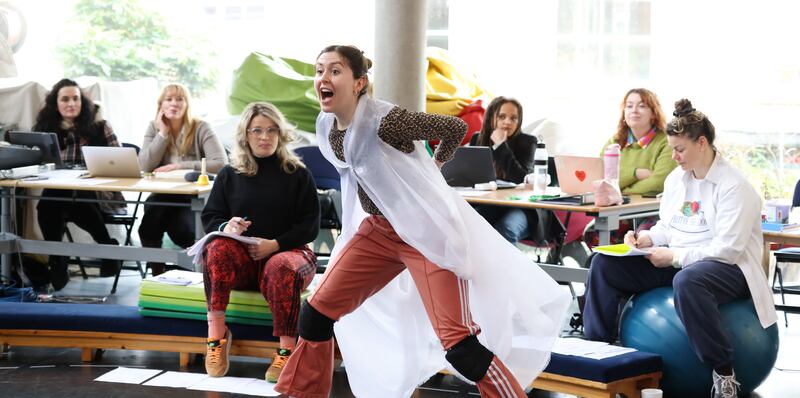
“I’m caught in my chrysalis,” laughs performer Niamh McAllister in the rehearsal room of The Ark, Dublin’s cultural centre for children.
The rehearsal pauses while she tries to free herself. There is a paper crescent moon in a cage on the floor, and a tree made of wood, with bamboo branches.
McAllister is tangled in a white floor-length, gauzy piece of fabric that has become twisted in the branches of a wooden tree, and is indeed appropriately enclosing her like a chrysalis. That’s because McAllister, performer in the Ark’s new show, The Last Moth, is in fact playing a moth.
She is the show’s sole performer, but there are no fewer than seven people also in the rehearsal room, all engaged in the production process. Among them are artist Jesse Jones and student Naomi Moonveld-Nkosi (19). They were co-commissioned in 2023 to make this show, when Moonveld-Nkosi was then 16. They each share director/writer credits for this 45-minute show, which is for children aged four upwards.
READ MORE


Jones is an established artist, who represented Ireland at the Venice Biennale 2017, and is also a member of Aosdána. Moonveld-Nkosi is a former member of The Ark’s Children’s Council, a facility for children in the latter years of primary school to proactively engage with the centre’s activities and programme. She is now an undergraduate student at UCD, studying English, drama and film.
So how did this unusual collaboration come about, one which The Ark describes as “our first commissioned piece by an adult and child for professional performance”? After the rehearsal, we sit down to chat through the creative process of this show.
“Back in November 2022, I was in TY [transition year] at the time, and I was looking for work experience,” Moonveld-Nkosi says. “I wanted to do something very creative, because I had been very creative up until that point. and I asked Jesse if she knew anyone who was interested in mentoring me, or if she knew anyone who would be interested in offering me a space for work experience or shadowing them. And then she told me The Ark was commissioning her to do this project and that she would love to collaborate with a young person, and she asked me if I would do it with her.”
The project was very much in development stage back then, but Jones knew that she wanted to have some kind of iteration on a non-traditional witch character within it. This is the character which ended up being a moth, via a caterpillar.
“So I spent that week in November reading about witches in my pyjamas,” Moonveld-Nkosi says. “And critiquing the representation of the witch.”

As TY projects goes, this sounds entirely original to me, unless it’s commonplace to spend time in night-attire reading about witches.
Two months later, under the approval of the director of The Ark, Aideen Howard, Jones and Moonveld-Nkosi were officially commissioned together to collaborate on the project.
I ask Moonveld-Nkos to describe the plot of The Last Moth in a sentence.
“It’s a story about a caterpillar who goes on a quest to save the moon but also goes on a quest to change herself,” says Moonveld-Nkosi.
Any performance piece for children needs to be strong on story and visuals. What do the duo think makes an engaging show for children?
“Being a young performer and getting to be a young creator, what I have really noticed is that young people want really good stories,” Moonveld-Nkosi says. “They want to trust the character to be taken on a journey. They are smarter than you think. They don’t want things dumbed down for them. It’s about making things as entertaining and as dynamic as possible.”

“I think something funny,” Jones says. “Something that will make them laugh, something that taps into things that are not totally known, so a mystery revealed along the way. Kids are very trusting to follow a character on a journey, if they can see that they are being brought along. Also, kids seem to love music in shows.”
The Last Moth doesn’t have a script, but there is music within it, composed by Irene Buckley. There is instrumental music, some singing, and a recitation of names. Moth names, specifically. Creatures that fly by night, like witches.
“A lot of my shows are about witches and dark things,” Jones says. “I realised for this show I would like to work with a young person to explore that story. When we started the project, Naomi was researching the part of the witch in literature and film for young audiences. We were trying to figure out how the witch is usually represented to young people, and what does that mean to young people to see women and witches represented in that way.
“We decided to think about the animal world as a metaphor for the witch. If butterflies are the fairies, moths are the witches. And we just got this really strong connection with the moth as a spirit animal for that night flight character that we think of as a witch.”
In 2024, the pair went down to Sherkin Island for a week in the summer. Working with a specialist, they put out moth boxes every night. “And we got up every morning and counted the moths and looked at the species of moths and we did an ecology survey on Sherkin Island,” Jones says.
“The script came from when we opened the moth boxes, as soon as we started to find out the names of these moths. Foxglove Pug? Oh my God. We thought, that’s going to be so fun to interpret in a performance.”
So as part of the performance, Niamh McAllister incants the names of a number of different moths. They include a moth named Mother Shipton.
“There was also a person called Mother Shipton, in Yorkshire in the 16th century and she lived in a cave. She was an oracle who was a real person, and famous for predicting storms,” Jones says. Later, they say that most people who see the show won’t know about all the backstories of the piece, such as the story behind the Mother Shipton moth, but that this all goes to creating the story.
“The character of the caterpillar becomes a moth called Mother Shipton,” Jones says. “So we are presenting an experience that is about witches, but which comes at it very far away from the hook nose and the broomstick kind of witch. You can tell that our witch creature is in motion and in flight at night time, and discovering different sounds. There are no broomsticks and there are no pointed hats, but there is a witch in our story.”
“The moth became our personification of a spirit animal,” as Moonveld-Nkosi says.
They performed some of the material in rehearsals in front of young audiences, who came up with the ending for the show.
“These kids have genius ideas,” Jones says. “They are great at giving feedback. The feedback was very pure and very instinctual. The whole ending of the show was suggested by the kids in the room last week.”
So what was it? As they explain it, the show takes place at night, which is the time of the moth. The children suggested that the sun come out at the end of the show. Which is what happens now.
“There does need to be an arc of time,” as Jones says.
They had had some discussions about whether the moth performer should have aerial abilities or not, but decided against it. “We want children to leave the show and run around and pretend they are moths themselves, like the performer, which they couldn’t really do if we used aerial.”
Moonveld-Nkosi points out that she has transitioned into adulthood alongside The Last Moth project. “This has been a really big part of my life,” she says. “I have gone from being a child to a young adult. A lot of myself has gone into this piece of work.”
How has it helped her third-level studies?
“I was always on the feedback side before, never on the creating side,” she says. “I have learned it takes an amazing network of people to put on a show.”
The Last Moth runs at The Ark from March 5th to 15th.


