The early 2000s were the best time to be earning sterling; it was two euro to the pound. My other half was riding the crest of the internet revolution in London, while I was working in the music business. We were, as some described us, a metrosexual couple, read, trendy and urban – a hideous description. But it was the “noughties” and cool was re-exploding.
With notions of starting a family, we did a grown-up thing and bought a house. One of those 100 per cent mortgages which were then being given out like Smarties.
But once settled, the panic set in. Would our hedonistic travel lifestyle disappear once nappies and naps became a thing? So on a “sky’s the limit” notion of “buy one euro get one free”, I bought, not shoes, but an apartment – in the windy capital of Europe, Tarifa.
We had discovered it when on a trip to Seville, Spain. Using our Lonely Planet guide, off we had gone to what was highlighted as the furthest point of Europe. Since Ireland is arguably the furthest point before the Americas, we thought, “Let’s see what the last stop before Africa is like.”
READ MORE


It must have made some sort of impression as, back in London with a growing bump, the panic grew louder. What if we’re stuck here, kids with Cockney accents, job juggles and outrageous nursery fees? Not for us. Having abandoned social whirling by now, I actually wanted to be with my children as they grew up; playing Lego, building forts and reading stories. Friends’ competitive reports over who could be the most tired did not attract. Consequently, with the pound so cocksure of itself, I convinced myself that an investment in an apartment would be practically free.
Few people I knew had heard of Tarifa at the time. Nestling in a natural park, it is a small “pueblo blanco” – originally a Moorish town. A millennium on, it became home to families of farmers and fishermen; values that rang a cultural familiarity to having grown up in Ireland. However, responses to my move were wrinkled-nosed!
They say a woman changes when she’s pregnant, so like a salmon I felt drawn “from whence I came”. But this was the south of Spain.
With no-nonsense Irish wisdom, my mum figured it out when looking out of my Tarifa window: “It’s like living in Dún Laoghaire.” Hardly, I thought. But with the exotic mountains of Morocco in the near distance, I suddenly understood.
Growing up, I would look out of my bedroom window and see Howth sitting on the horizon. And now, bizarrely, a similar view – except it was Africa.
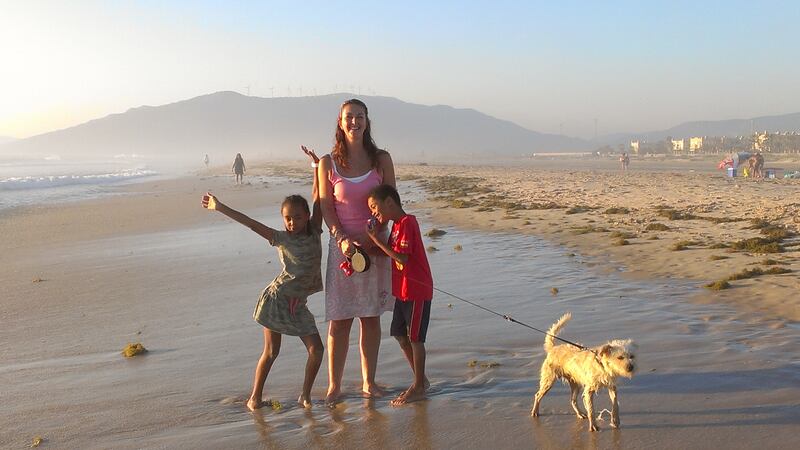
Cutting rain on my bare legs walking to school as a child had left me traumatised by the weather. However, the winds of Tarifa gave a similar, albeit warmer embrace that didn’t deter us from making it our home. It’s also this same wind that has saved the town from the exploits of Big Hotel and Big Burger.
Only an hour away, the Costa del Sol – with its high rises and high living – stands in stark contrast to Tarifa’s Costa de la Luz, with its wild empty beaches. To me it resonated heady, sunny days hiding in the dunes at Brittas Bay in Wicklow – beautiful but windy.
Tarifa became our new forever home, a refuge from the internet and banking crash that shook our world, but we became richer in what mattered. Good friends and fresh food. It wasn’t just the place, it was the people and the pace. We had time for each other. There was no newspaper for the town, so coffee, friends at 11 with a dash of gossip, was vital.
For the children, school was by the beach and finished at 2pm. We’d then go, with our giant €1 sandwiches, to after-school classes in the mountains riding horses. Back on the beach there were lessons in surfing in all its forms – even for us. Weekends were spent with friends in camper vans or going to a chiringuito, a beach bar, where we could dance, swim and relax.
For the holidays the kids went to “nature camps”, making bread in stone ovens and running wild the rest of the time. In the winter, we would drive a few hours to the sierras to ski. From the mountaintop you could see the Mediterranean sparkling.
The Spanish locals were welcoming and us extranjeros, foreigners, were bonded by the commonality of being in the last elemental stop before Africa and the varied stories that took us there.

But things change and the children, in time no longer children, said they were tired of small-town beach life. They hankered for cities ’n’ Starbucks and travelling on Tubes. So after many sunny years we left – back to London. However, I realised the bustle of red bus living no longer felt right,
Spain had changed me. A friend visiting to London coined it innocently, remarking that no one says, “Hello”. That simple observation echoed when walking down the pier in Dún Laoghaire. I noted how many people stopped to talk to the dog and say hello to me. Total strangers, stopping for a bit of a chat. It was then I knew London had passed its sell-by date; I had to come back.
Full circle, I’ve now returned to the view of Howth. It’s wonderful to be home. It feels familiar, in a Spanish sort of way!
Fiona Austin is originally from Dublin. She left Ireland in the 1980s, and recently returned. She works as a therapist.
- Are you Irish and living in another country? Would you like to share your experience in writing or by interview? You can use the form below, or email abroad@irishtimes.com. Irish Times Abroad submission guidelines here.
- Follow us on Instagram to keep up with the latest
- Sign up to The Irish Times Abroad newsletter for Irish-connected people around the world.