Co Wicklow visual artist Cian Duggan says casually of his move to Vietnam almost a decade ago: “I just booked a ticket one day.”
He is speaking after a day spent putting the finishing touches to his solo exhibition T H I N S P A C E at a contemporary art gallery in Ho Chi Minh City.
It’s 6pm in the city and it’s dark outside. Unlike Ireland, where on dark winter evenings our thoughts turn to the long summer brightness, close to the equator the sunset doesn’t vary much. “Every day it gets dark around this time,” says Duggan.
Back in 2017 he swapped the still waters of Dunmore East, where he had lived from the age of 10, for the warren of alleyways and buzz of motorbikes in the city formerly known as Saigon.
READ MORE


When Duggan’s friends, who were also artists, moved from Hanoi to Ho Chi Minh City, he says: “All things lined up and I said ‘now is as good a time as any’ [to go].”
“I had never been to Asia before but I was always fascinated. I had a deep curiosity because it seemed so otherworldly.” Duggan was always interested in Asian art and culture, and wanted to see what it was like “to be there and not just to receive it”.
“I always wanted to go to Vietnam. It seemed like a mysterious place to me.”
Duggan “kind of fell in love instantly with the place”. It is “very sensory” and from the moment you land you are “hit with everything”, he says of the smells and sounds.
It has a “real life-affirming vibrancy that made sense to me ... it was exactly what I was looking for”.
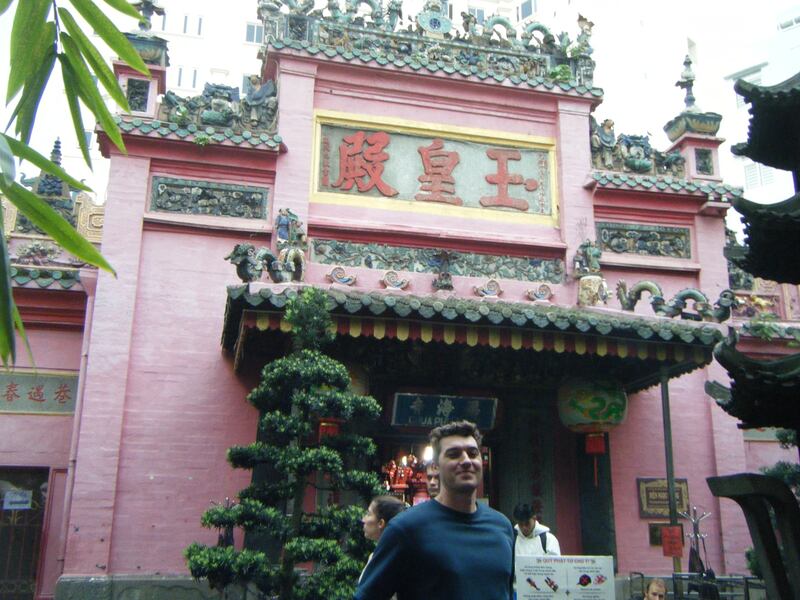
Ho Chi Minh City is a ‘megacity’, with an estimated population of more than 10 million, and is the southeast Asian country’s economic engine.
“Every single thing seemed to have a charge of light put into it,” says Duggan of his first impressions of Vietnam.
After six months in the city he was invited to join an international art residency, A. Farm, a collaboration between the Nguyen Art Foundation, one of Vietnam’s biggest private contemporary art collections, MoT+++, and Sàn Art.
It was through artists he met during his six months on this project that Duggan discovered the “collaborative approach” in the city’s art scene, which is mainly privately funded.
Here people “want to work together, want to make things happen” and have the attitude that “success is only good if we all succeed”, he says.
In Ireland the work was “more solitary” says Duggan, a self-taught artist, while acknowledging that working alone is a necessary part of the job. What Duggan hadn’t realised he wanted before moving to Vietnam was “a more collaborative approach to making art, for the benefit of everyone”.

The strengths of collaboration and community don’t just apply to the art scene but permeate through Vietnamese society in general, he says. “If you need something done, like a journey or trying to find a certain material, there is a good chance it may not be a fast and efficient journey but you will get there. You’ll ask a bunch of people, go to some market. People are always willing to help and a big part of life here is that nothing is impossible.”
[ Why are so many Irish moving to the ‘new Berlin on the Med’?Opens in new window ]
Duggan’s solo show, the gallery’s first from an Irish artist, features his distinctive UV prints on acrylic. The title T H I N S P A C E refers to the liminal spaces where “human and non-human, animate and inanimate, natural and artificial forms coexist”.
The idea has strong connections to the Irish landscape, to Duggan’s father and to the late author Manchán Magan. The term ‘thin space’ comes from Celtic mythology, the idea of places where the boundary between the earthly and spiritual are permeable.
Duggan began working on some of the art in this collection during Covid, after he had received a package from his father. “My dad sent me Manchán Magan’s book Thirty-Two Words for Field. In it he talks about the other world, the thin space, geographical locations where the gap between our world and the other world is at its thinnest, like Skellig Michael and Samhain. I thought that was fascinating,” he says.
Duggan’s father was an amateur folklore collector and gave him this interest in otherworldliness from a young age. “He was always recording old tales and cures, any old tale about someone with a field annoyed with the fairies. I was fascinated by that too. The natural and the supernatural.”
In his art, Duggan explores the thin spaces and the connection to the land. He describes a process for making one piece which results in a “layering of time”: he painted a landscape, took a photograph of the painting, cut out the photograph and re-edited with stock image collages and painted back over them. This results in “a painting that did exist, and doesn’t any more, combined with a place that didn’t exist. It’s the idea that the other world is not ahead of or behind us, but parallel to us”.


Duggan connects this Irish idea with a Vietnamese one of “ancestral worship”, which is a “very deep part of the culture”. Here most homes have a “ban tho”, a small shrine to honour their deceased relatives. People believe their ancestors continue to exist in a parallel realm and are given offerings to keep them happy, but not in a religious way, he explains. “It is a spiritual place.”
The use of acrylic material is a central concept in his work because of its “variable relationship with light” and each piece “transforms within its environment”, according to the show description.
Much like Duggan’s artwork, Ho Chi Minh City is always changing. “You could go down a street one day and a week later there would be five new shops. It’s changing all the time, lots of new buildings getting built. It adds to the dynamic,” he says.
The city offers Duggan a good quality of life. “You can choose how you live here and everyone makes it work. The bases are always covered for everyone, the food is very affordable,” he says, praising the quality of Vietnamese cuisine. He also enjoys ca phe sua, the Vietnamese coffee made with creamy condensed milk.
Although he’s almost a decade in Ho Chi Minh City, Duggan still gets lost as he drives his motorbike through the streets (the main way people get around), ducking down the myriad of small alleyways. “You have to get lost. That’s how you find things. Every adventure is just one turn away,” he says.
Cian Duggan’s solo exhibition T H I N S P A C E at Galerie Quynh runs until February 28th and is supported by the Embassy of Ireland in Hanoi.
- Are you Irish and living in another country? Would you like to share your experience in writing or by interview? You can use the form below, or email abroad@irishtimes.com. Irish Times Abroad submission guidelines here.
- Follow us on Instagram to keep up with the latest
- Sign up to The Irish Times Abroad newsletter for Irish-connected people around the world.